June 20, 2013

"[Writing] is theft", Ctd


At 1 hour 17 minutes Christopher Hitchens explains that plagiarism and using other peoples words is "inevitable".

Complimentary analysis can be read in an article entitled 'Makers and Takers: Art and the Appropriation of Ideas'.

Also of important note is the piece written by Christopher Hitchens in his book 'Unacknowledged Legislation: Writers in the Public Sphere' where he wrote a chapter entitled, 'In Defence of Plagiarism'.

And in George Orwell's essay on Charles Dickens entitled simply,'Charles Dickens' Orwell said:
"Dickens is one of those writers who are well worth stealing."


Christopher Hitchens - A writer can never truly stop


Speaking on C-Span, Christopher Hitchens explained how a writer can never truly stop or switch off. For a writer is a professional without a set clock. A writer is person with a vocation who is always absorbing so that he or she can then hold a mirror up to society. A writer is above all this: a person with the responsibility to use their gift for they occupy an important role in society.
"If you’re a self-employed writer, there’s a tendency to always feel guilty anytime you’re not working, because you never quite know when you’ve stopped because you don’t have office hours or an employer."
From 22 minutes in the video above, also here. Also here.

June 19, 2013

'Drink and Draw' with the Loft collective


The lovely picture above is one taken by a member of The Loft Collective (@loftbelfast) - a shared studio that hosts an exciting group of artists in the north side of Belfast city centre. The above event was a night eponymously called 'Drink and Draw' - held June 18 2013: Life drawing with alcohol in suit. Always good for freeing up the creative impulses and loosening the hand and wrist. Carrying on Ronald Searle's bibulous tradition supremely.

Click the link below and check out a selection of my drawings from the night:

June 18, 2013

Christopher Hitchens - Writing is hard


Christopher Hitchens explained how he finds writing most pleasurable when he sees it in print (33m20s):
"I don't really know if I [enjoy writing] or not. I hate not writing, I know that. I sort of do it because I feel I have to. Sometimes it's a real pleasure doing it. Usually the pleasure comes though when you see it in print. Not until then and usually not until some time after."
Then he explained how he writes:
"I write on table at home in long hand. I sometimes write in bars too, in the afternoon. I go out and find a corner of a bar. If the noise isn’t directed at me me I quite like it if the jukebox is on and people are shouting the odds about a sportsgame and I’m hunched over a bottle in the corner. I write in long hand anyway so I can do it anywhere. Sometimes in airport terminals. And then when I’ve got enough down I start to type it out, editing it as I go. I don’t use any of the new technology stuff."


And at 39m20s he explains how politicians aren't any smarter than the average man. Then at 40

The Northern Ireland economic recovery

Richard Ramsey, chief economist at Ulster Bank breaks it down:

"6 years after our Wile E. Coyote moment, is the economy ready to hit the ground running?

Bears and bulls often feature in economic parlance – the former indicating a market that has experienced significant decline, the latter is a market on the rise. But the Wile E. Coyote is a lesser spotted economic creature who perhaps best symbolises Northern Ireland’s experience over the last six years.

Northern Ireland experienced its Wile E. Coyote moment - when the “super genius” races off a cliff and for a fleeting moment appears to defy gravity before plunging to the hollow below - around mid-2007.

For Northern Ireland, this was the moment when the so-called ‘NICE’ decade (to coin the phrase used by Sir Mervyn King - Non-Inflationary, Continuous Expansion) came to an end with a ‘RUDE’ awakening (Rising Unemployment and Declining Economic activity).

Prior to that, our economy had enjoyed low inflation and sustained growth in employment, property prices and public expenditure, plus the positive overspill from the Celtic Tiger boom. Furthermore, the economy benefited from its new found political stability, stemming from the setting up of the Northern Ireland Executive.

In short, practically everything that could have been a positive driver for the economy was present in the NICE era. In economic terms, however, we ran over a precipice without realising that gravity would kick in, and practically everything that was positive during the NICE decade went into reverse. It quickly dawned on us that our economic indicators were set to fall from a great height.

In the six years that have followed, the fall has been taking place, and the most frequently asked question has been ‘have we hit bottom yet’? Or, ‘is the Northern Ireland economy experiencing a recovery’?

When answering this question honestly, economists increasingly sound like Vicky Pollard of ‘Little Britain’ fame, with their “Yeah, but, no but, yeah but…” responses. Indeed, anyone flicking through the newspapers in recent weeks and months could be forgiven for being confused. Mixed messages have been the order of the day, with optimists and pessimists provided with a steady stream of information to strengthen their respective cases.

But there have been grounds for optimism on a number of fronts which indicate that the coyote may have hit bottom, survived and could soon be up and running again.

The number of corporate insolvencies has fallen in each of the last three quarters. Indeed, the Q1 2013 outturn represented the smallest number of corporate insolvencies since Q3 2009. Meanwhile, the newest edition to the suite of official economic indicators, the Northern Ireland Composite Economic Index (NICEI) rose in both the third and fourth quarters of last year. This follows a peak to trough decline of some 12%.

Last month, the number of individuals claiming unemployment benefit, more commonly known as the dole queue, fell for the fourth month in a row. This is a feat not achieved since before the credit crunch began in August 2007. For most of the last six years new car sales, a key barometer of consumer confidence, have been following a downward trajectory. Indeed, new car sales fell by almost a third between 2007 and 2012. Once again, however, new car sales have experienced some recovery by posting year-on-year increases in each of the last four months. As a result, new car sales over the last 12 months are just 29% off their 2007 high.

As far as recessions go, what has marked out Northern Ireland’s current downturn has been the housing boom and bust. Indeed, the housing market has experienced the most pronounced Wile E. Coyote moment of all within the Northern Ireland economy. Therefore signs of a sustainable recovery within the housing market will be the most closely watched barometer of a wider economic recovery. After all, a recovery in the US housing market has been a key factor behind its wider economic upturn.

In this respect, it is encouraging to note that the local housing market too is starting to produce some mixed messages (i.e. some good as well as bad) which is a pleasant change from the overwhelmingly negative news flow over the last six years. Granted Northern Ireland house prices are 56% below their 2007 peak, the mortgage market is still experiencing its lowest level of home mover mortgage activity since 1974, and the level of remortgage activity in Northern Ireland is still over 80% below its pre-credit crunch levels. However, last week the latest DSD (Department for Social Development) housing bulletin confirmed that 2012 saw its first increase in house completions in six years. The 2012 outturn of 7,900 housing units is still very low by historical standards, but suggests that 2011 now marks the low in house completions. The rise in completions probably also reflects the completion of houses started years ago. This explains why the housing starts figure for 2012 is still marginally lower than the previous year. However, 2012 also looks to be the turning point for housing starts too. Following a lacklustre first half of the year, the second half of 2012 saw year on year rises in housing starts. 2013 is now expected to see a pick-up in house building activity.

In time, these forward looking indicators of economic activity (housing starts) will feed through into the lagging indicators of economic activity, most notably the labour market. Last week’s Quarterly Employment Survey (QES) reminded us that whilst we may be debating whether a recovery has taken place or not, it has largely been a jobless one, particularly for the construction sector. The total number of jobs in Northern Ireland fell by 1,510 in Q1 2013. Whilst Northern Ireland has been successful in announcing a raft of job announcements in recent weeks and months; the scale of the challenge it faces is worth highlighting. According to the QES, Northern Ireland lost (in net terms) 41,480 jobs between Q2 2008 and Q1 2012. Since then only 4% (or 1,800) of those 41,480 jobs have been recouped. As a result, in Q1 2013 there were still 39,680 fewer jobs relative to Q2 2008. Making a significant dent in these figures will be a major long-term challenge.

It is also worth noting that some sectors, and indeed numerous firms, have not experienced any Wile E. Coyote style fall off a cliff. Their experience of the recession has been more akin to the gravity-defying Roadrunner. Two obvious examples within the manufacturing sector are the pharmaceuticals and agri-food sectors, which have not experienced a huge drop in demand whatsoever. Indeed, output from our pharmaceuticals sector, which includes flagship exporters such as Norbrook, Randox and Almac has never been higher. Similarly, there are sub-sectors and firms within the services sector that continue to thrive. The ICT and software sectors are obvious examples. Again firms within this sector don’t suffer from a demand deficit. Instead a lack of supply of skilled graduates is their biggest limiting factor to further growth and expansion in the future.

Whilst the Northern Ireland economy currently looks like a rather dishevelled Coyote; we should take some comfort from the fact that Wile E. Coyote never gives up, never dies and is always up and at it again soon after, becoming more innovative by using whatever resources it can get its hands on. However, the trick is to break the cycle, learn from the mistakes and avoid any Wile E. Coyote moments in future."

Irish News Business Insight, June 18 2013

Barack Obama speech to Northern Ireland, in full


Michelle and President Barack Obama's address to Northern Ireland in full here, in the video above and transcribed in full below:

MRS. OBAMA: 
"Good morning. Oh, what an honor. Good morning, everyone. First of all, let me thank Hannah for that very bold and wonderful introduction. And of course, I want to thank all of you for being here today. 
It is such a pleasure to be here in Belfast. And as you might imagine, whenever we travel to places like this or anywhere else in the world, we’ve got a pretty packed schedule. We’re meeting with Presidents and Prime Ministers and First Ladies. We’re visiting historical sites and attending state dinners. And my husband is spending hours trying to make progress on global issues from trade to international security.

June 17, 2013

Alex Kane suggests NI21 could gain 6 Assembly seats in 2016


Complimented by earlier analysis in the News Letter when he said:
"And if NI21 does make an impact, even a limited one, that will also damage the UUP more than anyone else: which, in turn, will probably benefit the DUP." 

And on the UUP electoral fortunes come 2016:


"I don't vote. Don't see the point."

An Open Cover Letter

  
Hey guys,

First up: I love the Dish. I love what it does for Dishheads, non-Dishheads, for myself, my thinking and for driving fresh thought and for creating new models of writing and online journalism.
But why would the Dish that does so much to contribute authentic writing to the internet want to be in any way associated with me, Brian Spencer - a dude from Ireland?

EU Kids Online survey suggests Irish kids consume more than createonline content


In the Irish Times Breda O'Brien talks about our new online world and the habits of Irish children:
"Irish kids tend to favour gaming, chat and watching endless YouTube videos, which an EU Kids Online Survey suggests may leave them at a disadvantage in an era where generating, rather than consuming, content will be key."
Breda O'Brien, p. 14, Irish Times, Saturday January 5 2013.

Hannah Nelson speech in full


"Good morning. My name is Hannah Nelson, I am 16 years old and I am from Belfast. I have been thinking about an important question: how do you make peace permanent in Northern Ireland? 
Permanent peace in our country is not just a simple dream for me as a teenager growing up today in Northern Ireland. It is a sincere, genuine aspiration. I believe that enduring peace can only come about through true respect for others. We have a right to express and celebrate our diverse cultures.We all have an obligation to value each other as individuals. 
As a 16 year old I dont want to live in the past, I want to live for the past. I want to live in a country where it is not my religion that is important but my value as a person which is significant. It is important that we all have a unique identity. A choice in life to chose who and what we want to be. We are growing up in a world where we are taught to be tolerant. To live peacefully we must put this into practice.

Coffee with Jeffrey Peel, talking NI21


For some time now I've enjoyed reading and following Jeff Peel on Twitter and on his blog which you can access here.

He's a man of erudition and a man of the globalised world, but also a man rooted in Northern Ireland. And so he drives a fresh type of discourse and debate that Northern Ireland so desperately needs. It isn't the idealism that you see elsewhere or the old-time thinking, but talk of the future, guided by ambition and pragmatism.

And so I thought it right to ask Jeff for a on the record comment on his thoughts of NI21, the latest political party in Northern Ireland. Here's Jeff:
"As I’ve mentioned in my blog I wish Basil et al my good wishes. But I’m not sure I’ll be joining any time soon. 
Firstly, I don’t really ‘get’ the Northern Irish parochialism of it. Basil used to talk at length about appealing to the “garden centre Unionist” - the type that sing “Ireland” at rugby matches but still love the Queen. Hmm.
My political interests are not really in that domain.

Northern Ireland needs to start behaving in a different way to tap into a new world order that is, increasingly, connected - with a consequent reduction in the importance of nation-state and politician. We need to define ourselves less as anything in particular in terms of “identity” and more in terms of the quality of things we say. We need to start thinking about really important things that affect us all - not just here, but in the rest of the UK.

Therefore a Party that is as narrowly defined as NI21 doesn’t really do it for me. I’m comfortable in the secular, melting pot of UK progressive politics. I’m fiscally right but socially left. But I want to be associated with a Party with a grander, national ideology. I’m a Classical Liberal. I want to see the return of a confident UK Conservative Party that is clearly ideologically defined. I’m much more comfortable with UK politics than Northern Ireland politics. So I’m disappointed that Basil and John didn’t join the Conservative Party locally. Because that Party needs some leadership and some clear direction. 
NI21 is half-baked and unimportant. It’s tiny and will remain so in my view. Its appeal is to the local and to the nice. But it’s unimportant in the scheme of things.

In short we need to stop “defining ourselves” as British, Irish, or Northern Irish - and just start getting involved in politics if we want to change things. However, we’re part of the greatest pluralist democracy on earth and we need to join in that country’s debates and challenges. We need to reduce our dependency on aid - that’s what the block grant is. Aid. And we’re aid-dependent. We need to start building companies without expecting grants. We need to start knocking down peace walls immediately - rather than waiting 10 years. We need to realise that governments are mostly wasteful and nearly always meddling. We need to reduce our public sector employment. We need to reduce the role of clerics in our civil society. We need to extend the 1967 Abortion Act to here. We need to embrace diversity.

If Basil starts addressing these fundamentals I might be convinced otherwise. But speaking in Irish isn’t a good start."
My response to Jeffrey would be to cite Alex Kane writing here. A commentator who has as good a view and informed insight into Northern Ireland politics as anyone:
"The UUP will stay around for a long time yet, but the Conservatives (as I have said before) will remain dead in the electoral water."
https://twitter.com/alexkane221b/status/351368849729400832
Alex further said on eamonnmallie.com:
"Conservatives are busy reconstituting themselves as some sort of ‘new’ vehicle to attract non-voters—yet how do they avoid the reality that they are as much a part of the political/electoral past as the rest of us?"
http://eamonnmallie.com/2012/02/ourselves-alone/

Why does everyone want to go to law school? Ctd with Alex Aldridge


Alex Aldridge of Legal Cheek talks about going to law school from 13 minutes of his Law Tour podcast series interview with Charon QC.

Listen to podcast in full here.

June 16, 2013

Considering cliché with William Giraldi and Terry Colon, Ctd

Image thanks to Terry Colon here.
William Giraldi breaks it down an gives a nomenclature of cliche that had bedded itself into the common phrase:
"And so we come now to Eagleton’s own language. One requires a counselor to help explain how someone so attentive to the words of others can often be so frivolous with his own. If Eagleton had sent a cliché constable to patrol his streets of sentences, we'd have been saved assault by the following hoodlums: “pulling out all the stops,” “a hair’s breadth,” “packs a formidable punch,” “stuffed to the rafters,” “the skin of his teeth” (three times), “random thoughts,” “one fell swoop,” “without rhyme or reason,” “a thin line,” “stuck in their ways,” “the tip of the iceberg,” “tender hearted” (with an AWOL hyphen), “load the dice,” “only skin deep” (twice), “something to be desired,” “bare bones” (twice), “safe haven,” “by the sweat of his brow,” “dreams of grandeur,” “bleeding-heart liberal” (at least it has its hyphen), “head over heels,” “out of thin air,” “paper-thin,” “the best of both worlds,” “rags to riches,” and “cheek by jowl.” Please don’t ever wed “beyond” to “pale” or “shed” to “light”—Eagleton presides over those delinquent nuptials twice apiece."
William Giraldi in the Daily Beast in full here.

One of my favorite cartoonists out there is Terry Colon, the man responsible for the image above and for many other great works. In his blog post 100 % Pure Cliche, Terry considers his critique of cliché and the regurgitation of stock phrases among American sportsmen:
"So, what am I getting at, you ask. Not much really. I'm not anti-cliche. It's just shorthand used over and over to answer the same questions asked by reporters over and over about similar things in sports which happen over and over. In some ways it's like a ritualized event. Nobody, the reporter, the athlete nor the viewing fan, expects much more than a cliche which is taken with a grain of salt by all. Nobody expects fresh and articulate off-the-cuff answers to stale questions, rehashing subjects that have been thoroughly hashed out before. 
After all is done and said, athletes aren't wordsmiths, they're not Dr. Johnson or Groucho Marx or anything like. As the new most popular sports cliche goes, "It is what it is.""

June 15, 2013

Christopher Hitchens - The authority of bloggers


At 7 minutes 30 seconds in the video above and here Christopher Hitchens talks about the authority of the online writers.
"I became a journalist because I didn't want to have to rely on the press for information. I'm very sorry for people who do think that's what they're getting when they buy the New York Times in the morning. I only read it to make sure I know what everyone else thinks is going on. It's useful to know what people think is the news. None of my sources are from the press... Yes, from bloggers and their allies I get most of what I think I need to know and I'm very happy at the possibility of, the evident likelihood now of the decline of the networks and of the flagship newspapers, which seem to me to be engines of reassurance and consensus and bad writing, poor English. Let it all die, I don't give a damn."


In an earlier post here on how Hitchens write, Christopher said: "I don’t use any of the new technology stuff."

June 14, 2013

On drinking from the hose pipe and the resurgence of reading from print


Emily Rhodes in the Spectator begins her recent essay, 'The Special power of the printed word' by confronting the dilemma the modern Internet user and reader faces: trying to ingest material from a never ending spray of links, stories, blogs and breaking news, memes, cat videos and so on. She says:
"I wonder if we don’t all feel rather overwhelmed by the huge number of articles online. There is simply too much to read – an infinite, impossible amount – and in a veritable forest of links, it becomes hard to see the wood for the trees."
Her answer: the traditional printed word.
"Print conveys a certain authority on words, and perhaps even a short book has more clout than a digital essay. Penguin Specials offer more depth than a newspaper or magazine article, and yet their brevity makes them less intimidating than a weighty tome. They are a winningly approachable means of getting a digestible, insightful briefing on a vital, current issue."
And there's demand for the printed word. The Penguin Specials which went out of print in the 1980s are coming back. In an age where digital has supposedly killed the print media star it runs against the rhythm of play. But it's so - there is a demand for the printed word. Over to Emily again:
"After twenty-five years of dormancy, it would seem that once again there is a demand for a short, reliable, printed briefing on a current issue, in spite of the proliferation of online information and eBooks."
Spectator essay in full here.

Northern Ireland: outward looking? A global competitor?

Here's Prime Minister David Cameron's bargain for Northern Ireland: pull down the peace walls over the next 10 years and get more spending powers.

This was the proposal and announcement made after Cameron summoned Robinson and McGuinness to Downingg Street ahead of the G8 summit in Fermanagh.

Cameron then said, and this is what I found interesting:

"This agreement is a symbol of our ambitious vision for Northern Ireland – a genuinely shared society that is fulfilling its economic potential and strengthening the foundations for peace, stability and prosperity."

The peace walls were built in response to calls from locals who feel threatened by sectarian attacks. In a sign of how the Good Friday agreement brought peace, but not harmony, to Northern Ireland there are more peace walls now than there were in 2006. They play a particularly important role in north Belfast where the two communities live close to each other."

More in the Guardian here.

http://m.guardian.co.uk/uk/2013/jun/14/northern-ireland-spending-peace-walls

June 13, 2013

Being British and Irish and Northern Irish


Timeline of NI21


September 9 2013 - 
Basil McCrea puts ‘robust’ case for Union to Sinn Fein meeting - Regional - Belfast Newsletter: 

August 28 2013 - 

August 19 2013 -
Basil McCrea in QUB blog - 'Compromise After Conflict':

July 13 2013 -
'The Catholic Unionists' wrote Gerry Moriarty in the Irish Times:
http://www.irishtimes.com/life-and-style/the-catholic-unionists-1.1461624

July 12 2013 -
John McCallister wrote in Belfast Telegraph: 'It's time for Stormont to develop a maturity.'
http://www.belfasttelegraph.co.uk/debateni/blogs/its-time-for-stormont-to-develop-a-maturity-29413988.html

July 10 2013 -
'In full: proposal for opposition at Stormont' - News Letter coverage as public consultation into John McCallister's private member's bill is launched (Assembly Reform (Opposition) Bill).

July 8 2013 -
In the Stormont Assembly Basil McCrea calls again for Official Opposition in light of Spotlight revelations, here.

July 7 2013 -
Basil McCrea gives YouTube update on SF event, Spotlight revelation and other developments, here.

July 4 2013 -
Huff Post blogger Jason A Murdock asked: 'Can NI21 Change the Face of Northern Irish Politics?'

July 2 2013 - 
Irish Times reports on NI21 at SF summer school and reported that Basil said border poll would be divisive in Northern Ireland, here.
NI21 unhappy with AERC report into Stormont Opposition, see here.
NI21 takes firms stance against homophobia in Stormont, see here.
Commitment to tackling homophobia well received by Twitter community, see here.
'Convergence: the new consensus in N Ireland' in the Scotsman. 

July 1 2013 -
Basil and Mary Lou McDonald interviewed after debate on border poll, see here.
Audio recording hereVideo here

June 29 2013 -
John O'Dowd urges republicans to listen to what Basil said at SF summer school, see here.


June 28 2013 - 
Basil reflects on Obama visit to Northern Ireland, here.


June 19 2013 - 
The Tyrone Times reported that DUP MLA Ian McCrea called NI21 "chameleons", see here.

June 18 2013 -
An Phoblacht reports that Basil is to speak at SF summer school here.
NI21 confirms intention to introduce bill that would revoke labels on designation.

June 17 2013 -
'Alex Kane suggests NI21 could gain 6 Assembly seats in 2016', writes Brian John Spencer.

June 16 2013 -
 'Can NI21 appeal to the Great Silent Minority?' asks Bill White of LucidTalk.

June 15 2013
In an interview with Alex Kane, Peter Robinson said that NI21 offer nothing new, here.

June  15 2013 -
Alex Kane writes about, 'The new party girl' Tina McKenzie in the Belfast Telegraph, as in image below:


June 14 2013 - 
Alan in Belfast covers Tina McKenzie's feature on Lisburn's 98FM, 'NI21′s chair Tina McKenzie on why she got involved, party labels and Alliance'.
Breidge Gadd wrote in the Irish News, 'NI21 has no debt of loyalty to pay', in the image below:


Alex Kane wrote in the Irish News, 'Catholic Unionist quest an exercise in folklore', as in the image below:


The Irish News also reported that, 'NI21 will tweet more as gaeilge', as in image below


June 13 2013 -
Writeup by BBC political reporter, Stephen Walker: 'New unionist party tweets in Irish'
Brian John Spencer writes, 'NI21 Tweets in Irish'.


June 12 2013 -
Mid-Ulster Mail writes, 'NI21 targets Mid-Ulster ‘non-voters’'


June 11 2013 - 
Fermanagh Herald writes, 'Fermanagh is in our plans, says leader of new unionist party'.

June 10 2013 - 

Alex Kane wrote in the News Letter, 'Not a bad start, but the real work begins now for NI21'
Article by Spanish blogger under the title, 'Presentado oficialmente 'NI21' de McCrea y McCallister'.


June 9 2013 -
Article by Irish language news site, An Tuairisceoir entitled, 'An mbeidh rath ar pháirtí úr Mhic Rath?' Translates into English as, 'will there be success for McCrea's new party?' As retweeted here.

June 8 2013 - 
Liam Clarke in the Belfast Telegraph wrote, 'NI21's task is to live up to expectations'.
Liam Clarke writes again, 'It was all laughs at NI21 party launch... but just 11 hours later Basil put his foot in it as he seemed to back polygamy on radio'.
Sam McBride writes, 'Hours after launching, NI21 in polygamy row'.


June 7 2013 - 
Gerry Moriarty in the Irish Times writes, 'New pro-union party launched in Belfast will be modern and inclusive, its leaders pledge'.
David Vance on A Tangled Web writes, 'Yes, it’s what Northern Ireland has been CRYING out for – a new UNIONIST Party!  We just don’t have enough, do we? cough!'
Hoboroadblog writes, 'Another Unionist Party'.
Irish News report headlines, 'Leader of new party NI21 seeks to enthuse non-voters'.
Sam McBride writes in the News Letter, 'NI21 may be a new party, but will face age-old dilemmas'.
Rebecca Black in the News Letter wrote, 'NI21 has crowd clamouring to hear political vision'.


June 6 2013 - 
Launch speech by party leader Basil McCrea in full here, published by the Belfast Telegraph.
Launch speech by John McCallister here.
Claire Cromie in the Belfast Telegraph writes, 'Basil McCrea and John McCallister launch new political party NI21'.
Alan in Belfast on Slugger O'Toole, 'NI21 launches – looking for fresh voices rather than defectors'.
Stephen Nolan featured party on his show and later published audioboo, 'Will Basil McCrea & John McCallister's new party NI 21 "offer a robust & constructive opposition" at Stormont?'


June 4 2013 -  
Alex Kane wrote in the Belfast Telegraph, 'Pros and cons to success for latest pro-Union party'.
News Letter: 'McCrea won’t confirm ‘NI21’ party name'
BBC NI: 'Basil McCrea and John McCallister's new party is NI21'.


May 14 2013 - 
Brian John Spencer writes, 'Prelaunch Meeting of NI21'.


May 12 2013 - 
Alan in Belfast on Slugger O'Toole penned a piece entitled, 'Team Jasil – that’s John and Basil – say: “Get off your backsides and vote for people that are trying to make a difference”.'

NI21 Tweets in Irish

This was a tweet sent by @NI21official, citing and directing people to an article written by An Tuairisceoir, an Irish language magazine. The tweet triggered a report by Stephen Walker, BBC political reporter.

Stephen Walker explained in his report:
'The party's Jonathon Rainey said they would tweet in Irish "because our party is of interest to Irish speakers".'
Though this tweet puts a question mark over the idea of this being established Twitter practice for the party:
Update 

Response from @N121official communication officer:
"We're genuinely pleased with level of support we got for tweeting Irish language link. I live in Cavan and my kids all speak Irish. Second nature to me. I'm in favour of tweeting in Irish when its warranted. Interested in alternative view too."


June 12, 2013

Oscar Wilde: "Only dull people are brilliant at breakfast"

Writing a Blog is an "Art Form"


Andrea Tomkins asks here: "Is blogging an art form?" She responds:
"I think so. If art is defined as self expression, I think it can certainly be argued that blogging is art. There is, after all, an art to blogging. Just like someone can pick up a brush and express themselves with paint on canvas, I can do the same using digital tools to weave a picture out of words, sound, photo, and video. And it’s a picture that grows a little bit every day.
I think that if you pour yourself into something, and it’s truly the work of your hand working in tandem with your head and your heart, it must be art. If an artist took a giant canvas and painted something on it every day for the rest of her life, is it art? What if she decoupaged the odd receipt or bus ticket or photo in there. Is it still art?"
The legal blogger Kevin O'Keefe of LexBlog picked up on the analysis by Andrea and spun off some thoughts on how lawyers should blog. Here's some highlights for me; he said:
"Blog as you talk. It’s a conversation after all."
Also of great interest:
"Blog when you feel like it. If you’re blogging in a fashion that is true to yourself, you’ll find time for blogging and you’ll find blogging enoyable." 
"I hated to write articles. Still do. I think I have written one article in the last 10 years. Yet I have penned thousands of blog posts."
Kevin O'Keefe's blog post in full here.


June 11, 2013

The Original Sin: "Being Boring"

William Giraldi said in the Daily Best that Oscar Wilde regarded "being boring" as the ultimate, inexcusable sin:
"For Wilde, to be boring was the only unpardonable sin."
The passage drew a tangent out of a narrative discussion on modern literature that came to discuss Martin Amis, among others. The nexus being that Oscar Wilde was the hero of Martin Amis.

Moving on, this Wilde idea of "being boring" echoes directly the stance of Christopher Hitchens, who himself is the self-proclaimed best friend of Martin Amis and self-professed hater of boredom. Hitchens said to attendees at the Hay Festival in 2003 that he regarded "being boring" as the one thing that "frightens him the most. Watch that here.

It would be wrong not to mention the linkages here, between Wilde, Amis and Hitchens. Three literary giants which shows the incestuous circularity of the writing world. And by that you can tell that I'm not sure if this triumvirate is a good thing or not.

Northern Ireland House Prices at 2003 levels


As sourced from tweet from Newton Emerson:

Also, here's tweet with link to Stephen Nolan interview with two leading property agents in Northern Ireland:

June 10, 2013

Dawkins on why the Left-Right Continuum is Insufficient


At 4 minutes 35 seconds Richard Dawkins explains persuasively why the traditional Left-Right spectrum employed to describe political viewpoints is insufficient. Saying that psychologists have long used multiple mathematical models to place and measure human behaviour.


"Bring back Polytechnics" says Think-Tank


Lord Baker who was in the the Thatcher government welcomed calls for bringing back the Polytechnics that had been abolished by legislation in the 1990s. Lord Baker speaking to Eddie Mair on BBC Radio 4's PM show said that the move to remove Polytechnics from the UK's educational landscape was all down to "status".

He went on to say that there is a patent and latent need for traditional vocational training and for the skills that well trained technicians and tradespeople bring.

Read more in the Telegraph here and on the BBC here.


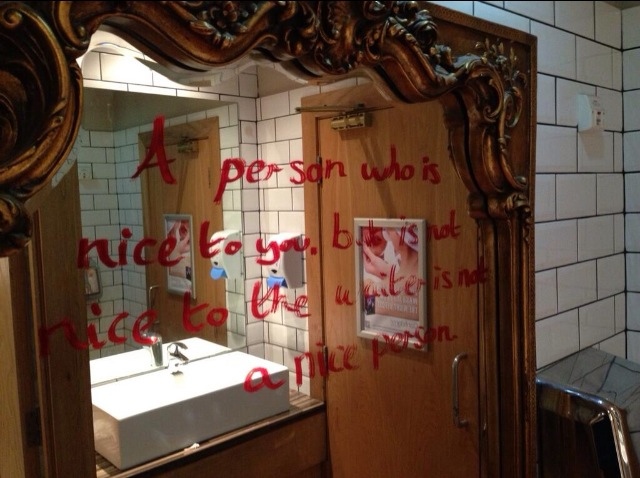
A person who is nice to you, but who is not nice to the waiter is not a nice person

Having worked in two bars before, one in Belfast and one in Toulouse I can say with confidence that the quote in the picture and in writing below, rings very true. The person who said this remains anonymous to me. I found the picture on Bronagh Waugh's Twitter account (@bronaghwaugh). The quote in full:
"A person who is nice to you, but is not nice to the waiter is not a nice person."

One Million Fatherless Homes in the UK


A report by the think-tank, Centre for Social Justice has found that the number of single-parent families in the UK is on the rise, and will top 2 million by the next General Election in 2015.

Liverpool was found to have the highest level of single-mum households. This growth in lone-parent families represents the emergence of what Christian Guy pf the CSJ calls "men deserts."

You can see the Radio 4 clip here. Read the CSJ Press Release here and read what Clare Carter had to say of the phenomenon in the Telegraph here.


Access the Centre for Social Justice website here.

June 08, 2013

David Ogilvy: "Big ideas come from the Unconscious"


Ever wondered how the creative process works? Where the sparks and big ideas really come from? Well here's David Ogilvy's take on it:
"Big ideas come from the unconscious. This is true in art, in science, and in advertising. But your unconscious has to be well informed, or your idea will be irrelevant. Stuff your conscious mind with information, then unhook your rational thought process. You can help this process by going for a long walk, or taking a hot bath, or drinking half a pint of claret. Suddenly, if the telephone line from your unconscious is open, a big idea wells up within you."

#BelfastFaces - Amanda Poole Previews the Exhibition


Amanda Poole (@AmandaPoole) , freelance journalist pictured above previews my exhibition, Belfast Faces and Famous Places:
"Pubs, poets, politicians and more feature in the new Belfast Faces and Famous Places exhibition opening tomorrow (June 7 2013). The latest work from artist and writer, Brian John Spencer, runs at the Common Grounds coffee shop (16 - 17 University Avenue) in the south of the city from June 7-29. 
The celebration of Belfast includes cartoons of the world famous Crown bar and Kelly's Cellars. Poet Michael Longley, restaurateur Michael Deane, SDLP leader Alasdair McDonnell and No Alibis books store owner David Torrens are among those immortalised in cartoon form. 
Brian (25) from Stranmillis said: 
"The exhibition is a celebration of the city, its well known faces and popular places. I initially focused on Ulster poets and politicians and then broadened the scope." 
Veteran journalist and author Eamonn Mallie, who specialises in politics, security and 20th century art, will be speaking at tomorrow's exhibition launch. “He's a rather new wave artist in a sense,” Eamonn said of Brian. 
“He is where Jack Yeats was when he started out as a young man for Punch magazine. He's working in a very rich vein of interpretation. I know Brian better as a writer, with a very finely tuned ear and awareness of political and legal evolution. He has a dual approach and a huge capacity for learning. I can't praise the guy enough.”

A big thanks to Amanda for taking the time out of her day to write this up. You can find out and see more about Amanda Poole on her Facebook fan page here.

"[Writing] is Theft"


It was Picasso who said: "art is theft." 

This quote has since evolved and spawned several permutations. Steve Jobs famously misquoted Picasso when he said, “Good artists copy; great artists steal.” T.S. Eliot said something a little closer to Picasso's original: “Immature poets imitate; mature poets steal.”

Then there's the writer Austin Kleon wrote a book entitled, Steal Like An Artist. See video below:

Research says you should keep your blog posts and online essays short

http://dish.andrewsullivan.com/2013/06/08/you-might-finish-reading-this-post/

Drawing my own finding here but I think it sensible to suggests that crafting a good headline title is super important. Here's some comment and advice from copyblogger: http://www.copyblogger.com/magnetic-headlines/

Bag-carrying junior barrister in the Leveson inquiry paid £218,606

bag-carrying junior barrister in the Leveson inquiry — Carine Patry Hoskins, who had a fling with Hugh Grant’s barrister, David Sherborne — was paid £218,606 of taxpayers’ money for 16 months’ routine work

The reason why Boris and Christopher Hitchens are such powerful writers...

Marcus Berkmann in the Spectator gives his thinking on why these totemic writers are so very good at their craft:

"The words are his (Boris Johnson) none-too-secret weapon. He is as natural and talented a comic writer as we have; or rather, he is as natural and talented a comic talker — for like Christopher Hitchens, he can write so fast because he is only writing down what he would have said. The rest of us have to work at our words."

In the same article Boris Johnson is quoted from a 2004 interview which gives us an insight into the secret of his writing and speaking success. He says:

"I think it’s important to remember that most people find politics unbelievably dull, so I don’t see any particular vice in trying to sugar the pill with a few jokes."

The Spectator essay in full here.

http://www.spectator.co.uk/books/8920151/the-wit-and-wisdom-of-boris-johnson-edited-by-harry-mount-review/


Why does everyone want to go to Law School? Ctd

I think the former barrister Harry Mount writing in the Spectator is onto something:

"There’s no reason why they should be paid any more than other graduates in less overrated jobs. But their high prices, and their dashing reputation, stoked up by Charles Dickens, John Mortimer and a million courtroom dramas, have conspired to produce this delusion of brilliance. It is a delusion many of them fall for themselves."

He's referring to the shrieks and wails of horror being emitted by the legal profession as the Lord Chancellor and non-lawyer, Chris Grayling implements swinging cuts to the legal aid bill.

But it still has resonance with the question of why everyone wants to go to Law School?

Because, as he suggested, Dickens, Mortimer and TV court room dramas have conspired to create a delusion of brilliance. On that is a fiction and but a grotesque characters that does nothing but lead young people up the garden path.

Harry tears into the legal profession, which he calls a "overcharging charade" and the "last unreformed profession", a little more which provides some interesting reading:

"A few specialist areas — banking law, trust law, intellectual property — require brainiacs with Oxbridge firsts, who deserve to be well paid. Most of the rest of it is child’s play. Divorce, death and housebuying are straightforward enough — lots of us manage them with little difficulty — and so is the law associated with them. But over the centuries we’ve let a small group of not particularly gifted people monopolise the legal control of these routine, if crucial, acts."

A little more:

"Most things barristers do for hundreds of pounds an hour could be done as well not just by solicitors but by any intelligent person. Many of the things high-street solicitors do, too — conveyancing, divorces and wills among them — are a doddle, especially in the age of the internet."

Read Harry Mount's piece in the Spectator in full here: http://www.spectator.co.uk/features/8927101/take-it-from-a-former-barrister-chris-grayling-is-right-to-reform-legal-aid/

#BelfastFaces Exhibition Opens

http://boo.fm/b1438286

June 07, 2013

Education's Information Asymmetry, Ctd

https://twitter.com/brianjohnspencr/status/342718475611025408


https://twitter.com/brianjohnspencr/status/342574332817575937

June 05, 2013

Hitchens on Cliché


Christopher Hitchens discusses cliché and his crusade to avoid it at 17 minutes 20 seconds of the video above. He also discusses it at 1 hour 14 minutes 45 second of his talk on George Orwell here.

More of Hitchens on cliche on Slate Magazine here:
"Cliché, not plagiarism, is the problem with today's pallid political discourse."
Then there's a profile of Vladimir Nabokov on brainpickings.org which includes his take on cliche. Available here:
"Journalistic cliches… ‘the moment of truth’ — ‘the moment of truth!’"


Hankering for Agrarian Society is a Reactionary Fantasy

At 1 hour 6mins 30


http://m.youtube.com/watch?feature=related&v=rY5Ste5xRAA

Islamic Extremism against the United States goes back to 1788

From 2 minutes 5 seconds Christopher Hitchens explains how Islamic extremism against America has nothing to do with George Bush and everything to do with the absolute dysfunction and hatred embedded in Muslim faith.

http://m.youtube.com/#/watch?v=xUFAuE6dnZM&desktop_uri=%2Fwatch%3Fv%3DxUFAuE6dnZM


Also, interesting quote from founder of modern Turkey on Islam:

"Islam, the theology of an immoral Arab (the Prophet Mohammed), is a dead thing. It might possibly have suited tribes of nomads in the desert, but it's no good for a modern progressive State."
- Mustafa Kemal Ataturk


You should also check out Douglas Murray's new ebook, 'Islamophilia'.

Review here:

Douglas Murray:

'ISLAMOPHILIA' shows how so many of the celebrities above, have, at some point chosen to abandon any hope or wish to criticize Islam and instead decided to profess some degree of love for it. Love, that Murray points out in the book, is often irrational and certainly misguided: Murray is not afraid to name and shame, and the book’s tour includes novelists Sebastian Faulks and Martin Amis, Boris Johnson, South Park, Tony Blair, Ridley Scott, David Cameron, Liam Neeson, Justin Bieber, Random House Publishers, the BBC, Richard Dawkins, the Prince of Wales and even George Bush. Yes, George Bush.


Six men planned terrorist attack on EDL demonstration:

http://m.guardian.co.uk/uk/2013/jun/06/islamic-extremists-attack-edl-rally

Education's Skills Asymmetry, Ctd

I published an essay on the Huffington Post by the title, 'Education's Skills Asymmetry' on Friday 30 May. The essay was an attempt to show the gross skills mismatch that exists between the world of education and the world of work. The effect of this is that young people leave school not work ready.

Only a few days later the Times of London published a news report by a similar title: 'Businesses urged to teach pupils how to fill skills gap'.

Pretty much an echo of what I called for less than a week earlier. In a sentence here's essentially what they said:

'A report from the government advisory body says that many young people have unrealistic career ambitions and need better advice on how to develop the qualifications and skills for specialist jobs that employers need.'

Article in full here (£).

http://www.thetimes.co.uk/tto/education/article3782843.ece?CMP=OTH-gnws-standard-2013_06_05

June 04, 2013

Employability versus The Traditional University Degree - An Open Letter to Sir David Bell (part 3)

Sir David Bell, Vice-Chancellor of the University of Reading.
The Socratic dialogue continues.

Part 1 of this dialectical series was began by me with an open letter published on the Huffington Post and on Ambitious Minds which addressed Sir David Bell who had made suggestions in the Times newspaper that a growing push towards "employability" of university degrees was putting the 'intellectual integrity of degrees at risk.'

In Part 2 Sir David Bell responded to my riposte and gave his own counter-argument. I have since published what he had to say on my blog which you can read it here. Sir David Bell made a number of fair and interesting points.

In Part 3 of the dialectic I would like to give further response by broadening my argument, and by citing more of the commentators and authorities that I've been following and reading assiduously in recent months. To begin with, I would like to present three testimonies that all give a dim account of the "status quo" university education.

Firstly, to start with Dale J Stephens (@DaleJStephens), the founder of the Uncollege movement said of his university experience in the US:

An Open Letter from Sir David Bell

This is turning into a real dialetic of the Socratic Dialogues kind!

After my open letter essay to Sir David Bell, 'Why Sir David Bell is Wrong to Smack Down the Employability Concerns of University Students' was published on the Huffington Post, I was pleased to receive a response, among others, from Sir David Bell himself.

After making a request I've now got permission to publish his response. While Sir David Bell has put up a number of rebuttals to my points raised on the Huffington Post, I welcome the debate. Over to Sir David Bell:
Dear Brian, 
I read your recent Huffington Post blog post with interest. I’m glad you have drawn attention to issues of employability skills at university. It is a subject that is of genuine importance and it’s vital that we prompt debate among the public, as well as those with closer ties to the sector. I felt your blog raised some important points, but was some way wide of the mark on others.

With the current economic climate and increases in student contributions to tuition fees, it is inevitable, and in many ways welcome, that students are becoming more focused on matters of employability. However, I would argue, as was reported in the Times, that university courses ought not to be wholly ‘tailored towards employability’ – and I would disagree forcefully that university is a ‘sham’. Nor do I believe that degrees have been significantly devalued by widening access to higher education.

It is right that students today, more than ever, need to be given good career advice before, during and after attending university, to help them make informed choices. Evidence shows that other factors, such as work experience, are often crucial to a graduate’s job prospects. But this is not the same as turning degrees themselves into another form of vocational training. A good university education should be above all intellectually challenging, and help prepare graduates for the world, as well as the world of work.

I note from your website that you are interested in typography. We have an award-winning Department of Typography & Graphic Communication at Reading, which exemplifies this point marvellously. It provides courses that encourage study and research for the joy of learning and deepening understanding. They also support the development of practical skills, which contribute towards creating a highly-skilled workforce and help graduates get jobs. And with some success – 90% of former students are in work or further study six months after they graduate, and 95% of those with jobs are in professional or managerial positions.
Perhaps you’d like to come along to Reading and see for yourself? The department has a degree show for final year students from 18-22 June. More details, and a programme of the excellent work on display, are available from www.typofamily.co.uk.
 
With warm regards,

Sir David Bell KCB
Vice-Chancellor, University of Reading

Why does everyone want to go to Law School? Ctd


This is an open discussion with my last post here. I want to pick the debate up on the blog post by Max Tucker who wrote an essay for the Huffington Post entitled, 'Why You Should Not Go To Law School.'

He backs up my thinking that everyone wants to go to Law School and that it's the default career choice. He said:
"At some point in their life, everyone thinks they should go to law school. You may in fact think you want to go to law school now."
The rest of his essay is great and deserves a read and attention, which you can do here. But I want to leaves things on an interesting comment that was made in response to the post by a practicising attorney. Lara Gardner said:
I'm an attorney and I could have written this, word for word. It is dead on. I wish I had read it before going to law school and getting a degree that ensures I'll have an impossible time ever finding a job that isn't law-related or free of massive student loans. I have virtually no regrets except for attending law school. It was the biggest mistake of my life. Don't do it! Believe what he says here. He's right!

Comments on SpAd Bill

Opinion of former soldier injured by Kavanagh here.

Malachi O'Doherty's take on the events as they unfolded:


June 02, 2013

My List of Ambitions


Have a Wikipedia page

Produce art for Vanity Fair and other  magazines

Write for Vice Magazine, the Guardian, similar dailies, the weekly magazines like Spectator, monthly like Wired and Time Magazine

Exhibit in Dublin, London and New York

Work in New York

Sinead O'Connor on Being Creative


I Thought it was just me. Procrastinating, whittling away the hours, being busy doing nothing and all that. However, I'm increasingly finding that this is a shared experience. That these are simply the habits of the creative person, the by-products of the creative process.

Here's Sinead O'Connor in an interview with the Sunday Times Magazine entitled, 'I'm Finally Learning How To Love with Being Bipolar' (June 2 2013):
"I spend most afternoons pottering around. I love it - it often feels like the most important part of the creative process. It's when songs come to me."


Streetkleen: Turning Dog Waste into Fuel

http://www.streetkleen.co.uk/

Youth unemployment in Ireland

Fintan O'Toole on the effects here:

http://www.irishtimes.com/news/politics/emigration-story-by-far-the-most-important-of-modern-ireland-1.1400519

"Imagine the populations of Cork, Galway, Limerick and Waterford cities put together. They amount to about 400,000 people. That’s about the number of people who will be absent from the Republic of Ireland in 2026 if things continue as they are going. If emigration remains at the levels it has reached because of economic collapse and so-called austerity, the long-term effect will be monumental."

One last go from Fintan here:

The old habit has reasserted itself: emigration substitutes for change and the lack of change reinforces emigration. Without a radical shift of direction, the Famine will continue into the next generation.

Robert Shiller, author of irrational exuberance on slate magazine here:

http://www.slate.com/articles/business/project_syndicate/2013/06/we_need_stimulus_not_austerity_to_combat_unemployment.html

Survey has shown 300,000 have emigrated in last 4 years:

http://www.rte.ie/news/2013/0509/391211-emigration-report/

While 90% of rural youth have considered emigration:

http://www.irishexaminer.com/ireland/cwmhkfojojoj/rss2/


Youth organisations in Ireland are warning that the number of young people emigrating could be devastating for the country's economy.

http://m.bbc.co.uk/news/world-europe-22698740

While in Northern Ireland youth unemployment is at 23.8%

In case you've forgotten: youth unemployment in Northern Ireland stands at 23.8% - Disgraceful. Shameful! http://t.co/20RyS2SBNR

June 01, 2013

Christopher Hitchens - Why Socialism Doesn't Work


In interview here, Christopher Hitchens said (22m):
"You can’t lie to the young. You must not bullshit the young. It’s an absolute principle. These people were asking me questions, 'Seriously what should I do with my life? Should I commit to socialism or not?' I reviewed it. Is there now an international working class movement linked at the point of production, internationalist that could replace capitalism as was once thought possible. No. There isn't. Is it in long term decline that idea? Yes. Is it coming back? I don't think so. Is there an ideology at least, without anchorage in a material class movement, that could at least say it was a critique of capitalism that could transcend it? Not known to me, no. And one's I've seen on offer, not very persuasive. At that point it seemed meaningless to go on calling myself a socialist."
In full here.

Let's talk Warby Parker

Given mention here: http://feedly.com/k/139l4W5

The (Northern Ireland) Boundary Dispute - a most hateful form of litigation

True to Northern Ireland if you ask me. Retired Court of Appeal judge Sir Alan Ward gives his two cents on boundary dispute:

“This is another of that hideous form of litigation called the boundary dispute, a form of litigation which is best not pursued. Just how much is this stupid piece of land worth? What you are arguing over is a few rhododendron bushes. If you live in St Georges Hill, you've got money to throw away, presumably. But why throw it away like this? You're all potty. Disputes of this kind are a most hateful form of litigation; go away and sort it out."

Here he was in another case:

"Not all neighbours are from hell. They may simply occupy the land of bigotry. There may be no escape from hell but the boundaries of bigotry can with tact be changed by the cutting edge of reasonableness skilfully applied by a trained mediator. Give and take is often better than all or nothing."

In another case he gives some advice on how to patch up differences:

"Love is, of course, an old, old story. 'Amor omnia vincit et nos cedemas amori' – love conquers all, let us surrender ourselves to love – wrote Virgil; 'Love is all you need,' sang the Beatles.”

And some prophetic words on the stubborn, bigoted, pre-1998 thinkers:

"You may be able to drag the horse (a mule offers a better metaphor) to water, but you cannot force the wretched animal to drink if it stubbornly resists. I suppose you can make it run around the litigation course so vigorously that in a muck sweat it will find the mediation trough more friendly and desirable. But none of that provides the real answer."


Read more here

http://feedly.com/k/19vOktx

We Need Two Tier University System

http://lawyerist.com/would-you-sign-up-for-a-second-tier-law-school-education/

At the end of this Bloomberg Law video, Above the Law’s Elie Mystal predicts law schools will split into two tiers, one for law students who are aiming to become white-shoe law firm partners and Supreme Court justices, and another for law students aiming for a middle-class existence in smaller markets.

What we need in UK

The University Farce

Dale J Stephens on the farce that is university education:

"Going to college is meant to be the culmination of 12 years of hard work, determination and study. You're told that if you get good grades, ace your tests and do lots of extracurriculars, you'll get into a good university. The reasoning seems solid when you're at secondary school - after all, everyone tells you that university graduates earn more and are less likely to be unemployed.

I enrolled... However any idealism was quickly squashed. For the most part, people weren't there to learn - they were there to party, and hangovers permitting, learn something along the way. I started asking questions."

Dale J Stephens, Wired Magazine, March/April 2013.

Now here's Alex Aldridge from Legal Cheek:

"A turning point in my life was when I ran out of excuses to do more higher education. On reflection, my English literature degree (four years), GDL (one year) and BPTC (one year) amount to a massive waste of time and money. Indeed, if I could do it all again, I wouldn't even go to university.

But perhaps, as a middle class person whose university lecturer parents placed a high value on education, these were just the hoops I was destined to jump through. I just thank God that law schools weren't offering free further courses to their jobless alumni – as BPP announced it is to do last week – when I was graduating..."


"Having a career didn't only lift me out of post-law school gloom, but it has made me happier generally than when I was a student. As the thrusting execs at the helm of BPP well know, it feels good to develop a skill that generates money which you can then use to build a life of your own. Rather than getting bums on seats to fill obscure, apparently unsubscribed courses, they should let their graduates move on."

University is like part time job...

Uni Applications up in Northern Ireland, Down in England and Wales

Newspaper cutting is from p.14 of the June 1 2013 edition of the Guardian. It found that applications in England and Wales are well below pre-free rise highs. While applications to universities in Northern Ireland and Scotland remains unchanged.

This follows on from Guardian coverage on the topic which came in April, telling a similar story:

"The number of students who have submitted applications so far this year stands at 601,619 – 2.5% more than in 2012 but lower than in 2010 (-3.74%). Compared with 2010, English students' applications have fallen most sharply (-7.2%), while the number of Welsh applicants is also down (-3.8%). Numbers applying in Northern Ireland (+5.3%) and Scotland (+0.2%) have increased."

Article in full here: http://m.guardian.co.uk/uk/2013/apr/30/university-applications-tuition-fees-rise

Just like @QueensUBelfast, US college grads are overqualified, underemployed & in debt http://t.co/Zk9U31jcsA via @Circa @DaleJStephens

Related Posts Plugin for WordPress, Blogger...