 |
| Watch me painting here |

Showing posts with label art. Show all posts
Showing posts with label art. Show all posts
September 09, 2016
March 30, 2016
#NorthernIreland2016 Interview Series - David McCann

David McCann is a political pundit and deputy-editor of Slugger O'Toole. He is from Belfast and was educated at Ulster University where he was awarded as PhD in politics. Read David's political testimony, '1916 Rising and how it inspired me 78 years later'.
February 27, 2015
Grayson Perry - If loyalists want to remain loyal to Britain they’ve got to move on too
 |
| A banner by Grayson Perry, in the mould of an Orange Lodge standard, following a visit to British loyalists in Belfast |
"[Loyalism is] rooted in a vision of Britain that perhaps doesn’t completely gel with the modern 21st century idea of Britain we have nowadays."
And continued:
"If they want to remain loyal to it they’ve got to move on too and it’s all about embracing what Britain stands for today as much as what Britain stood for in the 1950s."My previous posts on loyalism can be read here. Previous Tumblr notes on loyalism here.
January 20, 2015
Salman Rushdie - Avoid politeness, Ctd
 |
| Salman Rushdie by Ralph Steadman |
In a conversation with Christopher Hitchens, Salman Rushdie said that respect proper means that you can take someone seriously and still disagree with them:
"One of the most mealy mouthed pieces of language that has developed to justify this kind of behaviour is a kind of reinvention of the meaning of the word "respect". It seemed to me when I was growing up that respect meant that you took people seriously. It didn’t mean that you never disagreed with them. To respect someone is to say we’ll take on what you have to say and if I don’t agree with it I will offer a counter argument. The idea that it would be disrespectful to someone in any way disagree from this system of belief is a new idea, is a new meaning of the term "respect" and it seems to me to have nothing to do with respect. And what it actually means is I am too afraid to do it. So what you have is cowardice masquerading as respect. And that’s become more and more common. It’s very clear in the case of the [Danish] cartoons."
October 24, 2014
The unmoored, uncertain life of the artist

"In an unmoored life like mine, sleep and hunger and work arrange themselves to suit themselves, without consulting me."
October 23, 2014
Roy Lichtenstein - Art is theft, Ctd
 |
| The famous Roy Lichtenstein 'Wham!' panel is the above image. The original by Irv Novick is below it. |
Roy Lichtenstein is well known for the painting ‘Whaam!’. But less known is that the image was modelled upon an original panel drawing by comic book artist Irv Novick from the “Star Jockey” DC Comic story. Some say homage. I say plain old plagiarism.
October 21, 2014
Artists are labourers to their unconscious
[UPDATE - Zadie Smith said: "[My] writing was an explosion of 18 years worth of reading all the time."
Graham Linehan talked about "practical procrastination" and said: "Your subconscious is this huge glacial thing under water that’s just doing a lot of work when you don’t realise it."]
 |
| Scottish artist John Byrne with a self-portrait. More John Byrne self-portraits here. |
Graham Linehan talked about "practical procrastination" and said: "Your subconscious is this huge glacial thing under water that’s just doing a lot of work when you don’t realise it."]
Agnes B said on Radio 4:
"When you are designer you are like a sponge you don’t know where ideas come from."
John Byrne said:
"I am the labourer to my unconscious."Michael Longley said:
"The raw material of experience… needs to settle to an imaginative depth where it can be transformed and emerge as art."
Francis bacon said:
"There’s this deep sea which we call the unconscious which we know nothing about. I always hope the most wonderful images will emerge from it."
October 12, 2014
The Backfire Effect
The Backfire Effect or Identity-Protective Cognition is when people hold onto their personal and tribal narrative even when it is wrong and unfounded. The antidote to this kind of egregious thinking and groupthink is the Orwell Method. But first, a little more on the Backfire Effect.
Maria Popova is well known for writing, "Allow yourself the uncomfortable luxury of changing your mind." This is a painful process, made all the harder by the "Backfire Effect" as Maria Popova explained, changing the mind is a problem many grapple with, however it is hard. Because on one hand:
Maria Popova is well known for writing, "Allow yourself the uncomfortable luxury of changing your mind." This is a painful process, made all the harder by the "Backfire Effect" as Maria Popova explained, changing the mind is a problem many grapple with, however it is hard. Because on one hand:
"The awareness that personal growth means transcending our smaller selves as we reach for a more dimensional, intelligent, and enlightened understanding of the world."
And on the other hand:
"The excruciating growing pains of evolving or completely abandoning our former, more inferior beliefs as we integrate new knowledge and insight into our comprehension of how life works. That discomfort, in fact, can be so intolerable that we often go to great lengths to disguise or deny our changing beliefs by paying less attention to information that contradicts our present convictions and more to that which confirms them."
October 11, 2014
Christopher Hitchens on the Falklands War
 |
| A cartoon by Ralph Steadman of Margaret Thatcher being haunted by the ARA General Belgrano |
The cartoon is by Ralph Steadman of Margaret Thatcher being haunted by the ARA General Belgrano, an Argentine cruiser leaving the British Declared Exclusion Zone that was ordered to be sunk under her instructions.
In all the polarisation around Thatcher and controvery about the Falklands War, Christopher Hitchens brings some clarity. He held that line that he could not agree more with Thatcher and her position on the Falklands War. Hitchens shared his position on the Falklands War in a conversation with Salman Rushdie, where he said:
October 07, 2014
Live Drawing at @MurphysButchers on @theLisburnRoad
Following a wonderfully enjoyable day of Live Drawing at Arcadia Deli on the last Saturday of August 2014, I did a day of Drawing at Murphy's Butchers on the Lisburn Road on Saturday October 4.
Murphy's was another very enjoyable day, drawing people of all ages and backgrounds. From drawing a little boy who had just finished a morning of mini-rugby at Belfast Harlequins, to drawing Ulster Rugby players Stephen Ferris and Robbie Diack. Please have a look and explore all the drawings and videos from the day.
See the pictures below to see all my work from the day of drawing in Murphy's Butchers. See all my Vine freeze-frame videos here. Also be sure to look and read about my Conference and Seminar Drawing here.

October 04, 2014
My work with Michael Deane
The Daily Draw: featuring @MichaelDeane61 as promised. pic.twitter.com/MQ6EVIgTtF
— Brian John Spencer (@brianjohnspencr) March 2, 2013
[UPDATE - also read this post here]
It all began with a chance tweet and a simple cartoon as explained here in my 'The Artist's Journey' series, and in even more detail my journey is described here. That original cartoon, created on a wet March Saturday afternoon after rugby coaching and before going into town to sit in Waterstones all day, was then used in the Michael Deane signature wine, 'Chez Deano', which you can see below.
September 30, 2014
Deanes Meatlocker Malbec wine label

It all began with a simple Matisse-inspired cartoon and a chance tweet. The cartoon then led to the Michael Deane 'Horsemeat' collection and the first wine label. You can read all about the creative process and working relationship here.
September 25, 2014
Conference Drawing
 |
| My Conference Notes Cartoon of Josh Richards (@Mighty_Ginge) at @Create2014Co, more here. |
I do Live Drawing. I also do Conference Drawing. This is where I go to conferences, seminars and talks and document what is said through words and coloured drawings. Think mind maps. Think story boards. A wonderful way to remember the special event and the special ideas and contacts made. Below are 12 images from the 12 conferences and events that I've done Conference Drawing at over the last year. Click the links below to see a full selection of images from each of the 12 events.
September 23, 2014
How Matisse inspired Miffy
The creator of Miffy the Rabbit explained here (45m25) how Matisse inspired him. In an article in the Telegraph, 'I saw Matisse - and came up with Miffy', Dick Bruna said:
"[In Paris] I saw Picasso for the first time and Léger and all those big painters. When I saw Matisse's work – especially his late collages – he became the most important man in my life."Also here and here. Below is how Matisse inspired other modern graphic designers.
Christopher Hitchens - We are in need of a renewed Enlightenment
 |
| Benjamin Frankling, a pillar of the American Englightenment, by Gerald Scarfe, here |
Christopher Hitchens said:
"Above all, we are in need of a renewed Enlightenment, which will base itself on the proposition that the proper study of mankind is man and woman. This Enlightenment will not need to depend, like its predecessors, on the heroic breakthroughs of a few gifted and exceptionally courageous people. It is within the compass of the average person. The study of literature and poetry, both for its own sake and for the eternal ethical questions with which it deals, can now easily depose the scrutiny of sacred texts that have been found to be corrupt and confected. The pursuit of unfettered scientific inquiry, and the availability of new findings to masses of people by electronic means, will revolutionize our concepts of research and development. Very importantly, the divorce between the sexual life and fear, and the sexual life and disease, and the sexual life and tyranny, can now at last be attempted, on the sole condition that we banish all religions from the discourse. And all this and more is, for the first time in our history, within the reach if not the grasp of everyone."Jenni Russell (@jennirsl) wrote that there's nothing inevitable about the victory of enlightenment values. In an earlier post I wrote that Christopher Hitchens said that enlightenment principles need to be fought for and defended by every generation. Scottish historian Niall Ferguson (@nfergus) noted that "the greatest thinkers of the Scottish Enlightenment were not nationalists but cosmopolitans".
In Northern Ireland, where tribal acrimony and antipathy govern all levels of public discourse these principles are exceptionally necessary. We need to move away from what David Hume called "the vulgar motive of national antipathy."
In a Letter to Lafayette Monticello in May 1817, Thomas Jefferson said:
"Ignorance and bigotry, like other insanities, are incapable of self-government."I earlier wrote that we could say that sectarians are mentally and morally unwell. And so as Christopher Hitchens said, "condemnation of bigotry and superstition is not just a moral question but a matter of survival."
September 09, 2014
Ralph Steadman and Quentin Blake on the term cartoonist

"In some ways ‘cartoonist’ is a derogatory term. People have said it to me dozens of times – you’re just a cartoonist. But I’m rather keen on the Wittgenstein bit about the only thing of value being what you cannot say. That’s the thing about drawing: when you try to say something in pictures, it gains a dimension that language can’t match. I like that.”And I wouldn't even use the term illustrator. As Quentin Blake said:
"There's a snobbery about illustration."
Ralph Steadman said that he's an artist, not an illustrator, but prefers cartoonist to illustrator:
"I always wanted to be an artist, period: I hate the word illustrator - it just sounds so limp - I prefer cartoonist. Goya was a cartoonist, Daumier was a cartoonist, even Picasso used the cartoon form to express himself. But cartooning has got a really bad name now hasn’t it? People think it’s just something for filling up a column in a newspaper [adopts condescending voice] ‘Oh, it’s only a cartoon, here’s a fiver…’ I’m not trying to be artsy-fartsy but I don’t like the division that one thing is fine art and another thing isn’t."
And:
"Cartooning meant more to me than just funny pictures. I needed to apply it as a weapon almost."And finally Ralph Steadman said:
"I try to use cartoon as an artist. I hate artistic snobbery. It’s bullshit. You should have no truck with it whatsoever. Have no truck with it."
August 30, 2014
Christopher Hitchens on Orwell and feeling inferior against otherwriters
 |
| Christopher Hitchens by Ralph Steadman |
Christopher Hitchens said about George Orwell:
"The point was made better by Lionel Trilling. The remarkable thing about Orwell and the encouraging thing was he is not a genius. He lived to only 46 years. He never went to university. He never had a steady job. He usually didn’t have a steady publisher. He will never be forgotten because he managed to disprove imperialism, Stalinism and fascism in one lifetime and made some imperishable raids on its territory that no-one is ever going to forget. All the time ill. All the time poor."He then said:
"[George Orwell] shows how much difference a person of really average integrity and intelligence and education can make if they have a little courage and a little intellectual honesty. The shortcomings of the individual you can see in him too. But he basically won his own battle against his own prejudices. This is an example for all time. You don’t get the sense for example when you’re reading Proust or Nebokhov or George Eliot that you shouldn’t be in the writing business. All the people in history who said alas there was nothing I could do are lying or at least discrediting themselves. They could have. They just chose not to."
August 27, 2014
Sean O'Casey - Writing gets harder the more you do it
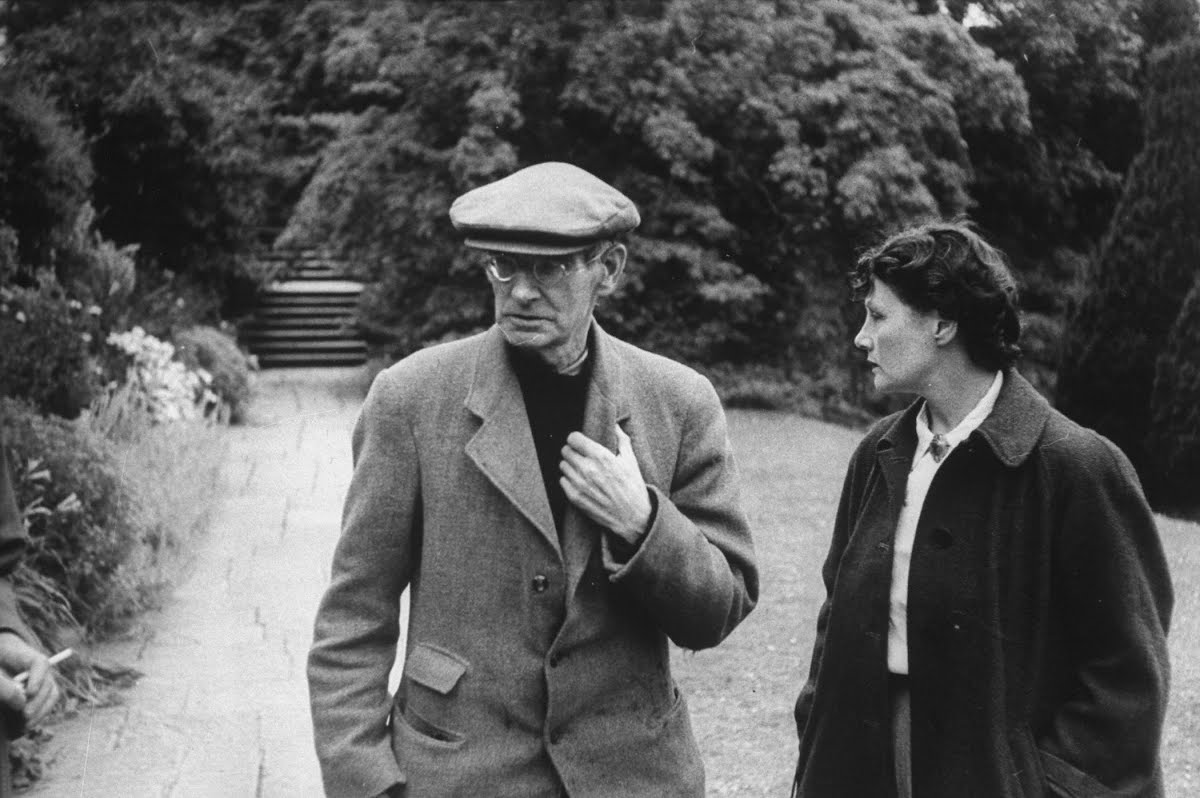 |
| Irish writer Sean O'Casey and his wife Eileen Reynolds |
"When I write a new play. When I sit down to try to write a new play, I’ve had the experience of many plays before. Yet that new play that I am going to try to write gives me the same agony, the same trouble, the, same effort, the same Herculean work as the very first play I ever wrote gave to me."Christopher Hitchens said the same thing:
"I hate to agree with George Will about this… The truth is, yes there is nothing like not writing for making you unhappy and if you have the compulsion then the only problem that you’ll have is, you surrender to this compulsion more and more and, you’ll find [writing] gets harder the more you do it. That seems a shame. It should get easier, it should become more like a facility for example. It becomes more difficult and it becomes more difficult because you are reading more and more work by better and better people and you’ve lost the sheer nerve and the blind solipsism that allowed you to think you could try it when you were young before you had made any proper comparisons. So it gets much more nerve wracking and much more difficult in every way costly for you and no doubt for your readers."Samuel Beckett on writing more generally said in 1954:
"It’s hard to go on with everything loathed and repudiated as soon as formulated, and in the act of formulation, and before formulation."Beckett also wrote:
"I realized that Joyce had gone as far as one could in the direction of knowing more, [being] in control of one’s material. He was always adding to it; you only have to look at his proofs to see that. I realized that my own way was in impoverishment, in lack of knowledge and in taking away, in subtracting rather than in adding."
July 19, 2014
Belfast Castle Wedding

This happened on Wednesday July 16 2014. See my Live Drawing website with a full portfolio and selection of photos, here.
July 13, 2014
Kenneth Branagh - Art is theft, Ctd

"Shakespeare was fantastically comprehensive in where he went for all his stories. He knew how to borrow and he knew how to be inspired."He also said:
"The Barge speech in Thomas North’s ‘Lives of the Ancient Romans’, Shakespeare pilfers fairly comprehensively. He scattered his gatherings but always, always transforming."Steven Greenblatt wrote in the Telegraph about the move of ideas from Montaigne to Shakespeare:
"The borrowing extends beyond certain expressions – kind of traffic, name of magistrate, use of service, and the like – to a vision of a whole society organised on principles directly counter to those in place in the familiar, grim realm of contemporary European reality. That is, here [The Tempest] as in the case of King Lear, Shakespeare is mining Florio’s Montaigne not simply for turns of phrase but for key concepts central to the play in question."He continued:
"Scholars have seen Montaigne’s fingerprints on many other works by Shakespeare, whether in the echoing of words or ideas. When Hamlet exclaims to his mother, “Ecstasy? My pulse as yours doth temperately keep time,” (III .iv.130–31), Shakespeare may have picked up a hint from Montaigne’s “during his ecstasy, he seemed to have neither pulse nor breath” from “Of the Force of Imagination.” And Polonius’s “This above all: to thine own self be true” may owe something to “That above all, he be instructed to yield, yea to quit his weapons unto truth” from “Of the Institution of Education of Children.” More broadly, there is something strikingly Montaigne-like in Hamlet’s intertwining of Stoicism — “Give me that man / That is not passion’s slave, and I will wear him / In my heart’s core” — (III .ii.64–66) with philosophical skepticism — “And yet to me what is this quintessence of dust?” — (II .ii.297–98) and inner acceptance — “If it be now, ’tis not to come. If it be not to come, it will be now. If it be not now, yet it will come. The readiness is all.” (V.ii.158–60)...But what is a problem for the scholarly attempt to establish a clear line of influence is, from the perspective of the common reader, a source of deep pleasure. Two of the greatest writers of the Renaissance — two of the greatest writers the world has ever known — were at work almost at the same time, reflecting on the human condition and inventing the stylistic means to register their subtlest perceptions in language."
Subscribe to:
Posts (Atom)
