Showing posts with label Maria Popova. Show all posts

October 12, 2014

The Backfire Effect

The Backfire Effect or Identity-Protective Cognition is when people hold onto their personal and tribal narrative even when it is wrong and unfounded. The antidote to this kind of egregious thinking and groupthink is the Orwell Method. But first, a little more on the Backfire Effect.

Maria Popova is well known for writing, "Allow yourself the uncomfortable luxury of changing your mind." This is a painful process, made all the harder by the "Backfire Effect" as Maria Popova explained, changing the mind is a problem many grapple with, however it is hard. Because on one hand:
"The awareness that personal growth means transcending our smaller selves as we reach for a more dimensional, intelligent, and enlightened understanding of the world."
And on the other hand:
"The excruciating growing pains of evolving or completely abandoning our former, more inferior beliefs as we integrate new knowledge and insight into our comprehension of how life works. That discomfort, in fact, can be so intolerable that we often go to great lengths to disguise or deny our changing beliefs by paying less attention to information that contradicts our present convictions and more to that which confirms them."

August 23, 2014

Avoid politeness, be constructively blunt

Henry Louis Mencken at work
There is a difference between being irreverent and offensive. Criticism and confrontation is a cleansing act that helps people and argument to refine and streamline. Just as destruction is not opposite to birth, reform and creation, so impoliteness can be constructive and politeness can be destructive. Don't be destructively polite, be constructively blunt. As Edward Land said"politeness is the poison of collaboration." Maria Popova echoed this when she said:
"[Refuse] to infest the garden of honest human communication with the Victorian-seeded, American-sprouted weed of pointless politeness."
Thomas Sowell said:
"When you want to help people, you tell the truth. When you want to help yourself, you tell people what they want to hear."

July 16, 2014

Leo Baxendale - Art is theft

Giles cartoon 25th July 1954
Leo Baxendale wrote:
"The catalyst for my creation of Bash Street was a Giles cartoon of January 1953: kids pouring out of school, heads flying off and sundry mayhems. Straight away, I pencilled a drawing of 'The Kids of Bash Street School' and posted it from my home in Preston to R. D. Low, the managing editor of D.C. Thomson's children's publications in Dundee. I received an offhand response, a dampener. It was only after I'd created Little Plum (April 1953) and Minnie the Minx (September 1953) that the Beano editor George Moonie travelled to Preston on 20 October 1953 and asked me to go ahead with Bash Street (he gave it the provisional title of 'When The Bell Goes'; when it appeared in The Beano in February 1954, it was titled 'When The Bell Rings'."
He also wrote:
"Alan Moore, Steve Bell, Savage Pencil and others have taken the ethos of my work, The Beano Spirit, that uninhibited outlook, and they’re carrying it on in their own work. I think that’s wonderful."

February 05, 2014

Maria Popova and @brainpickings - The best the Internet has to offer


Legal blogger David Allen Green (@DavidAllenGreen) (@JackofKent) gave his take here on the best legal commentary the Internet has to offer. Washington Post blogger and darling of the Internet Ezra Klein (@EzraKlein) warrants note as he spins off from Wonkblog to create an altogether new form and breed of Internet journalism. One that changes the model from one of "relentless presentism" to "persistent content". Vague. I know. We're still waiting to see what this actually means.

December 31, 2013

The artist's journey, Maria Popova Explains Our Remix Culture

The above image is a screen shot from a video on remix culture by Kirby Ferguson here and here
Maria Popova gave a Creative Mornings presentation here and included a video by Kirby Ferguson who said:
"George Lucas collected materials, he combined them, he transformed them. Without the films that preceeded it, there could be no Star Wars. Creation requires influence. Everything we make is a remix of existing creations, our lives and the lives of others."
Watch the Kirby Ferson video, Everything is a Remix here. See Ferguson's blog here. Read about the remix culture on Wikipedia here. Watch the Maria Popova video in full here. Daniel Hannan on combinatorial creativity here.

My blog post on Aleks Krotoski on combinatorial creativity is here (Krotoski's blogs here, here and here). My previous posts on the artist's journey featuring political cartoonists Morten Morland, Martin Rowson and Steve Bell here, on the standing on the shoulder of giants cartoon by Thompson here and on Terry Bradley here. With a special focus on my work and on how I moved from a wine label illustration to an exhibition series here, on the elements that were combined to create a wall painting for Michael Deane here, the process behind a wall painting here, my move from pen and ink and into a clay model version of the Michael Deane Decano Man here, and my explanation on how the original Decano man was created here. On the Deaneos wine label, click here. For the Deaneos Prosecco label, click here.

My Art is Theft series featuring Ronald Searle, Quentin Blake and Morten Morland here, with Ian Knox and Brook here, with Morten Morland talking about theft here, and a piece on the links between Morten Morland and Michael Ramirez here. On the theft of Peter Brookes' cartoon, read here.

December 30, 2013

Retuning our definition of success, Ctd James Hart

"Once a musician has enough ability to get into a top music school, the thing that distinguishes one performer from another is how hard he or she works. That’s it. And what’s more, the people at the very top don’t work just harder or even much harder than everyone else. They work much, much harder." 
 - Malcolm Gladwell, Outliers: The Story of Success
In October 2013 The Irish Times wrote a piece here on the Irish rugby player James Hart by the title, 'James Hart’s work ethic at Grenoble opens alternative route to success.' And that's the key point. The assumption that natural gift is the normal route to success, as opposed to hard work. Matthew Syed spoke about that on Radio 4 which I covered here. James Hart explained his story to Peter O'Reilly in The Sunday Times of December 29 2013 here:
"I was on a bus on the way out to a 20s session in Donnybrook when I got the call. The day I got my Leaving Cert results. All I’d been working for was to make the Leinster 20s. It was a real kick in the balls. I just didn’t give up."
He explained his move to France and the role of being up close and personal with the senior players at Stade Toulousain:
"I was just in awe of [Byron Kelleher and Jean-Baptiste Elissalde]. I used to love watching the two of them pass and kick. Kelleher was so physically impressive. Elissalde was just so smart in the way he read the game and could kick off either foot. That summer I read one of Jonny Wilkinson’s books and it kind of made sense to me. I knew I had a bit of natural talent but I knew that if I was going to make anything of myself, I’d have to work extremely hard. So that’s what I decided... I’d have been bored out of my tree at weekends. I used to just have a bag of balls and kick and pass, I don’t know for how long. It was just what I used to do when I was bored. I suppose all those hours add up. At the start I found it tough. I wasn’t really playing well. I was thinking, ‘Am I really that good?’ And sometimes I wanted to go home. I rang my mam and told her: ‘I can’t do this.’ You’ve got to hold your own, though. I’d be upset for a little bit and I’d tell myself: ‘You’ve got to keep working. Maybe something will happen.’"
Bernard Jackman gave his take on James Hart here:
"Lots of players want to be great but not many are willing to put in the hours and hours of practice that it takes. I’ve never seen anybody train as hard as James Hart. He has made himself an unbelievably good, technical player. He’s picture perfect."
Read my blog post on Christopher Hitchens and his definition and secret to success here, where he said:
"I became a really hard worker. A person of almost iron self discipline. I built my own workspace at home. I never went to an office anymore. I didn't hang out with people at lunch. Got on with it. If I wasn't reading, I was writing."
We can also look to this quote by unknown:
"Successful people aren't born that way. They become successful by establishing the habit of doing things unsuccessful people don't like to do. The successful people don't always like these things themselves; they just get on and do them."
My previous posts on the need to redefine our definition of success with Maria Popova here, with Matthew Syed here, with Matthew Syed again here, with Dan Pink here, with Washington educationalist Michelle Rhee here, and with Sir Ken Robinson here. My posts on creativity with Charlie Rose here, with Aleks Krotowski on combinatorial creativity here, on networked knowledge here, here, with Giles Coren here, with Sinead O'Connor here, with Muriel Rukeyser here and on coffeehouses as crucibles of creativity here.

December 16, 2013

Conformity and convention is over-rated

Sarah Green wrote in the HBR here
"Americans love to give lip service to creativity, celebrating imaginative artists and innovators and calling for "out of the box" ideas. Yet when we encounter creativity in real time -- before we know whether an unusual or outlandish idea will pay off -- we’re all too quick to reject it, argues Jessica Olien. She runs through a litany of evidence that becomes more and more depressing, but she comes to a surprisingly optimistic conclusion, thanks to research out of Cornell that shows being rejected leads creative people to conclude that conformity is overrated and thus liberates them from the need to fit in. True, this often doesn't lead to happiness -- but it does lead to more creativity. "To live creatively is a choice," Olien concludes. "You must make a commitment to your own mind and the possibility that you will not be accepted. You have to let go of satisfying people, often even yourself." I find those words oddly comforting. But maybe I'm just being creative."
My blog post on the Dilbert creator and my Dilbert moment here. Timothy Ferriss, prolific author, speaks in similar terms. As Tim Ferriss said in the Four Hour Work Week:
"The common sense rules of the real world are a fragile collection of socially reinforced illusions."
As I often say, Silicon Valley is less a place and more a mindset. That's why we need to think like Maria Popova and Matthew Syed here and Sir Ken Robinson here, and totally re-evaluate the educational experience and education's relationship with industry.

In a new world with a new and exciting economy, we need to think and act anew. If you always do what you always did, you'll always get what you always got.

November 03, 2013

Bureaucracy - The rule by Nobody

Steve Hilton, former director of strategy for David Cameron, left Downing Street in 2012 exasperated at the schlerosis, rolling tedium and near-impossibleness of getting anything done under the Niagra of Whitehall bureaucracy. As he said, "the bureaucracy masters the politicians."

An American friend recently recounted his experience of trying to negotiate an Irish passport out of the joint Irish-American bureaucracy. By his testimony, the process was a vapid and satanic mill of tunnels, u-turns, closed doors and no-men. It overthrows the senses and almost breaks the person. Hannah Arendt wrote fluently on the blunt awfulness of bureaucracy in her book On Violence. She also explained the bureaucracy's inherent leaning towards fostering unrest. She said:
"In a fully developed bureaucracy there is nobody left with whom one could argue, to whom one could present grievances, on whom the pressures of power could be exerted. Bureaucracy is the form of government in which everybody is deprived of political freedom, of the power to act; for the rule by Nobody is not no-rule, and where all are equally powerless we have a tyranny without a tyrant."
She continued: "Bureaucracy, or the rule by an intricate system of bureaux in which no men, neither one nor the best, neither the few nor the many, can be held responsible, and which could be properly called the rule by Nobody. Indeed, if we identify tyranny as the government that is not held to give account of itself, rule by Nobody is clearly the most tyrannical of all, since there is no one left who could even be asked to answer for what is being done. It is this state of affairs which is among the most potent causes for the current world-wide rebellious unrest."

Hannah Arendt comes via Maria Popova here.

October 29, 2013

Maria Popova - Our current definition of success needs serious retuning

Maria Popova said:
"The myth of the overnight success is just that – a myth – as well as a reminder that our present definition of success needs serious retuning. As I've reflected elsewhere, the flower doesn’t go from bud to blossom in one spritely burst and yet, as a culture, we're disinterested in the tedium of the blossoming. But that’s where all the real magic unfolds in the making of one’s character and destiny."
This very much follows on from my earlier post on Matthew Syed who spoke on Radio 4 about the need to promote grit and resilience over the cult of immediacy and overnight success. He said:
When you speak to young people, it is striking just how often they blame their innate deficiencies when they are struggling with a subject such as, say, maths. “I don’t have a brain for numbers” is a phrase heard up and down the country. This may sound trifling, but it has deep effects. After all, if I lack the mental equipment to understand maths, what is the point of persevering? Surely it is as pointless as someone without hands trying to master origami. In effect, the belief destroys the grit that is essential to success.

October 28, 2013

Art is theft, Ctd

Austin Kleon put it in especially fluent terms: "Nothing is completely original. All artists’ work builds on what came before. Every new idea is just a remix or a mashup of two previous ideas." As designer Paula Scher said: "You are a mashup of what you let into your life."

Via Maria Popova on Brain Pickings here

September 11, 2013

Martin Scorsese on the Importance of Visual Literacy

Martin Scorsese wrote in the New York Review of Books here:
"We’re face to face with images all the time in a way that we never have been before. And that’s why I believe we need to stress visual literacy in our schools. Young people need to understand that not all images are there to be consumed like fast food and then forgotten—we need to educate them to understand the difference between moving images that engage their humanity and their intelligence, and moving images that are just selling them something."
George Lucas has made a contribution to the debate. He said:
"If people aren't taught the language of sound and images, shouldn't they be considered as illiterate as if they left college without being able to read or write?"
Maria Popova talks here about the power of imagery and graphics to move and compel here:
"From hand-drawn diagrams to sophisticated data visualization, by way of graphic design, illustration, photography, and information architecture, this magnificent volume of contemporary and experimental visual storytelling explores what it means to convey information with equal parts clarity and creativity, speaking with remarkable aesthetic eloquence about the things that matter in the world today."

September 10, 2013

Aleks Krotoski on Combinatorial Creativity


On a recent BBC Radio 4 show, 'Last Bus to Serendip' Aleks Krotoski (@aleksk) discussed serendipity (her blog runs some stuff on it here and here as well). Serendipity being that delightful learning moment or moment of discovery, encounter or chance meeting that can change the course of your life. That happy accident we've nearly all had. We're all like lightning conductors to everyone else's lightning. The term was coined by Horace Walpole, an 18th Century man of letters who created the word after the Three Princes of Serendip who made great discoveries whether through chance or sagacity.


Aleks Krotoski explored serendipity its role and effect in building networked knowledge and fuelling combinatorial creativity. She asked the poet Richard Price, "Do you think about serendipity during the creative process and when writing poetry?" He responded by explaining the two types of serendipity. The first kind of serendipity:
"Very much so. There are two kinds of serendipity for poets. One is serendipity of influence. A good example is, I'm in a second hand book shop in Brighton. I come across the biography of the French poet Guillaume Apollinaire and I'm very taken by his WW1 poetry. 15 years later, I'm working on my last book 'Small World' which is just about parenthood. There is no connection there. Yet Apollinaire's style - that became really careful for 'Small World'."   
Aleks interjected: "The reason why people talk about libraries as sources of serendipity is that 2 books next to one another could have completely different topics but could bump well against one another. But you're talking about war and parenthood - some people may not see the connection. To be able to see that connection is quite a skill."
"Maybe but it's also to do with the industrial process of reading tonnes and tonnes of things."

September 02, 2013

"[Writing] is Theft" Ctd Thomas Lynch, Yeats, Auden, Heaney, etc.

 
On the death of Seamus Heaney, Michigan-based undertaker and poet Thomas Lynch paid tribute to the Irish poet on BBC Radio 3 with an essay which spoke on the role of combinatorial creativity. He said:
"I stole that thing about a bridge from another poet who read it somewhere or stole it from another one or made it up. It's what we do, rent to own. Borrow, steal, make things up... When Auden got word of Yeats' death he wrote his famous elegy in memory of William Butler Yeats in which he gives his own directive, borrowing the dead man's table manners:
"Earth receive an honored guest
William Yeats is laid to rest,
Let the Irish vessel like emptied of its poetry."
When Brodsky died, too young, too soon in 1996 Heaney borrowed for Audenesque the rhyme and meter that Auden borrowed from Yeats, and Yeats from Blake and Blake from maybe a children's rhyme."

July 29, 2013

Reimagine, create new rules, lead the world


We're living through incredibly difficult days. It's painful for everyone, young and old. But especially the young. However, too often we think that the best is past and that we've missed the boat.

Au contraire! We have been given a fit and healthy body: the best and finest instrument you will ever possess. And we live in a world where young men and women are creating multi-billion dollar companies in their bedroom. With that I say, yes there are difficulties, but we are living in an age of immense opportunity. And age in which young and old can take control and actively shape the rules and the world around them.

Read Maria Popova's take on it here:
"We live at a time when we have a rare opportunity to make up the rules, because they haven’t been invented yet. To set the standards and the norms and the honorable way of doing things. And this, I believe, is our responsibility as publishers and curators and consumers of information. Again, it comes down to choice: The normative models we choose today will shape how much our culture will value this form of creative labor tomorrow."

July 23, 2013

"[Writing] is theft", Ctd 'All art is derivative'


I've referred before to Christopher Hitchen's 2004 essay in Vanity Fair on James Joyce, 'Joyce in Bloom.' In the essay Hitchens notes the parallels, parodies and plagiarisms evident in Joyce's work.

The conclusion is that all art and writing is theft in one way or another. In his book, 'Unacknowledged Legislation: Writers in the Public Sphere' Christopher Hitchens even wrote a chapter entitled, 'In Defence of Plagiarism.'

It's an inconspicuous, unspoken but patently obvious habit of the writer and the artist. One that can be hard to describe in plain English.

However Maria Popova of Brain Pickings has encapsulating it nicely. She said:
'All art is derivative.'

July 18, 2013

"[Art and writing] is theft", Ctd

The above image is a compilation of two images, of which, the one on the right is plainly a "theft" of that on the left. Sourced here.
I've cited Maria Popova numerous times before, including here and here. Another time here. All on the creative process of writing and creating art. Then I featured Alexia Tsotsis here. I've done loads more which you can look around for.

This time it's Maria again. Who, writing here, again explained the laws that govern art:
"All creativity builds upon something that existed before and every work of art is essentially a derivative work."

Combinatorial creativity and networked knowledge

I recently started digging into the concepts of remix culture and combinatorial creativity, concepts introduced to me by Maria Popova on Brainpickings. She's effectively managed to give expression, in plain English, to the suspicions I've been mulling over as I consider the creative process and how ideas and end-products come to completion. This is my second post on this theme, my first being here.

Today I want to sketch and push things out; and to try and get my head around the two concepts in the title. Over to Maria writing here:
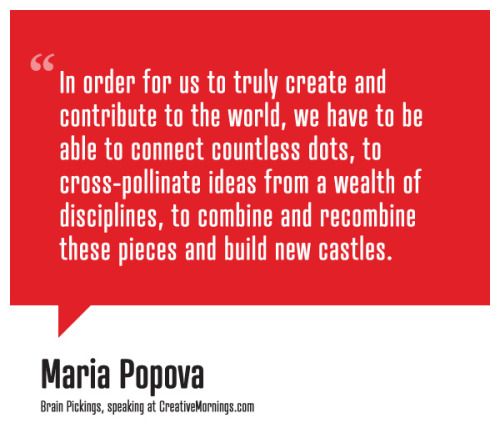
"The idea that in order for us to truly create and contribute to the world, we have to be able to connect countless dots, to cross-pollinate ideas from a wealth of disciplines, to combine and recombine these pieces and build new castles.

July 04, 2013

"[Writing and] Art is theft", Ctd


Maria Popova puts it, citing Charles Eames, wonderfully:
'I’m particularly taken with this bit affirming remix culture and combinatorial creativity:
"[Is design] a creation of an individual?No — because to be realistic one must always admit the influence of those who have gone before." 
Read it here.

July 02, 2013

Writing is hard Ctd with Ernest Hemingway


I produced the illustration of Mr Hemingway that you can see above recently with a comforting quote that soothes the disgruntled writer, blogger and other word maker:
"There is nothing to writing. All you do is sit down at the typewriter and bleed."
Powerful and emotive language that tells us even Nobel Prize winning writers struggle to put words onto paper. Then just as I was coming to publish this I came across a Brainpickings blog post by Maria Popova, 'Work Alone: Ernest Hemingway’s 1954 Nobel Acceptance Speech.' The stand out quote was the below. Not only is writing hard; it can be and often is a lonely process:
“Writing, at its best, is a lonely life.”
Related Posts Plugin for WordPress, Blogger...