Showing posts with label journalism. Show all posts

October 22, 2014

Joseph Pulitzer on the proper role of journalism

Cartoon of Joseph Pulitzer cartoon. More here.
Joseph Pulitzer was a Hungarian-American Jewish reporter turned newspaper owner, who owned the St. Louis Post Dispatch and the New York World. Joseph Pulitzer introduced the techniques of "new journalism" to the newspapers he acquired in the 1880s. His legacy lives on most prominently through the annual Pulitzer Prize and in an awareness of what the real role of the journalist is. He said that the role of journalism and the fourth estate is:
"An institution that should always fight for progress and reform, never tolerate injustice or corruption, always fight demagogues of all parties, never belong to any party, always oppose privileged classes and public plunderers, never lack sympathy with the poor, always remain devoted to the public welfare, never be satisfied with merely printing news, always be drastically independent, never be afraid to attack wrong, whether by predatory plutocracy or predatory poverty."
Joseph Pulitzer, May 10, 1883, quoted on the Times plaque. My previous post on the role of journalism here.
 

June 16, 2014

#FutureOfJournalism - New journalism and hyperlinks

The Independent published an article on how the internet is changing journalism and hyperlinks, yet it didn't include a single hyperlink in it. Look here for a great example of effective use of the hyperlink on the media law blog, Inforrm. Andrew Sullivan said of hyperlinks:
"The superficiality [of a blog] masked considerable depth—greater depth, from one perspective, than the traditional media could offer. The reason was a single technological innovation: the hyperlink… a blogger’s chosen pull quote, unlike a columnist’s, can be effortlessly checked against the original. Now this innovation, pre-dating blogs but popularized by them, is increasingly central to mainstream journalism. 
The blogger can get away with less and afford fewer pretensions of authority. He is—more than any writer of the past—a node among other nodes, connected but unfinished without the links and the comments and the track-backs that make the blogosphere, at its best, a conversation, rather than a production."
With the future of journalism in mind we should turn to the two headline reports. 

One the leaked New York Times innovation report called "one of the key documents of this media age." The guys at Vox looked at the report here.

Two, Sir Howard Stringer’s report for the BBC, here:
"Given Buzzfeed, for example, was only founded in 2006, this raises the question of why the BBC’s global digital reach is not more significant. It is impossible to escape the conclusion that the BBC is punching well below its weight in the digital world."
We should also give a nod to the 2014 Stead Lecture given by James Harding - 'Journalism today'.

Also to the 2014 Charles Wheeler lecture delivered by Robert Peston (@peston) here.

June 05, 2014

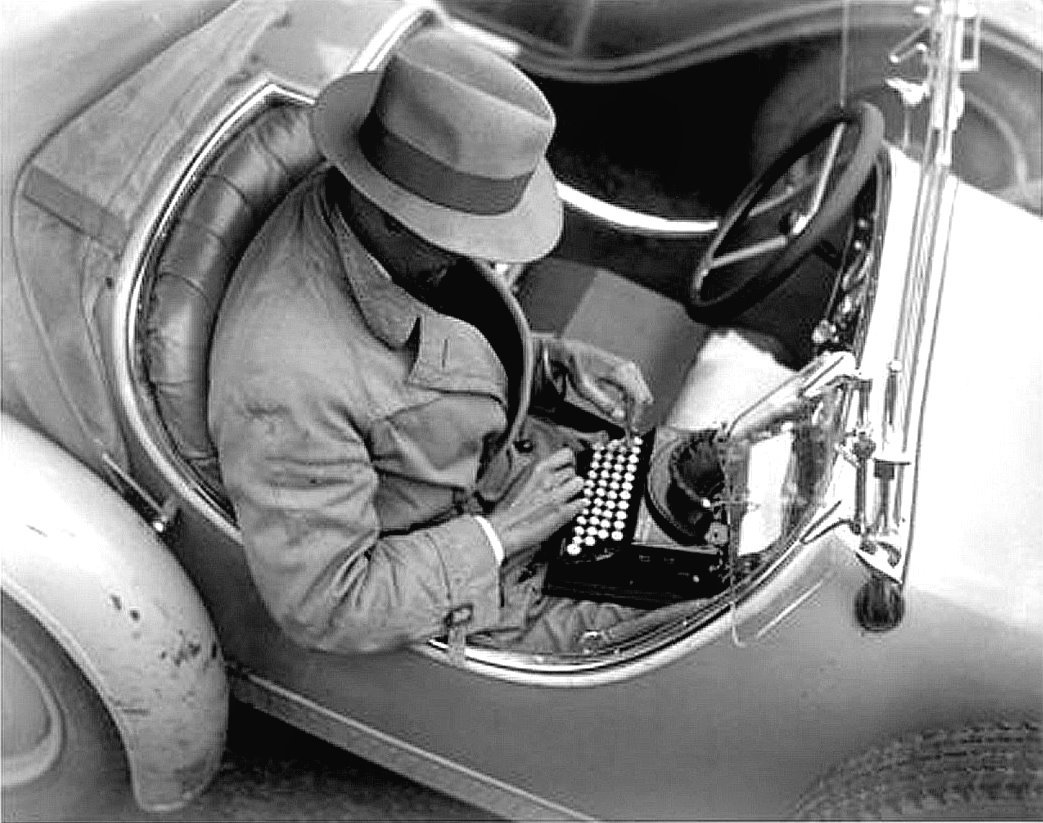
Hunter S. Thompson - Typing out the work of the best writers

Airman (2nd class) Hunter S. Thompson before his (honourable) discharge from the USAF in 1958.
Porter Bibb, a childhood friend of Hunter S. Thompson explained (8m) how the famous writer immersed and smothered himself in the work of many of the most famous writers of all time. He said:
"He chose, rather than writing original copy, to re-type books like The Great Gatsby and a lot of Norman Mailer, the Naked and the Dead, a lot of Hemingway. He would sit down there on an old type-writer and type every word of those books and he said, "I just wanna feel what it feels like to write that we'll."
Speaking with Charlie Rose in 1997, Hunter explained (9m) how this worked:
"If you type out somebody's work, you learn a lot about it. Amazingly it's like music. And from typing out parts of Faulkner, Hemingway, Fitzgerald - these were writers that were very big in my life and the lives of the people around me - so yea I wanted to learn from the best I guess."

June 02, 2014

David Carr (@Carr2n) - Always lament the present, Ctd


David Carr of the New York Times said (20m):
"This lament about a generation incapable of significant or long thoughts is a hardy perennial that comes up every ten years. Now we're worried about the Millennials. Before that we were worried about the Gen X'ers. Before that it was the punk rockers or the hippies, I forget which, that somehow had lost their ability to think critically about what's going on. I've been both. The problem and the old grampy-pants Pointing a finger at each and I think that we cycle through this." 
Video in full here. He also said here:
"Back in the day, for one thing… you know what, it wasn’t all that great."
Previous post in the series here.

May 30, 2014

The writer can never really stop, Ctd


Edna O'Brien said:
"I think that all writers are like that – your mind is always galloping, trying to write the thing you cannot write. That is one of the characteristics, one of the norms of writing."
Northern Irish poet and writer Nick Laird said in 2005:
"When I was a lawyer… I never stopped writing reviews and poems and articles. I’d do it in my lunch hour or after work. It didn’t matter how tired I was.
In January 2014 Nick said:
"I’m working on poems all the time. I was writing a poem this afternoon, before I came here. I’ve got other work—teaching at Princeton, writing articles and so on—but I’m pretty much always working on a poem." 
Precious post with Christopher Hitchens here.

May 02, 2014

A good blog is your own private Wikipedia


Writing in the New Yorker, Ian Crouch (@iancrouch) wrote an article with an interesting headline, 'The curse of reading and then forgetting.' Ian Crouch explained a recent experience of reading and suddenly remembering:
"Recently, a colleague mentioned that she had been rereading Richard Hughes’s “A High Wind in Jamaica,” which was first published in 1929 and is about a group of creepy little kids who become the unwanted wards of sad, listless pirates. She praised it, and her recommendation sent me to Amazon. The title was familiar, as was the vibrant cover of the New York Review Books reissue. One cent and $3.99 for shipping, and the book was on its way. A couple of weeks later, I opened to the first page and started reading. By the fifth page, I realized that I had read this novel before, and pretty recently, about three years ago, when another colleague had also praised it and lent me his copy."

April 11, 2014

Understanding journalism and the proper role of the Fourth Estate


As Andrew Sullivan said, "Every now and again, it’s perhaps worth revisiting the entire definition of journalism." At present, journalism and the media is out of step with the original and traditional model. The traditional model is based on the premise, as Glenn Greenwald said, that:
"Basic to political science and the American founding and to human nature is that people cannot operate and exercise power without checks or they’ll inevitably abuse it."
As Daniel Ellsberg, the Edward Snowden of the 20th Centruy, said:
"Secrecy corrupts, just as power corrupts." 
Therefore it falls upon journalism and the free press, Edmund Burke's "Fourth Estate", to shine a light upon the powerful and those who want to act in secrecy. Journalists are to be the adversaries and opponents of the powerful. Their job is to be in confrontation against, and not in collaboration with the government. Glenn Greenwald said July 2 2013 on Fox and Friends:
"Thomas Jefferson, 250 years ago, said those who most fear investigations are the ones who attack free press first. This is what journalism is about, shining a light on what the most powerful people in the country are doing to them in the dark. "

April 10, 2014

The relationship between money and words will be corrected, Ctd


Andrew Sullivan said during a March 2014 address to Harvard University on the fall of journalism to advertising and PR:
"Suddenly this great [internet] freedom became a great liability. [The internet] was destroying their profits. Eradicating lots of things they were able to do."
Sinead Gleeson (@sineadgleeson) wrote an article in the Guardian on how writers are poorer and struggling to survive, eat, pay rent in the internet age. Joanna Kavenna was quoted as saying, ‘Being a writer stopped being the way it had been for ages. It wasn’t what I expected.’

Yet Shane Smith (@shanesmith30), VICE envisions a change and a correction in the relationship between words and money:
"Everything online is free, we have been a free magazine, everything we do online is free. I think we are going to move towards more of a subscription model. I think that young people are realizing that I’d rather be a part of it. You know Kickstarter has been really successful. On a business sense, on a philosophical sense, where people realize if I believe in something I’m going to actually be part of that. Which I think is incredibly positive. And I think that that’s going to be the next wave of how people are going to get things done online."

April 03, 2014

What a time to be alive - The great opportunity of new media journalism, Ctd


Shane Smith (@ShaneSmith30) co-founder and CEO of Vice (@VICE)

Shane Smith (@ShaneSmith30) said at Internet Week NY 2013 here:
"It’s the best time ever in history to be a content creator."
He also said here:
"It’s shifting towards the content-creator - it’s literally the best time in history... creating content is the best business model out there at the moment."
Interestingly, he sees India as the measure of the future, by grace of its booming youth population:
"As goes India, so shall go the world."
Jonathan Ives, Apple designer, said:
"We are at the beginning of a remarkable time, when a remarkable number of products will be developed. When you think about technology and what it has enabled us to do so far, and what it will enable us to do in future, we’re not even close to any kind of limit. It’s still so, so new."
Shane explained the VICE media model during his Internet Week talk:
"We didn’t start out to be a news company... we started out as an entertainment company. We were sort of pushed into news. A, we enjoy it. B, our audience pushed us into it."

March 27, 2014

The great opportunity of new media journalism


This is for @otrjasona @Jason_A_Murdock @bartoncreeth @LyraMcKee and @dmcbfs. Please watch the video above.

Legacy media is moribund. Legacy media is on a journey of managaed and inexorable decline. It's steady as she sinks. Yes, the relationship between words and money is off. But it will be corrected.

The decline of legacy media isn't all a matter of money. The decline of legacy media is the making of two entirely avoidable circumstances.

One it has lost it's soul. It has capitulated to advertising and public relations. It has been co-opted by those who govern us. As George Orwell said:
"Journalism is printing what someone else does not want printed: everything else is public relations."
Our press isn't this. Our press is flat, serving and servile. It isn't curious or courageous, partisan and adversarial. We need to fix that. Only a vigorous and voracious press will keep countries and governments honest. Our head of government, Peter Robinson wants the press to be more positive and cuddly. But if the press is accountable to Peter Robinson, who is Peter Robinson and our government accountable too?

Two, journalism has failed to iterate and innovate.

March 25, 2014

Will Social Media Change – or Even End – Journalism As We Know It?

[This is a guest post by Sarah Brooks from Freepeoplesearch.org]

"Social media are not so much mere tools as they are the ocean we’re going to be swimming in — at least until the next chapter of the digital revolution comes along."

- Geneva Overholser, for the Nieman Foundation for Journalism at Harvard

Social Media services and websites have experienced phenomenal growth over the last decade – Facebook and Twitter users number in the millions – and the impact of so many people from all walks of life upon the process by which information is shared cannot be overstated. And one area that has likely felt the impact more than any other is the field of journalism.

March 05, 2014

Glenn Greenwald on the abuse of state power through terror laws


Glenn Greenwald said here of the lessons learnt from the Church Committee:
"The lesson of the Church Committee from the 1970s is that when you allow people in government to spy on Americans in the dark with no accountability and without warrant, they abuse that power and that’s what’s happened; it’s rampant abuse and it needs sunlight."
Glenn Greenwald has previously also cited Cicero who said: "Laws are silent in times of war." Andrew Sullivan (@sullydish) said of Glenn Greenwald and the abuse of terrror laws:

"In this respect, I can say this to David Cameron. Thank you for clearing the air on these matters of surveillance. You have now demonstrated beyond any reasonable doubt that these anti-terror provisions are capable of rank abuse. Unless some other facts emerge, there is really no difference in kind between you and Vladimir Putin. You have used police powers granted for anti-terrorism and deployed them to target and intimidate journalists deemed enemies of the state. 
You have proven that these laws can be hideously abused. Which means they must be repealed. You have broken the trust that enables any such legislation to survive in a democracy. By so doing, you have attacked British democracy itself. What on earth do you have to say for yourself? And were you, in any way, encouraged by the US administration to do such a thing?"

March 04, 2014

We need a new generation of journalists and politicians


It's self-evident that the political class in Northern Ireland is entirely out of step with a people rapidly advancing in civilisation. As Mick Fealty said:
"The irony is that in general terms, sectarianism is on the slide, and mixed marriages are up and the wider population is beginning to adopt a more open view of how the world works than many of their most senior politicians." 
Politicians stand as fountainheads for the most extreme: talking singularly about the past, parades and victims. Yet, as Brian Rowan said of the parading stalemate of summer 2013, "The standoff is in one part of Belfast, and here and everywhere else, people have other worries - food, bills, jobs, education."

The effect of this cause is apathy and indifference which only sustains the bogus cause. A negative and hideous feedback loop. Taking a line from Alex Kane, moderate unionism and nationalism has been replaced with opt-out-couldn't-care-less-about-the-whole-thing-anymore unionism and nationalism. We need to break and replace the negative with a virtuous feedback loop.

This requires a two strand remedy and the dismantling of the older order. Northern Ireland needs a new generation of journalists and new politicians.

A New Generation of Journalists

Micheál Martin leader of Fianna Fáil said:
"Fundamentally, a public discourse once solely focused on conflict has not evolved a new approach. There are only a handful of journalists who pay any attention to the wider cultural, social and economic dimensions of relations within Northern Ireland and between North and South."
A New Generation of Politicians

Alex Kane said:
"Northern Ireland needs a new political generation, a new agenda and new political parties. It needs people who will work together to make Northern Ireland a success. It needs a generation of politicians who will refuse to accept that stalemate, mutual veto and same-old, same-old elections are the best we can hope for."
Previous posts on "The Two Worlds of Northern Ireland" series here, here, here, here, here and here.

February 17, 2014

@Jason_A_Murdock - Writing is hard, Ctd

Editor of Northern Ireland's digital journal Off The Record, Jason Alan Murdock (@Jason_A_Murdock) guest writes on The Ideas Workshop. He joins the 'Writing is Hard' series and shares his thoughts.

Writing Is Hard

​Starting off a 'writing is hard' segment with the proclamation that the literal process itself isn't actually that difficult seems like a bit of a cop out. But bear with me. Writing is a process many learn at a young age. At its most basic it is letter after letter, word after word. But before I start to sound like the world's worst substitute teacher I will say that using these familiar words and letters in a constructive, meaningful and emotive way can be a very difficult task indeed. Many have grappled with turning words into 'art' or something resembling a legacy. Orwell, Hitchens, Salinger, Yeats, Frost – men all recognised by their surnames alone – live beyond the ashes because of their ability to craft powerful sentences. The human body can rot, but the written word lives on. It must be said however, that whether you find writing hard or not will depend on your intentions. After all, there exist many crafts that use words as a tool and some will be harder to master than others. It could be journalism, poetry, short stories, blogging, comic sketches or writing a book or novel – all demand different skills, techniques and various blood/alcohol levels.

February 05, 2014

Maria Popova and @brainpickings - The best the Internet has to offer


Legal blogger David Allen Green (@DavidAllenGreen) (@JackofKent) gave his take here on the best legal commentary the Internet has to offer. Washington Post blogger and darling of the Internet Ezra Klein (@EzraKlein) warrants note as he spins off from Wonkblog to create an altogether new form and breed of Internet journalism. One that changes the model from one of "relentless presentism" to "persistent content". Vague. I know. We're still waiting to see what this actually means.

February 04, 2014

Arm folding and mirror holding, Ctd The power of the political cartoonist


Menzies Campbell said:
"Cartoons are a traditional feature of British political coverage and the cartoonist's pen stroke has often conveyed judgments more deadly than anything journalists would dare to express."
They're called "ink-stained assassins" for a reason, as The News Statesman put it here. As Diane Abbott said:
"The idea of John Major in his underpants: he used that over and over and it became part of the political lexicon. It spoke of his timidity, caution and greyness."
Likewise, of Ed Miliband, Tim Benson wrote in the book 'The Best of Britain's Political Cartoons 2013':
"[Peter] Brooke's believes that [Ed Miliband's] comparison with Wallace has damaged Miliband's chances of ever becoming prime minister. This is because, like Wallace, Miliband's also appears hapless, making the public's perception of him unsuitable prime ministerial material."

January 17, 2014

The surrender of journalism to PR

 
Andrew Sullivan said at the end of 2013 here:
"The surrender of journalism to advertizing and public relations – not alliance with, but surrender to – was the biggest media story of 2013 that the media almost didn’t cover at all."

June 20, 2013

Christopher Hitchens - A writer can never truly stop


Speaking on C-Span, Christopher Hitchens explained how a writer can never truly stop or switch off. For a writer is a professional without a set clock. A writer is person with a vocation who is always absorbing so that he or she can then hold a mirror up to society. A writer is above all this: a person with the responsibility to use their gift for they occupy an important role in society.
"If you’re a self-employed writer, there’s a tendency to always feel guilty anytime you’re not working, because you never quite know when you’ve stopped because you don’t have office hours or an employer."
From 22 minutes in the video above, also here. Also here.

June 17, 2013

An Open Cover Letter

  
Hey guys,

First up: I love the Dish. I love what it does for Dishheads, non-Dishheads, for myself, my thinking and for driving fresh thought and for creating new models of writing and online journalism.
But why would the Dish that does so much to contribute authentic writing to the internet want to be in any way associated with me, Brian Spencer - a dude from Ireland?

June 15, 2013

Christopher Hitchens - The authority of bloggers


At 7 minutes 30 seconds in the video above and here Christopher Hitchens talks about the authority of the online writers.
"I became a journalist because I didn't want to have to rely on the press for information. I'm very sorry for people who do think that's what they're getting when they buy the New York Times in the morning. I only read it to make sure I know what everyone else thinks is going on. It's useful to know what people think is the news. None of my sources are from the press... Yes, from bloggers and their allies I get most of what I think I need to know and I'm very happy at the possibility of, the evident likelihood now of the decline of the networks and of the flagship newspapers, which seem to me to be engines of reassurance and consensus and bad writing, poor English. Let it all die, I don't give a damn."


In an earlier post here on how Hitchens write, Christopher said: "I don’t use any of the new technology stuff."
Related Posts Plugin for WordPress, Blogger...