 |
| Philip Roth by Zach Trenholm |
"A word after a word after a word is power."

|
| Philip Roth by Zach Trenholm |
"A word after a word after a word is power."

"Breakfast? No! None of that eating rubbish. You get down with an empty stomach. So you create this system of rewards – if you do this, you can have that. Otherwise you’d never get any work done… I take an hour off and work for an hour. And I work until late, six days a week. The other general rule is, no lunch with anybody. That’s an awful waste of time. And I would never drink in the day. Ever."
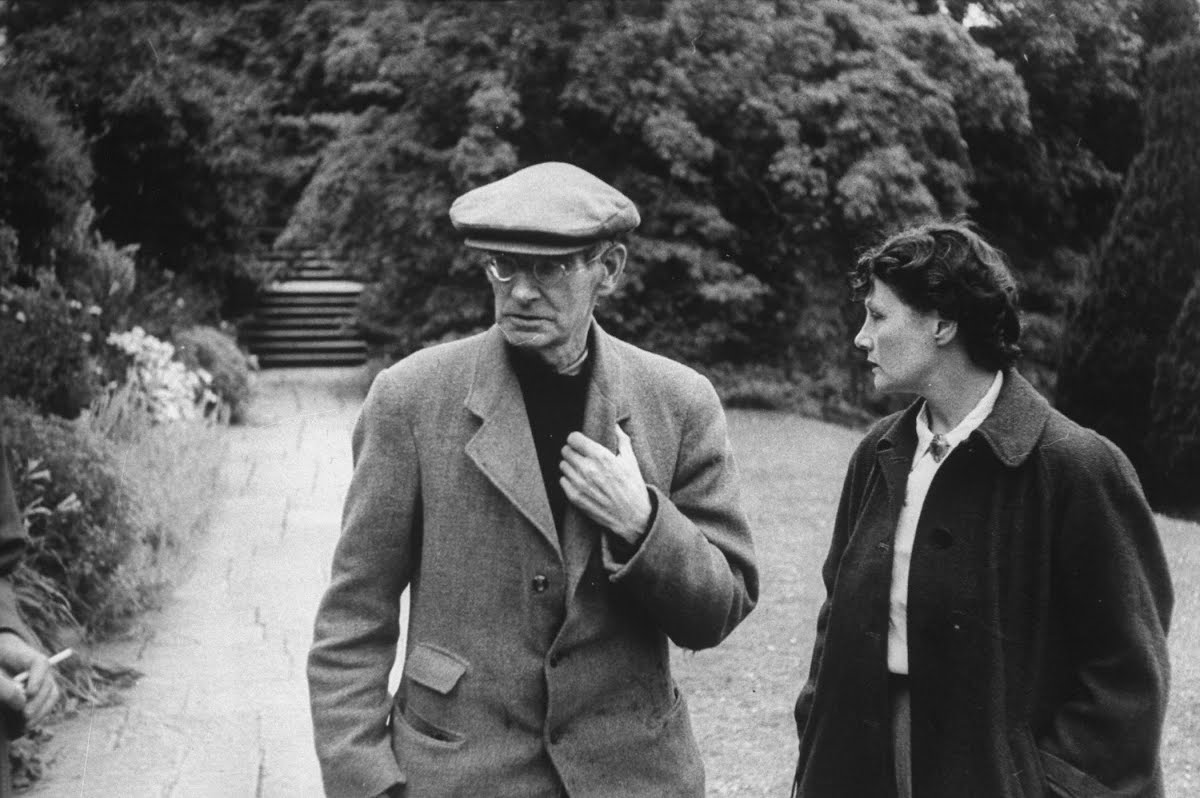 |
| Irish writer Sean O'Casey and his wife Eileen Reynolds |
"When I write a new play. When I sit down to try to write a new play, I’ve had the experience of many plays before. Yet that new play that I am going to try to write gives me the same agony, the same trouble, the, same effort, the same Herculean work as the very first play I ever wrote gave to me."Christopher Hitchens said the same thing:
"I hate to agree with George Will about this… The truth is, yes there is nothing like not writing for making you unhappy and if you have the compulsion then the only problem that you’ll have is, you surrender to this compulsion more and more and, you’ll find [writing] gets harder the more you do it. That seems a shame. It should get easier, it should become more like a facility for example. It becomes more difficult and it becomes more difficult because you are reading more and more work by better and better people and you’ve lost the sheer nerve and the blind solipsism that allowed you to think you could try it when you were young before you had made any proper comparisons. So it gets much more nerve wracking and much more difficult in every way costly for you and no doubt for your readers."Samuel Beckett on writing more generally said in 1954:
"It’s hard to go on with everything loathed and repudiated as soon as formulated, and in the act of formulation, and before formulation."Beckett also wrote:
"I realized that Joyce had gone as far as one could in the direction of knowing more, [being] in control of one’s material. He was always adding to it; you only have to look at his proofs to see that. I realized that my own way was in impoverishment, in lack of knowledge and in taking away, in subtracting rather than in adding."
 |
| George Packer - New Yorker |
"I needed to know how does one become a writer, and so I just read straight through what was then the only collection of George Orwell’s essays and journalism and letters… I became a slavish emulator and imitator for a while in my 20s. I think it’s a good way to learn how to write - To find a writer you feel some affinity for, and just master their prose style, their rhythms, get the cadences into your own nerve system and then try to find your own way into it."As I noted in an earlier post, Hunter S. Thompson did the same thing, modelled himself on great writers, and he explained how he did this on Charlie Rose:
"If you type out somebody's work, you learn a lot about it. Amazingly it's like music. And from typing out parts of Faulkner, Hemingway, Fitzgerald - these were writers that were very big in my life and the lives of the people around me - so yea I wanted to learn from the best I guess."
