June 26, 2014

Odd bedfellows - Anti-agreement republicans and unionists

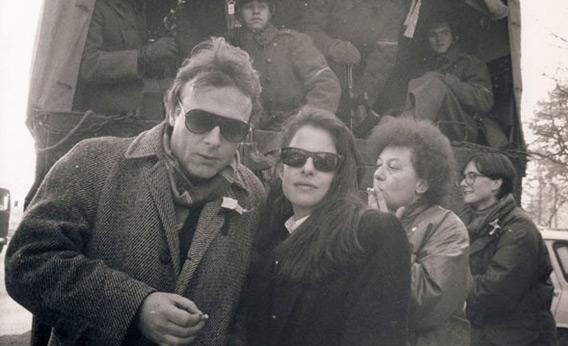
Danny McBrearty, former commanding officer of the IRA’s Derry Brigade and former comrade of McGuinness said:
"Nothing surprises me any more about Martin McGuinness, so if he does give the Queen of England a guided a tour around the jail where republicans fought and died for their principles, I would not be shocked… Authentic republicans should take no part in or welcome this visit to the Crumlin Road jail. Instead they should be outside protesting against the presence of a British Queen in a prison where their comrades suffered so much. As for McGuinness - he is only shaking hands and guiding around his true boss."
Linda Nash on Martin McGuinness said:
"Does Martin [McGuinness] forget that the Queen decorated the Parachute Regiment and that they remain decorated? Can you sleep at night having given orders to young Irish men and women to attack the Queen´s forces when many of these men, women and teenagers were then murdered? I hope you are happy with your new found friends Martin. For they are the employers of the men who murdered our loved ones. Your actions, in my opinion, are traitorous."

June 20, 2014

Herb Block - The coiner of "McCarthyism"


In this video interview (at 8m25) Herb Block explains how he cointed the famous terms, "McCarthyism".
"Yea [I invented McCarthyism], apparently so. That's the first use made of that word that I know of. I remember how it originated, because they wanted to put something on that top barrel, and you couldn't call it McCarthy himself, and you wouldn't say 'McCarthy techniques" or so on. I thought well we could maybe use just one word, "McCarthyism". And it caught on."
Video in full here.

June 19, 2014

Morten Morland (@mortenmorland) - The cartoon process with Michael Gove


Morten Morland walks us through how he began drawing Michael Gove. I have noticed this. That there are people who are deceptive. You look at them and think, Oh they're easy to draw. Then you draw them and it won't happen. Yea that's the deceptive type. Any way here's what Morten said:
"The sketch above is of Michael Gove, who I’ve always found quite difficult to draw despite his wonderfully peculiar looks. It’s a bit like with Ken Clarke. There’s too much to pick up on! In Gove’s case it doesn’t help that his voice is even funnier than his appearance, which somehow leaves you trying to draw sound. 
And if that wasn’t enough, he’s deviously followed Jack Straw’s lead and ditched his trademark glasses, revealing eyes that are only half the size of those he used to present. 
Fortunately though he’s got lips that can pout for England, and when Gove becomes just a tad more famous, those alone should be able to carry a caricature."
A broader observation:
"The best caricaturists have always been those who can capture that one line or feature that tell the whole story, so to speak. I wouldn’t count myself among them, as I tend to elaborate and then elaborate some more. It’s a confidence issue more than anything else, and I hope I’m getting better at it. This applies to cartooning in general as well. How you compose your image – and how you edit it. 
The multi-award winning cartoonist Mike Tombs, originally from Coventry in England, has been one of Norway’s most successful, controversial and misunderstood cartoonists for three decades. Outside Norway his work has appeared in Punch, New Statesman and the Observer among others…"
In full here

June 18, 2014

Christopher Hitchens on mass, warrantless surveillance


In 2006 the American Civil Liberties Union filed a lawsuit in Detroit against the NSA. They accused the NSA of violating the US constitution by eavesdropping on people without court oversight. The case represented the first legal challenge to the surveillance programme. It sought an immediate end to wiretaps, saying they violate constitutional rights to privacy and free speech. 

The ACLU suit included Christopher Hitchens. He said in a full written statement and published on the ACLU website:
"People will say it’s wartime and we have a deadly enemy, and I agree with that. I was in favour of the war in Iraq and Afghanistan very strongly, but it is even more important in such a time that we don’t give away power to the unaccountable agencies that helped get us into this in the first place. It is extremely important we know what the rules are and there has to be a line drawn. You mustn’t turn emergency or panic measures into custom or practice."
He also said here, and echoed the bold words above:
"[It is] imperative that we do not take panic or emergency measures in the short term, and then permit them to become institutionalised."
He spoke briefly of the lawsuit in a speech here
"I am currently a plaintiff in a lawsuit brought by the ACLU against the National Security Agency, for doing what it knows how to do, which is bug American citizens instead of doing what it appears not to know how to do which is how to predict terrorist attacks in the United States."
My previous posts on Hitchens on Northern Ireland here, on segregated schools here and on the "parasitic class" here. On Albert Camus and "the rats" here. On Northern Ireland's "barbaric, sectarian leaders" here. His comment that anti-semites are "mentally and morally unwell" here. On Vaclav Havel here. On the US First Amendment here, on the US as an empire and class-based society here, and on how to succeed here. On women and poverty here. On the US Declaration of Independence here. Christopher Hitchens explained that he left the UK in part because of the libel laws, see here. Christopher Hitchens spoke here about the authority of bloggers and online writers (7m30s) (original video in full here). Hitchens on "being bored" as the worst sin here. On why Hitchens is such a compelling writer here. On cliché here. On socialism here. On Iran's "Baby Boomerang", here. On the need to defend the principles of the Enlightenment here. On thought crimes here. On the "encouraging signs of polarisation" here. On feeling "envious of someone who is young and active and starting out" here. Christopher Hitchens on the anti-Columbus movement. On opinion polls here. On the term "political spectrum"here. On Obama's Nobel Peace Prize here. Hitchens on how writing is hard, here. Hitchens on how a writer can never really stop, here. Hitchens explains why he is no longer a socialist, here. On the "some Christians fell into error" excuse here.

June 17, 2014

"The worst discrimination has come from closeted gay men"

To the Guardian, Mark Harold wrote a letter and said, "The worst discrimination has come from closeted gay men." Following an interview with Lord Browne, the Guardian (@guardian) asked readers to share their stories about coming out as LGBT in the workplace. Here's what Mark Harold said in full:
"I am a senior executive of a FTSE 100 company in my early 50s, and have been out at work since my mid-30s. The worst discrimination I’ve come across has come from closeted gay men. They live with insidious lies, and are often ruthless in protecting those lies. It’s important that gay men support each other, so the more who come out of the closet in business, the better."
The story of Sam “Skelly” McCrory is remarkable. This is a racist, sectarian, homophobic skin-head turned open and activist homosexual. He said to Henry McDonald in the Guardian:
"Even before I joined the UDA, I used to pretend I was homophobic. I went along with the crowd who were then close to the National Front. I hated Catholics, blacks, Jews and gays - even though I was gay myself. I was hiding my true self. I used to lie to the rest of C Company that I was having a relationship with a policewoman. Only Johnny knew it was a man. The lads used to ask me "Who's that policewoman you are shagging?" I couldn't tell them it was a man, it was such a macho, homophobic culture."
Paul Berry of DUP was a similar character. A religious loud-mouth and virulent homophobic... who was caught with a rent boy. Wikipedia reports it like this:
"Just days before the [2005] election, the Sunday World newspaper claimed that [Paul] Berry had met a man for a massage, with whom he had made initial contact via a gay chatroom, in a Belfast hotel room booked by Berry under a false name. Berry claimed that he was seeking treatment for a sports injury, and said he was considering legal action against the paper. He was not elected and was the only DUP candidate to experience a fall in their share of the vote in favour of the Ulster Unionist Party
Weeks later the DUP who, since 1977 have maintained a Christian fundamentalist stance on gay rights, and launched a campaign known as Save Ulster from Sodomy, suspended Berry from membership and commenced disciplinary proceedings. Berry launched a legal challenge but in February 2006 dropped these proceedings and resigned from the party."

June 16, 2014

#FutureOfJournalism - New journalism and hyperlinks

The Independent published an article on how the internet is changing journalism and hyperlinks, yet it didn't include a single hyperlink in it. Look here for a great example of effective use of the hyperlink on the media law blog, Inforrm. Andrew Sullivan said of hyperlinks:
"The superficiality [of a blog] masked considerable depth—greater depth, from one perspective, than the traditional media could offer. The reason was a single technological innovation: the hyperlink… a blogger’s chosen pull quote, unlike a columnist’s, can be effortlessly checked against the original. Now this innovation, pre-dating blogs but popularized by them, is increasingly central to mainstream journalism. 
The blogger can get away with less and afford fewer pretensions of authority. He is—more than any writer of the past—a node among other nodes, connected but unfinished without the links and the comments and the track-backs that make the blogosphere, at its best, a conversation, rather than a production."
With the future of journalism in mind we should turn to the two headline reports. 

One the leaked New York Times innovation report called "one of the key documents of this media age." The guys at Vox looked at the report here.

Two, Sir Howard Stringer’s report for the BBC, here:
"Given Buzzfeed, for example, was only founded in 2006, this raises the question of why the BBC’s global digital reach is not more significant. It is impossible to escape the conclusion that the BBC is punching well below its weight in the digital world."
We should also give a nod to the 2014 Stead Lecture given by James Harding - 'Journalism today'.

Also to the 2014 Charles Wheeler lecture delivered by Robert Peston (@peston) here.

June 14, 2014

Morten Morland (@mortenmorland) and the "Cartoon-Test"


Back in 2007, Morten Morland wrote about the LibDem leadership election. He predicted Nick Glegg's election would lead the party to oblivion. On what premise? Because Clegg is so exceptionally ordinary to draw and therefore exceptionally unremarkable to the electorate. "Mr. Some Bloke embodified" as Morten put it. He said:
"It’s simple, really. If a person is easy to draw, he’ll do well [in politics]. Because the likelihood is he’ll have other interesting characteristics too, which will make him appealing to journalists, thus raising the party’s profile in the media. And people watching are more likely to remember him, which is a bonus!
Morten then put Nick Clegg through what he called the "cartoon-test":
"A quick cartoon-test shows that Nick Clegg, probably the favourite in the party at the moment, will lead the party into eternal oblivion, if elected. 
He is Mr. Some Bloke embodified – despite the fact that he can speak several languages. 
I did a couple of quick sketches, and worringly for him, the best caricature came after I in frustration drew a lifeless mask. 
People will see Nick Clegg on TV and wonder whether he’s that guy from marketing whose name they can’t recall – or someone they’ve met at All Bar One.


Morten then put Chris Huhne through the "cartoon-test":
"Chris Huhne on the other hand, is better. Not great, but better. He’s got a prominent crazy eye – a feature that he famously shares with both Maggie and Tony. His mouth is similar to that of a hamster…or a mouse, and remember, those ears will keep growing. 
Between Clegg and Huhne, there really is no contest.

June 12, 2014

Art is theft, Ctd


Above is a Michael Ramirez cartoon, dated 17th Dec. 2003. Below is one by Morten Morland, from what looks like 2004. The second is not a copy or a theft, but an example of how artists can borrow and replicate; or, as could be the case, coincidentally come up with strikingly similar ideas. 

June 11, 2014

Ian Knox at work


The above is Ian Knox working ahead of the last ever episode of Hearts and Minds. Here he is producing a piece for the If You Ask Me segment written and narrated by Malachi O'Doherty. Watch here and see screen grabs of the end result.

Other posts on Ian Knox. Slideshow of Ian Knox riding his Penny Farthing here. Ian Knox riding his Penny Farthing during the Giro 2014 here. Ian Knox and friends on their Penny Farthings for the Hume/Dunlop anniversary cycle here. Ian Knox speaking with the Detail here. Chatting with Michael Smiley here. My blog post on Ian Knox's cartoons of loyalists and republicans, here. Ian Knox and I drawing together in the Black Box, Belfast in 2013 here. Ian Knox and I drawing at McHugh's, Belfast here. My coverage of Ian Knox's December 2013 exhibition, 'Lifelines and Deadlines' here. A selection of photos of Ian Knox at work here. My article here on why an Ian Knox prize to encourage satire and political cartooning like the Herb Block foundation in America which rewards and encourages future talent. A notice about my joint exhibition with Ian Knox on Slugger O'Toole is here. Ian Knox talking about flags, the Union and loyalists here.

June 10, 2014

Glenn Greenwald (@ggreenwald) and gate-keeping the Snowden leaks


This is the charge repeatedly laid at Greenwald's door. Andrew Sullivan said it:
Greenwald flatly denies this charge, as he did here:
Yet Glenn Greenwald has always insisted on full editorial control. He started blogging in 2005 and by the time he reached Salon he maintained the self-direction and individualism of an independent blogger. This independence continued with his move to the Guardian. As he said:
"I will write daily at the U.S. edition of The Guardian, which is based in New York, and will do so exactly the same way as I have here [Salon]: with full editorial independence and the same type of readership involvement and support upon which I’ve long relied, including a vibrant comment section. In addition to the daily writing, I’ll also write a more traditional once-a-week column there."
Andrew Sullivan further wrote here:
"The way the US government has behaved since 9/11 – its outrageous and criminal secret activity – seems to me to tilt the question in favor of the whistle-blower and the journalist, and some legal leniency – certainly for the journalist. But in all times there is a balance between these two contradictory democratic necessities – government secrecy and transparency – and at some point, the rule of law is the rule of law. It’s not perfect, but it’s better than all the alternatives. 
Right now, for example, what the public knows and does not know about the NSA is determined by Glenn Greenwald. He has in his possession vast troves of information that he is keeping secret, until he decides it will becomes public. He is picking and choosing what to divulge and doing so over an extended period of time. In that sense, he is close to being an alternative government, but without any internal checks and balances, and with no recourse for the public through the democratic system. What Mike is insisting is that this too is a genuine problem from the point of view of the public interest. Who gets to decide what the public knows? Right now, it’s Glenn. And I bet his security system for his data is extremely strong. He doesn’t want any leaks either, does he?"

June 09, 2014

Glenn Greenwald (@ggreenwald) - Censorship makes a megaphone not a muzzle of speech

Glenn Greenwald (@ggreenwald) said:
"Beyond all the other reasons not to do it, free speech assaults always backfire: they transform bigots into martyrs."
New York Times wrote an article, 'For Hateful Comic in France, Muzzle Becomes a Megaphone.'

June 08, 2014

Elaine Sturtevant - Art is theft, Ctd

In an obituary on Elaine Sturtevant, Hans Ulrich Obrist wrote:
"[Elaine Sturtevant] made her controversial artistic debut in 1965 at the Bianchini Gallery, New York, when she repeated Andy Warhol's Flowers, a series of silk-screen prints that he had shown a couple of weeks before. Today it is par for the course for images to be sampled, re-used and edited, but in the early 60s, acts of appropriation were yet to become a staple of the art world."
On the occasion of her 2012 retrospective, Sturtevant: Image Over Image, at the Moderna Museet, Stockholm, Elaine Sturtevant said:
"What is currently compelling is our pervasive cybernetic mode, which plunks copyright into mythology, makes origins a romantic notion, and pushes creativity outside the self. Remake, reuse, reassemble, recombine – that's the way to go."
According to Alexis Petridis, Gerald Scarfe and Ralph Steadman fell out after Steadman's first wife accused Scarfe of plagiarism.

Oliver Jeffers on art as theft here.

June 07, 2014

Malcolm Jones - Art is theft, Ctd


In an article, 'There’s Nothing Wrong—and a Lot That’s Right—About Copying Other Artists' Malcolm Jones said:
"I learned to draw and paint on my own, and I did it by copying."
He also said:
"I understood more about Vermeer by painting my own Vermeer… than I had ever learned by simply staring at his paintings."
Oliver jeffers said the same:

"Any opportunity I get to see John Singer Sargent, I do. For technical ability. That’s how I learned how to paint, by dissecting his work and trying to work out, how does he make that look like an ear but he’s only done three strokes?"

Oliver Jeffers has previously spoken on art as theft here. Coco Chanel said:
"Only those with no memory insist on their originality."
Andrew Sullivan wrote a piece, 'In defence of duplicating art'.

Previous posts, Julian Opie on art as theft here.

June 06, 2014

Brendan Flanagan - "[The pub is] an unrivalled space for civic discussion"

Members of the Inishowen Civic Forum, including Tim Stampton, Patrick McCarroll, Ros Harvey, Jim McCarroll, Francis Faulkner, Brendan Flanagan, John Madden, Maragaret Tees, Doris Russo, Jim Fernand, Pat Heaney, Garret Hitchcock annd Alan Teer.
Brendan Flanagan wrote:
"Ironically, a feature of economic recession, where there is a welfare safety net, is that reflective people engage in collective philosophising. These people, experienced in formal and existential education, have time to think and ruminate on matters beyond the immediate. 
Ireland currently enjoys the most highly educated population in its history and therefore the best equipped for philosophical analysis of current problems and issues. It is ironic then that this phenomenon is also accompanied by the highest levels of anomie, of alienation. This is evidenced in electoral indifference, opinionated egoism, failure to educate for empowerment, the erosion of civic equality. 
Those who take time to reflect become ever more detached from civic society as they feel powerless to change what they conclude needs changing."

June 05, 2014

Hunter S. Thompson - Typing out the work of the best writers

Airman (2nd class) Hunter S. Thompson before his (honourable) discharge from the USAF in 1958.
Porter Bibb, a childhood friend of Hunter S. Thompson explained (8m) how the famous writer immersed and smothered himself in the work of many of the most famous writers of all time. He said:
"He chose, rather than writing original copy, to re-type books like The Great Gatsby and a lot of Norman Mailer, the Naked and the Dead, a lot of Hemingway. He would sit down there on an old type-writer and type every word of those books and he said, "I just wanna feel what it feels like to write that we'll."
Speaking with Charlie Rose in 1997, Hunter explained (9m) how this worked:
"If you type out somebody's work, you learn a lot about it. Amazingly it's like music. And from typing out parts of Faulkner, Hemingway, Fitzgerald - these were writers that were very big in my life and the lives of the people around me - so yea I wanted to learn from the best I guess."

Jonathan Jones - Art is theft, Ctd

Rembrandt, Self Portrait at the Age of 34.
Jonathan Jones wrote an article in the Guardian, 'Contemporary art isn't original – even copying has been done before.' He said:
"Good artists copy, great artists steal," said Pablo Picasso. Or at least he gets the credit for saying it. Perhaps he pinched the words from Oscar Wilde. For there truly is nothing new under the sun, or not entirely new, anyway. Originality does not burst from an artist's head like an alien entity, but is a subtle game of variations and transformations out of which, once in a while, comes the shudder of true artistic surprise.

June 04, 2014

Talk not walk, facts not flags - Making the "unremittingly" and "unrelentingly positive" case for the union


Scottish unionists campaigning for a "No" vote won't be waving the Union flag, (because it's associated with extremists) but will be bigging up the Union and Great Britain by looking at the economic and social facts and figures. 

If only our ever-so brutish, sorry I mean British, disLoyalists would take one second to look at the actual facts and the actual figures, the actual census data, poll data, the back of our currency and they would soon see that the Union is stronger than ever. No-one is chipping away at their British identity but those who say their is a "holy war" and a nazi-style assault against "the protestant-unionist-loyalist people".

David Cameron has frequently said that the Union will be won by making the "unremittingly positive" case. In an interview with BBC News, the Prime Minister David Cameron said:
"That’s my whole argument, which is go back to the big picture, and I think this family of nations is better off together. Not just is better off in the United Kingdom, but we in the rest of the United Kingdom think we’re better off with Scotland that we want you to stay. That argument is one that is unremittingly positive about the success of this family of nations and how we should keep this family together. 
I choose to make a positive argument just as I choose to make a positive argument about the defence jobs in Scotland, and financial services jobs here in Scotland, about jobs in oil and gas. We’re better off, Scotland’s better off, we’re all better off if we have the backing of the United Kingdom, a top-ten economy, behind these great industries."
He has even used the term, "unrelentingly positive"Henry McDonald wrote:

June 03, 2014

The forever problem of racism

Racism is nothing new but a perennial tension that exists as cycles of immigrants assimilate and they transition from foreigner to indigenous population. Yesterday's foreigner is today's native. Here's two examples: 

Evil May Day is the name of a riot which took place in 1517 as a protest against foreigners living in London.

The Gordon Riots of 1780 began as an anti-Catholic protest in London against the Papists Act of 1778, which intended to reduce official discrimination against British Catholics. The protest evolved into riots and looting.

David Remnick - Writing is hard, Ctd


The editor of the New Yorker Magazine David Remnick was speaking with David Carr (@Carr2n) of the New York Times and explained how writers find writing hard but that he finds writing comes easy for him. He said at 6 minutes:
"I'm very different from a lot of other writers I know and I also think this has been a problem for me, learning how to be an editor. I find the act of writing immensely pleasurable, and most of the writers I know spend an enormous amount of time talking about how much they hate to write, the suffering of writing and there's almost this competitive thing among writers, how much fetching they can do about how [writing is hard] - and I don't doubt that writing is hard, in fact maybe if I found it a lot harder and suffered more I'd be better at it. I don't know. But I found it and find it enormously pleasurable to be in a room by myself doing that with notes."
Video in full here. Previous articles in the series with Charles M. Blow here, with David Baddiel and Edna O'Brien here. Jason Alan Murdock here, with Alex Massie here, with Gideon Lichfield here, with Tim Kreider here, with Christopher Hitchens here, with American author Stanley Karnow here, with Ernest Hemingway here, with Neil Gaiman here, with James Joyce here, with Dan Brown here. My piece that looks at George Orwell's 6 rules to good writing is here. I also wrote a piece on The Huffington Post here.

I've also posted here about the propensity for law school to teach law students to write badly here. I made The Case For Plain English here. I've also written a few pieces, including here, on Writing on Paper as a way of making the writing process easier. Apparently blogging is an art form, seehere.

June 02, 2014

David Carr (@Carr2n) - Always lament the present, Ctd


David Carr of the New York Times said (20m):
"This lament about a generation incapable of significant or long thoughts is a hardy perennial that comes up every ten years. Now we're worried about the Millennials. Before that we were worried about the Gen X'ers. Before that it was the punk rockers or the hippies, I forget which, that somehow had lost their ability to think critically about what's going on. I've been both. The problem and the old grampy-pants Pointing a finger at each and I think that we cycle through this." 
Video in full here. He also said here:
"Back in the day, for one thing… you know what, it wasn’t all that great."
Previous post in the series here.

June 01, 2014

Ralph Steadman - "I envy the ones starting out now"


Like Christopher Hitchens, Ralph Steadman said that he envies the young person starting out. He said:
"I envy the ones starting out now, with all that in front of them to do something interesting. And whatever they do is theirs, not mine."
Original in full here (27m30s). Christopher Hitchens on being envious of the young person starting out, here. Shane Smith of Vice also said that the present is the best time to be alive and in journalism.

May 31, 2014

Nick Laird - "All writing is political"

Sketch of George Orwell by Ralph Steadman
George Orwell said:
"The opinion that art should have nothing to do with politics is itself a political attitude."
He also said:
"In our age there is no such thing as 'keeping out of politics.' All issues are political issues, and politics itself is a mass of lies, evasions, folly, hatred and schizophrenia."
Northern Irish writer Nick Laird said:
"I think all writing is political. All writing shows a preoccupation with something, whatever that thing might be, and by putting pen to paper you are establishing a hierarchy of some sort—this emotion over that emotion, this memory over that memory, this thought over another. And isn’t that process of establishing a hierarchy on the page a kind of political act?"


May 30, 2014

The writer can never really stop, Ctd


Edna O'Brien said:
"I think that all writers are like that – your mind is always galloping, trying to write the thing you cannot write. That is one of the characteristics, one of the norms of writing."
Northern Irish poet and writer Nick Laird said in 2005:
"When I was a lawyer… I never stopped writing reviews and poems and articles. I’d do it in my lunch hour or after work. It didn’t matter how tired I was.
In January 2014 Nick said:
"I’m working on poems all the time. I was writing a poem this afternoon, before I came here. I’ve got other work—teaching at Princeton, writing articles and so on—but I’m pretty much always working on a poem." 
Precious post with Christopher Hitchens here.

May 29, 2014

Unhappy when working. Unhappy when workless, Ctd


I often feel guilt for my bohemia. Guilty that I can sit in a coffee shop and read and practice my art while others have to slave around. Guilty that I can go to a Live Drawing event for a few hours and get paid what those coffee shop works get paid in a few days. Northern Irish poet Nick Laird said:
"I still feel a deep sense of guilt about writing. At least when I was a lawyer I felt useful, now I can waste whole days not doing much at all."
He also said:
"The writing life can be difficult. Time just dissolves away to nothing some days, and it is sometimes hard to believe in the validity of the enterprise."
Oscar Wilde wrote about the contrast between the bohemian and the lower echelons that make their bohemia possible. In The Soul of Man Under Socialism, he wrote:
"The fact is, that civilisation requires slaves. The Greeks were quite right there. Unless there are slaves to do the ugly, horrible, uninteresting work, culture and contemplation become almost impossible. Human slavery is wrong, insecure, and demoralizing. On mechanical slavery, on the slavery of the machine, the future of the world depends." 
Kevin Drum wrote an article in Mother Jones, 'We Shouldn't Denigrate the Diginity of Work, Even Accidentally'. In it he said:
"Even people who hate their jobs take satisfaction in the knowledge that they’re paying their way and providing for their families. People who lose their jobs usually report intense stress and feelings of inadequacy even if money per se isn’t an imminent problem (perhaps because a spouse works, perhaps because they’re drawing an unemployment check). Most people want to work, and most people also want to believe that their fellow citizens are working. It’s part of the social contract. As corrosive as inequality can be, a sense of other people living off the dole can be equally corrosive."
Eric Stough, producer and animation director for ‘South Park, said:
"The key to a great life isn’t just happiness. It would be a boring life if it were."
Previous post in the series here.

May 28, 2014

Ian Knox - Unionists aren't going to save the Union by shoving flags down people's throats


To mark the end of his December 2013 exhibition, 'Lifelines and Deadlines', Ian Knox spoke about his work and life with a local film maker. At the end (48m30s) Ian Knox shared a profound and deeply relevant insight about unionism and Northern Ireland's union with Great Britain. He said:
"As a political cartoonist, there's no defined criteria for what one does and what actually a political cartoon is. I think I tend to the school of dealing with realpolitik. That is the interests, the real motives of why people act. I always found it very strange as to why sections of unionism seem to perpetually want to shove the Union Jack down the throats of those who don't regard it as their flag. The big truth which unionism doesn't seem to want to talk about, let alone face up to, is the fact that when a border poll does come, it's going to be Catholic votes that decide on the constitutional position. Not Protestant ones. We know which way the prods are going to vote. But if the prods want a substantial number of, nationalists stroke Catholics, to vote to stay as part of Britain, they have to be nice to them; they're not going to do it by shoving flags down their throats."
Video in full here.

Other posts on Ian Knox. Slideshow of Ian Knox riding his Penny Farthing here. Ian Knox riding his Penny Farthing during the Giro 2014 here. Ian Knox and friends on their Penny Farthings for the Hume/Dunlop anniversary cycle here. Ian Knox speaking with the Detail here. Chatting with Michael Smiley here. My blog post on Ian Knox's cartoons of loyalists and republicans, here. Ian Knox and I drawing together in the Black Box, Belfast in 2013 here. Ian Knox and I drawing at McHugh's, Belfast here. My coverage of Ian Knox's December 2013 exhibition, 'Lifelines and Deadlines' here. A selection of photos of Ian Knox at work here. My article here on why an Ian Knox prize to encourage satire and political cartooning like the Herb Block foundation in America which rewards and encourages future talent. A notice about my joint exhibition with Ian Knox on Slugger O'Toole is here.

May 27, 2014

David Baddiel - Writing is hard, Ctd

In May 2014 David Baddiel (@Baddiel) spoke on Radio 4, Open Book with Mariella Frostrup and said:
"I am very distractable. I could get empires built in literary terms if I didn’t constantly get distracted. Constantly look at the Internet."
He wrote in 2010:
"I make sure I write something every day but it comes after hours of p***ing about, making tea, reading stuff on the internet and taking the children to school. A lot of the time I just look out the window. I listen to music on Spotify a lot, which takes 25 minutes to choose what to listen to then another 25 minutes of listening to Spotify's suggestions. Dave Gorman said the problem with writing now is the internet is there, it's a window on the world and you want to look through it especially when there are a lot of naked women through that window. It's incredible anyone gets anything done any more."
Edna O’Brien said:
"[The book] was hell to do. They’re all hell to do." - 

May 23, 2014

The cult of university, Ctd

James Delingpole reminds us of the growth of university. A growth that I might add, needs corrected. He said in an article in the Spectator, 'The gilded generation - Why the young have never had it so good':
"Education: Of course it’s harder for graduates to find jobs — but that’s partly because there are so many more graduates. In the 1960s just one in 20 people went to university; now around half of all young people get to know the joys of freshers’ week, essay crises, late-night kebabs on vomit-spattered pavements and other formative further education experiences."
Jenni Russell backed up the figures and shared some commentary in my post here.

Julian Opie - Art is theft, Ctd

On the left a painting from Julian Opie's collection. The right is one of his own works called 'Maria Teresa with sequined dress'. Photograph: Matt Cardy/Getty Images
Mark Brown, the Guardian Arts correspondent spoke with Julian Opie. Julian explained how people perceptions don't match the reality behind the paintings of the masters:
"With old masters there is a slight tendency to go, ‘Wow, look at that amazing craft’, and it seems to be outside anybody’s imagination quite how the flowers are painted. But actually it was a fairly standardised system as to how to do cloth, how to do flesh and so on. People would have learned it in workshops.”
Mark brown said:
"Some visitors [to the exhibition] will be able to spot more direct connections. The blue curtains in a portrait of an unknown woman by Cornelius Johnson – a court painter to Charles I before Van Dyck – inspired the blue curtains in a 2008 Opie work, Maria Teresa with sequinned dress."
He then said:
"Opie said he often used the poses of sitters in old masters as templates for his own works."
He then explained how Opie works in a east London converted warehouse studio where his keeps his collected works on display. Opie said of this:
"I find myself feeding off them as I'm working. You never know what you need or will find, so I do learn a lot."
Article in full here. Opie's exhibition opening on Wednesday 21 May at the Holburne Museum in Bath. The exhibition sees the artist display examples of his own work from the past 20 years with works also from his private collection, as you can see from the image above.

May 22, 2014

Public Exhibition - 'The People Behind the Masks'


Too much red tape and bureaucracy exists in Northern Ireland. Too much red tape in the mind. Too much green and orange tape in the mind. A reluctance, reticence and aversion to spontaneity - that ingredient so crucial to creation and innovation. Creativity doesn't do tick box exercises. Cynical, skeptical, defeatist. These are words that describe the common condition. An unthinking monotony that accepts the monotony of under performance and delinquency. Don't unthink. Think anew act anew. Less unthinking - more unflinching enterprise. Pick yourself. Don't wait.

The world is not bipolar but multipolar.
"Whatever you can do, or dream you can, begin it! Boldness has genius, power and magic in it."
- Jon Minnis
This public exhibition was a reaction to politicians forcing themselves before the public. This was in the public and for the public and against those politicians. Check out a full selection of the faux-election posters I created.

Ian Knox - "Ride with the Giants" #HumeDunlop125


On Sunday May 18 cycle fans came to the Botanic Gardens in Belfast to see the 4 men and their Penny Farthings, Ian Knox, Pete, Sam & Dave (pictured below) to "Ride with the Giants" for the #humedunlop125 anniversary. The Irish News reported on May 3 2014:
"In south Belfast yesterday, Ian Knox unveiled an artwork he has designed, left, to mark 125 years since Irish cyclist Willie Hume won a race with the world's first pneumatic tyre. Scottish vet John Boyd Dunlop made the invention while living in Belfast in 1888 after a doctor had recommended cycling for his ill son. He wanted to find a way to minimise the jarring of the city's cobbled streets and so tacked linen to the wheels of a tri-cycle, which in turn held an inflated tube in place against the wheel. The artwork by Mr Knox, himself a keen cyclist and penny farthing enthusiast, hangs on the side of Hatfield House on the Ormeau Road, where the race passed on May 18 1889. Kieran Cassidy, owner of the bar, said:
"With this fantastic event coming here we wanted to remind people of Northern Ireland's contribution to cycling through a comic and fun piece of art. "We hope that the artwork will not only welcome cyclists but also remind... visitors to the city that the first pneumatic tyre was invented in Belfast."
 
See a full selection of photos from the Sunday cycle below.

Other posts on Ian Knox. Slideshow of Ian Knox riding his Penny Farthing here. Ian Knox riding his Penny Farthing during the Giro 2014 here. Ian Knox speaking with the Detail here. Chatting with Michael Smiley here. My blog post on Ian Knox's cartoons of loyalists and republicans, here. Ian Knox and I drawing together in the Black Box, Belfast in 2013 here. Ian Knox and I drawing at McHugh's, Belfast here. My coverage of Ian Knox's December 2013 exhibition, 'Lifelines and Deadlines' here. A selection of photos of Ian Knox at work here. My article here on why an Ian Knox prize to encourage satire and political cartooning like the Herb Block foundation in America which rewards and encourages future talent.

May 21, 2014

Glenn Greenwald - Islamophobia in the United States is pervasive and intense

Scene after fire at the Islamic Society of Joplin, Missouri
Glenn Greenwald wrote in Salon magazine:
"In a trend largely ignored by the American media, hate crimes against American Muslims are at epidemic levels."
He continued:
"All of this reveals a broader truth: Islamophobia in the United States is pervasive and intense, and worse, is as ignored and tolerated as it is destructive The greatest harm from these incidents is not to the property they damage. It’s the climate of fear that is created for Muslims living in the United States. As I’ve written about before, it’s hard to put into words how palpable and paralyzing this fear is in American Muslim communities. It’s infuriating to behold: perfectly law-abiding citizens and legal residents feeling — rationally and accurately — that they are subjected to constant surveillance, monitoring, suspicion, denial of basic rights, hostility and worse solely because of their religion and ethnicity."
More:
"This happens because overt expression of Islamophobia is, far and away, the most accepted form of bigotry in mainstream American precincts. Now and then, certain expressions of it are so extreme as to embarrass mainstream circles — Peter King’s Congressional investigation into The Enemy Within or the Michele Bachmann attacks on Hillary Clinton’s Muslim aide — and are thus roundly condemend, but more often than not, they are perfectly acceptable."
More:
"And, as I wrote about yesterday, America’s foreign policy is, and for the last decade has been, driven by endless violence against Muslims in numerous predominantly Muslim countries, sending a message loudly and clearly to the American citizenry about the Real Enemy."
In full here.

May 20, 2014

Polygamy is doublespeak and irrelevant to the equal marriage debate

Lord Wilson of the UK Supreme Court said:
"The introduction of same sex marriage is largely designed to avoid discrimination against gay people, whereas the introduction of polygamy would create discrimination against women even if some of them felt driven to escape poverty by marrying men on that basis."
The irony is that it takes religion and the religious to bring in polygamy. Where in the world can a man hold multiple wives, but in religious communities. Point in hand: Kenya has just legalised polygamy and you can thank the religious for that. Arit John reported in the Wire:
"The argument for legalizing polygamy is that the practice is part of Kenya's pre-colonial heritage, as well as sanctioned by the Bible. "Solomon never notified anyone," as one male member of parliament said while the bill was debated. "It is in the Old Testament."
Further, German Lopez explained here how the institution of marriage has long evolved and changed.
 

May 19, 2014

Martin Rowson on William Hogarth


To celebrate the 300th anniversary of the Hanoverian period, Radio 3 presented a mix of essays on key figures of the Georgian era. Writer and political cartoonist Martin Rowson provided an essay on the satiric genius of William Hogarth and his lasting influence on the development of the political cartoon. His essay wrote:
"In his history of the first Australian penal settlements, "The Fatal Shore", the art critic Robert Hughes described the standard modern perception of Georgian England thus: 
"A passing reference to violence, dirt and gin; a nod in the direction of the scaffold; a highwayman or two, a drunken judge, and some whores for local colour; but the rest is all curricles and fanlights. Modern squalor is squalid but Georgian squalor is ‘Hogarthian’, an art form in itself." 
Note that adjective. By now it’s so well entrenched we instinctively know what it means, though it’s probably not the meaning Hogarth himself would have wanted. He had definite ambitions for his name to be associated with his practice, and yet the paint strokes or engraved lines and slashes aren’t, of themselves, "Hogarthian". 
And however much he wanted - pretty successfully - to found an entirely new school of British art, there’s nothing really "Hogarthian" in his proto-impressionist study "The Shrimp Girl" or in his innovatively realistic portrait of the philanthropic sea-captain Thomas Corum, or his portrait of David Garrick or his murals in the Inns of Court or for Bart’s Hospital. These are all by Hogarth, for sure; they might even be "Hogarthish"; but

May 18, 2014

Gary Mitchell - When it's cool to be dumb, Ctd

Gary Mitchell spoke with the belfast Telegraph and shared his experience of school:
"I left with nothing. It's strange because in primary school I excelled. I passed the 11-plus. I didn't go to grammar school but went to Rathcoole Secondary School. We did mid-term exams and I was first in almost every subject. But people wouldn't play with me. I wasn't allowed on the football team. I was on my own. 
I got this idea in my head that I could be bottom of the class in every subject if I really tried hard, and believe me coming bottom in some of the subjects was very difficult because they got really low scores. But I managed it, and I became popular."
Let's repeat what Gary Mitchell just said: "I managed it - [to be bottom of the class in every subject] - and I became popular." This is horrendous. Then he said:
"I realised that learning things was a bad idea, and being dumb was a good idea. Being stupid was the smart thing to do."
He explained here his journey from chronic worklessness to famous playwright. He then explained his life after becoming famous:
"Things were going great – I had a family, plenty of money, plenty of opportunities and plenty of work. Everything seemed perfect. In fact, I remember standing outside our house one day with my wife, and she told me it was like heaven. Nothing ever went wrong – just before everything did go wrong.

May 16, 2014

@TheJohnHewitt Exhibition - 'Troubled Into Utterance'


John Hewitt is the "conscience of the planter tradition". The "father figure" to a shelf of Irish poets that includes Seamus Heaney and Michael Longley. W.B. Yeats wrote, "I owe my soul to Shakespeare, to Spenser, and to Blake". Heaney can surely write that of Hewitt. By his own words Hewitt was "troubled into utterance". Troubled by the terror and tensions of his Northern Ireland.

He used the written word - an "incredible instrument, half wand, half weapon" (Martin Amis) - to address these troubles and to articulate a greater context and vision. In a verse portrait Robert Greacen said John Hewitt 'defined the issues of our time... [and] tried to break the mould of bigotry.' He flew "out and beyond those radar systems" of Protestant and Catholic. Offered a creative hand

May 15, 2014

Barack Obama - "The drone president"

 
Jeremy Scahill called Obama is "the drone president". He said on Democracy Now:
"On this issue of the drones and the permanent war footing, I mean, Obama has been the drone president. And his line with liberals is sort of "Trust me. I know what I’m doing. I’m monitoring this. I’m doing everything I can to make sure that civilians aren’t killed." But time and time again, we see incidents where large numbers of civilians are being killed, and there seems to be no public accounting for how this happened. They say that they investigate when civilians are killed, and yet we are now two years, almost, removed from the killing of this 16-year-old kid, Abdulrahman al-Awlaki, who appears to have been killed because of who his father was, was killed in a drone strike while

May 08, 2014

Ian Knox and his Penny Farthing, Ctd


A selection of pictures of Ian Knox on his Penny Farthing. Enjoy. Previous posts of Ian Knox on his Penny Farthing here and here.

Other posts on Ian Knox. Ian Knox speaking with the Detail here. Chatting with Michael Smiley here. My blog post on Ian Knox's cartoons of loyalists and republicans, here. Ian Knox and I drawing together in the Black Box, Belfast in 2013 here. Ian Knox and I drawing at McHugh's, Belfast here. My coverage of Ian Knox's December 2013 exhibition, 'Lifelines and Deadlines' here. A selection of photos of Ian Knox at workhere. Slideshow of Ian Knox riding his Penny Farthing here. My article here on why an Ian Knox prize to encourage satire and political cartooning like the Herb Block foundation in America which rewards and encourages future talent.

May 02, 2014

A good blog is your own private Wikipedia


Writing in the New Yorker, Ian Crouch (@iancrouch) wrote an article with an interesting headline, 'The curse of reading and then forgetting.' Ian Crouch explained a recent experience of reading and suddenly remembering:
"Recently, a colleague mentioned that she had been rereading Richard Hughes’s “A High Wind in Jamaica,” which was first published in 1929 and is about a group of creepy little kids who become the unwanted wards of sad, listless pirates. She praised it, and her recommendation sent me to Amazon. The title was familiar, as was the vibrant cover of the New York Review Books reissue. One cent and $3.99 for shipping, and the book was on its way. A couple of weeks later, I opened to the first page and started reading. By the fifth page, I realized that I had read this novel before, and pretty recently, about three years ago, when another colleague had also praised it and lent me his copy."

May 01, 2014

The Cult of university, Ctd


On BBC Radio 4's programme Zeitgesters, Will Gompertz, BBC Art Editor, meets cultural entrepreneurs who are shaping our lives. People who know what we want, even when we do not. The men and women whose impact goes beyond mere commerce, people who shape contemporary culture. On programme 3, Gompertz met Theaster Gates. A man with two degrees in urban planning (and a further one in religious studies), who worked for the city's Transport Authority, but now uses sculpture, installation and performance to bridge the gap between art and life. Will Gompertz travels to Chicago to meet the the artist who is using collectors' desire for his artworks (they sell for anything upwards of several hundred thousand dollars each) to transform the rundown Southside where he now lives. Theaster Gates said of vocational work:
"We have to make labour more skillful and more sensitive. We gotta bring dignity back. We have to assume that the entire world won't be a tech invested world and that the more we can create a skilled hand, we'll create new sectors of opportunity. Because the tech dude doesn't know how to change his plumbing. And so I don't think that there's a dignity issue in being a plumber. When I watch these guys sauter copper, I realise that they are much more sophisticated people than I am. Keeping water out of places were you don't want it is a big deal. For the roofer, for the plumber, for the electrician I'm paying these people 100s of thousands of dollars to do this work and these is no way I can argue with there value. [This goes deep with me, my dad was a roofer] and
Related Posts Plugin for WordPress, Blogger...