Showing posts with label surveillance. Show all posts

June 18, 2014

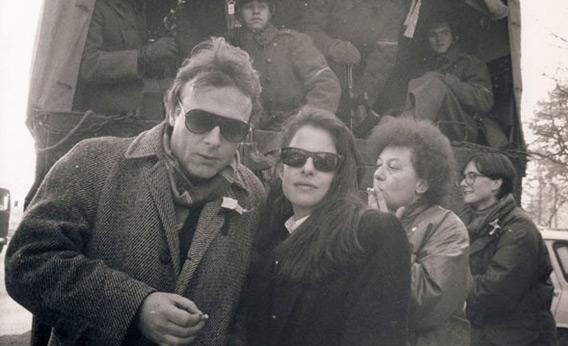
Christopher Hitchens on mass, warrantless surveillance


In 2006 the American Civil Liberties Union filed a lawsuit in Detroit against the NSA. They accused the NSA of violating the US constitution by eavesdropping on people without court oversight. The case represented the first legal challenge to the surveillance programme. It sought an immediate end to wiretaps, saying they violate constitutional rights to privacy and free speech. 

The ACLU suit included Christopher Hitchens. He said in a full written statement and published on the ACLU website:
"People will say it’s wartime and we have a deadly enemy, and I agree with that. I was in favour of the war in Iraq and Afghanistan very strongly, but it is even more important in such a time that we don’t give away power to the unaccountable agencies that helped get us into this in the first place. It is extremely important we know what the rules are and there has to be a line drawn. You mustn’t turn emergency or panic measures into custom or practice."
He also said here, and echoed the bold words above:
"[It is] imperative that we do not take panic or emergency measures in the short term, and then permit them to become institutionalised."
He spoke briefly of the lawsuit in a speech here
"I am currently a plaintiff in a lawsuit brought by the ACLU against the National Security Agency, for doing what it knows how to do, which is bug American citizens instead of doing what it appears not to know how to do which is how to predict terrorist attacks in the United States."
My previous posts on Hitchens on Northern Ireland here, on segregated schools here and on the "parasitic class" here. On Albert Camus and "the rats" here. On Northern Ireland's "barbaric, sectarian leaders" here. His comment that anti-semites are "mentally and morally unwell" here. On Vaclav Havel here. On the US First Amendment here, on the US as an empire and class-based society here, and on how to succeed here. On women and poverty here. On the US Declaration of Independence here. Christopher Hitchens explained that he left the UK in part because of the libel laws, see here. Christopher Hitchens spoke here about the authority of bloggers and online writers (7m30s) (original video in full here). Hitchens on "being bored" as the worst sin here. On why Hitchens is such a compelling writer here. On cliché here. On socialism here. On Iran's "Baby Boomerang", here. On the need to defend the principles of the Enlightenment here. On thought crimes here. On the "encouraging signs of polarisation" here. On feeling "envious of someone who is young and active and starting out" here. Christopher Hitchens on the anti-Columbus movement. On opinion polls here. On the term "political spectrum"here. On Obama's Nobel Peace Prize here. Hitchens on how writing is hard, here. Hitchens on how a writer can never really stop, here. Hitchens explains why he is no longer a socialist, here. On the "some Christians fell into error" excuse here.

June 10, 2014

Glenn Greenwald (@ggreenwald) and gate-keeping the Snowden leaks


This is the charge repeatedly laid at Greenwald's door. Andrew Sullivan said it:
Greenwald flatly denies this charge, as he did here:
Yet Glenn Greenwald has always insisted on full editorial control. He started blogging in 2005 and by the time he reached Salon he maintained the self-direction and individualism of an independent blogger. This independence continued with his move to the Guardian. As he said:
"I will write daily at the U.S. edition of The Guardian, which is based in New York, and will do so exactly the same way as I have here [Salon]: with full editorial independence and the same type of readership involvement and support upon which I’ve long relied, including a vibrant comment section. In addition to the daily writing, I’ll also write a more traditional once-a-week column there."
Andrew Sullivan further wrote here:
"The way the US government has behaved since 9/11 – its outrageous and criminal secret activity – seems to me to tilt the question in favor of the whistle-blower and the journalist, and some legal leniency – certainly for the journalist. But in all times there is a balance between these two contradictory democratic necessities – government secrecy and transparency – and at some point, the rule of law is the rule of law. It’s not perfect, but it’s better than all the alternatives. 
Right now, for example, what the public knows and does not know about the NSA is determined by Glenn Greenwald. He has in his possession vast troves of information that he is keeping secret, until he decides it will becomes public. He is picking and choosing what to divulge and doing so over an extended period of time. In that sense, he is close to being an alternative government, but without any internal checks and balances, and with no recourse for the public through the democratic system. What Mike is insisting is that this too is a genuine problem from the point of view of the public interest. Who gets to decide what the public knows? Right now, it’s Glenn. And I bet his security system for his data is extremely strong. He doesn’t want any leaks either, does he?"

April 13, 2014

Glenn Greenwald home. Sarah Harrison exiled.


This is exactly the contrast that struck me on hearing that Greenwald had returned to the United States without incident, event or arrest.

Glenn Greenwald landed in New York and passed through customs unhindered.

Sarah Harrison cannot return to the UK. This is on the very real fear and very material likelihood of arrest and prosecution as a terrorist under the Terrorism Act 2000. Glenn Greenwald said here (16m) of the risk of arrest and prosecution:

April 08, 2014

United Kingdom - The national security and anti-terrorism state


David Allen Green (@JackofKent) wrote an article on his blog, 'The national security and anti-terrorism party.' In that he said that government oversight and overreach is inexorable and inevitable. No matter who is in government. In 2012 the coalition government announced it planned more email and social media surveillance. The plan echoed a similar announcement made in 2009 by the Labour Party. Later scrapped. David Allen Green cited the Home Office which said in that article:
"It is vital that police and security services are able to obtain communications data in certain circumstances to investigate serious crime and terrorism and to protect the public."
And David Allen Green said in response:
"But they may as well be saying: 
"It is vital that police and security blah obtain data blah serious crime blah and TERRORISM KLAXON blah and to protect the public."

March 31, 2014

Glenn Greenwald - Privacy is necessary for creativity


In an article in Salon, "Surveillance breeds conformity" Natasha Lennard spoke with Glenn Greenwald. He explained why privacy the prerequisite to being a fully formed human being and the prerequisite to creativity. He explained this with two points.

Firstly, Glenn Greenwald said that the first value of privacy is the personal:
"I think the primary value of privacy is personal as opposed to legalistic or constitutional or political, by which I mean it’s essential to what it means to be human that we have a private life. We interact with other human beings as social animals, and live part of our lives in the public eye — that’s crucial — that’s why if you put someone in solitary confinement for 23 and a half hours a day like we do in U.S. prisons, it’s a form of torture. And it makes people go insane, because we need, as part of our human functioning, to be seen by other human beings and to be perceived by them and understood through the eyes of other people. 
Secondly, it's about being free to explore and express oneself creatively:

March 28, 2014

Glenn Greenwald - The problem with endorsing abuse of state power


Gore Vidal (at 17 minutes) said:
"Every president wants to be a dictator. It is the nature of power. You don’t accept limited powers unless you’re a very limited man."
Gore Vidal said in 1999:
"I don’t know where the Internet is going to go but I do know that the government is going to try and take it over. You can count on that." 
Glenn Greenwald (at 26 minutes) said there are lots of reasons why people should be concerned about civil liberties, even if theirs aren’t being infringed or abridged. He gave two reasons.

Firstly:
"The first of which, history leaves no doubt that, although civil liberties infringements begin in a very confined way - directed at the most marginalized minorities about whom people don’t care or to whom they direct their hostility – it is inevitable, absolutely inevitable that those civil liberties abridgments, once they are entrenched, will spread ; and they’ll spread far beyond their original intended targets."
He continued:
Related Posts Plugin for WordPress, Blogger...