September 29, 2014

Comparison and self-doubt are the thief of creativity

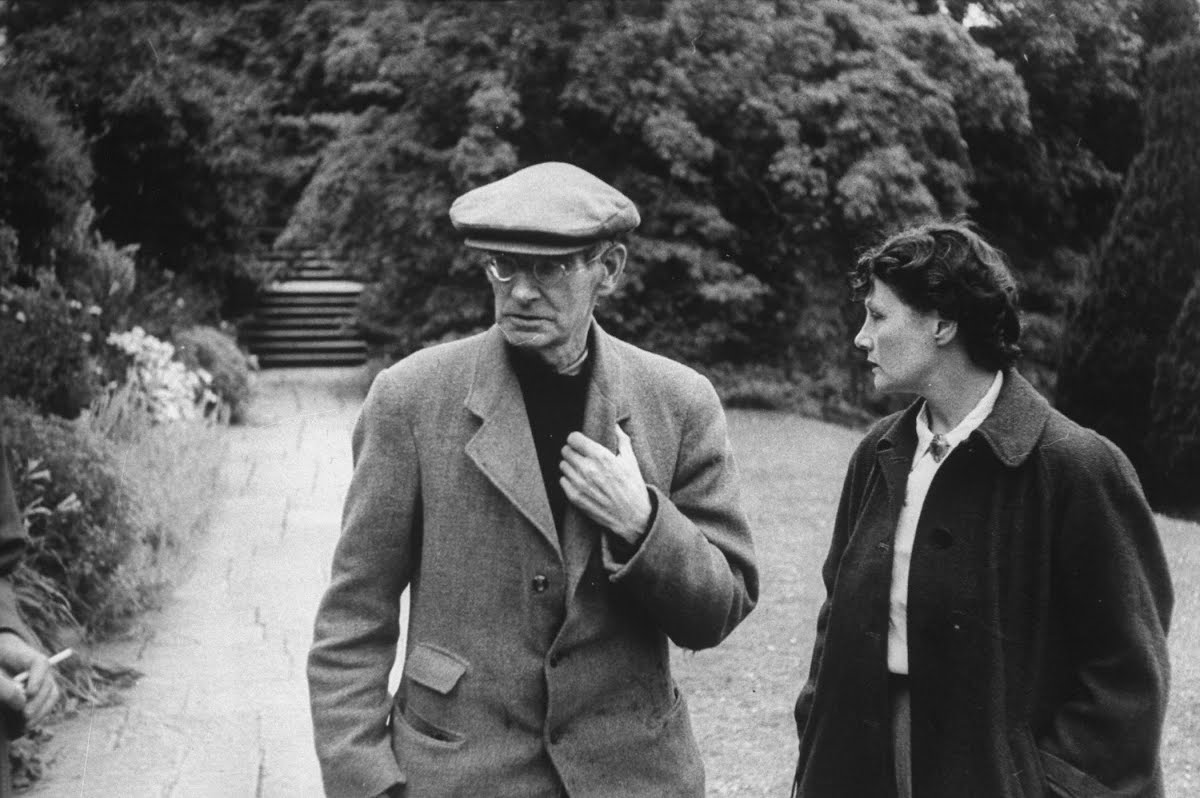
Eleanor Roosevelt wrote that "comparison is the thief of joy." Comparison is also the thief of production and creativity. It is deadly and antithetical to the artist, the creator and the creative process. Philip Larkin said to the Paris Review:
"Everyone envies everyone else."
He also wrote a poem, 'On Being Twenty-Six':
"I feared these present years, 
The middle twenties, 
When deftness disappears, 
And each event is 
Freighted with a source-encrusting doubt, 
And turned to drought."
Quentin Blake said: "As soon as I knew something was intended for print, I tightened up."

Hitchens wrote, embrace the doubt and comparison:
"The main thing as I keep saying, I never tire of saying is, to keep testing yourself against other writers who are better than you. That’s what qualifies one as a writer I think, permanently running the risk of having to say I don’t know why I bother."
He elaborated on this:
"[With George Orwell] you don’t get the sense for example when you’re reading Proust or Nebokhov or George Eliot that you shouldn’t be in the writing business."

September 28, 2014

George Orwell - Writing is hard, Ctd


George Orwell's1984 is the classic of classics. One of the most celebrated book in the English canon that speaks and sells powerfully to this day. Yes 1984 is a classic. Yet for Orwell, the writing of it was most testing. Early drafts were seen by Orwell as "ghastly" and "dreadful" messes. While writing 1984 in May 1947, Orwell wrote to his publisher Fred Warburg: 
"Of course the rough draft is always a ghastly mess bearing little relation to the finished result, but all the same it is the main part of the job."

September 26, 2014

Will Self - Art is theft, Ctd

Kingsley Amis by Anglo-Polish impressionist painter Feliks Topolski
Will Self (@wself) said during a panel conversation on Dubliners by James Joyce:
"Being pray to the anxiety of influence - and if any writer tells you that she or he doesn’t suffer from the anxiety of influence then they’re a stone-cold liar."
He explained how W.H. Auden notoriously used to write "GETS" in the margins of books for "Good Enough To Steal":
"W.H. Auden notoriously used to write in the marginalia "GETS", in the margins of books for "Good Enough To Steal". So I most re-read James Joyce’s Dubliners to steal stuff."
Will Self also explained that he likes to think he's a good enough writer to thieve. He said in the Guardian:

September 25, 2014

Conference Drawing

My Conference Notes Cartoon of Josh Richards (@Mighty_Ginge) at @Create2014Co, more here.
I do Live Drawing. I also do Conference Drawing. This is where I go to conferences, seminars and talks and document what is said through words and coloured drawings. Think mind maps. Think story boards. A wonderful way to remember the special event and the special ideas and contacts made. Below are 12 images from the 12 conferences and events that I've done Conference Drawing at over the last year. Click the links below to see a full selection of images from each of the 12 events. 

Read more about Live Drawing here. See a full chronology of all the Live Drawing cartoons I've ever drawn on my Flickr page here. See how I work and think and process ideas on my Live Drawing Tumblr portfolio here.

Ireland - A cynical tax haven?

Fintan O'Toole by Jon Berkeley
Fintan O'Toole wrote in May 2013, Ireland needs a better economic strategy than ‘come here to avoid tax'. He said: "An official White House report categorised Ireland as a tax haven in 2009 and last week’s Senate hearings on Apple’s creative accounting embedded the phrase in public discourse. If it takes permanent hold, the consequences could be enormous." He then said:
"I was browsing Forbes, the magazine for billionaires, online about a year ago. There was a piece about Ireland’s status as a tax haven. Apparently through some technological glitch, you could see that two phrases had been edited out and replaced with euphemisms. Thus “Ireland’s tax favoured status” was struck out and replaced with “Ireland’s hospitality”.

And the statement that “US companies can pretend to be headquartered in Ireland in order to avoid US tax” was doctored to say that US companies can “set up shop in Ireland”. This kind of thing is amusing, but it’s also deadly serious."
Fintan O'Toole explained how critical language is to international community's perception of Ireland:
"The Forbes piece is a perfect illustration of how vulnerable the perception of Ireland is to changes of language. Ireland is either a hospitable place where you can set up shop like a friendly village grocer or a cynical tax haven, and increasingly, in the US, it is routinely referred to as the latter.

September 24, 2014

Live Drawing at Arcadia Deli (@ArcadiaDeli), Belfast

Drawing Irish writer and thinker Colm Dore (@ColmDore) at Arcadia Deli
I spent the last Saturday of August 2014 drawing at Arcadia Delicatessan on the Lisburn Road, Belfast. With me being a regular this was a great way to interact with the staff and also meet some of the other customers, and of course draw them. I was operating on a donation system and started quickly. It was the usual Saturday bounce with young children smelling of grass and running about in their freshly used rugby and football kits; mums and dads doing their meat shopping and selecting a choice wine for the weekend dinner party.
 
It was great to see Irish poet Michael Longley come shuffling into the shop and accept my offer for a sitting. He was a joy to draw and speak with and you can see a Vine video of the drawing and a good selection of photos below. You can also see a full range of my cartoons of the staff and customers if you click to see more below.
 
This was a great way to lift things for the shop, the customers and the artist, all coming together in a cherry triangle of high spirits. Art, business and shopping - an intoxicating mix!
 
See my Live Drawing blog here, with a post on drawing Michael Longley here and drawing at Arcadia Deli here. Read about how I do Live Drawing from my website here. See a full chronology on all the Live cartoons I've ever drawn on my Flickr page here, and see how I work and think and process ideas on my Live Drawing Tumblr portfolio here.


The vivisected Northern Ireland

Cartoon if Isaiah Berlin
For the committed anti-sectarian and anti-tribalist in Northern Ireland, I give you Isaiah Berlin and his explanation on monism and why the belief in one unalloyed, fixed, unchangeable doctrine leads, inevitability, to the vivisection of society:
"There is little need to stress the fact that monism, and faith in a single criterion, has always proved a source of deep satisfaction both to the intellect and to the emotions… [However] it is bound, provided it is inflexible enough, to encounter some unforeseen and unforeseeable human development, which it will not fit; and will then be used to justify the a priori barbarities of Procrustes - the vivisection of actual human societies into some fixed pattern dictated by our fallible understanding of a largely imaginary past or a wholly imaginary future."
Also read Kenan Malik on multiculturalism here. Newton Emerson on a vivisected Northern Ireland, he said:
"Census figures for the Upper Ormeau Road… is 57% Catholic and 27% Protestant, yet just 36% describe themselves as "Irish", with the remainder evenly split between British and Northern Irish. So what can explain the DUP’s betrayal of an area that epitomises Peter Robinson’s stated vision of a Northern Ireland "at peace with itself" and "for all of us, not them and us".
 
Cowardice in the face of loyalism must be a partial explanation, and it is quite some cowardice, as the upper Ormeau Road are believed to barely number into double figures. Electoral calculations in Belfast and more widely against the TUV will also be a factor. However, this retreat from its own policy and constitutional objective implies so much short-sightedness, spinelessness and stupidity that there has to be a deeper explanation.
 
Is the DUP really envisaging a Northern Ireland that depends on Catholic support which would in turn depend on tolerance, neutrality and equality? The fact that the party sees no value whatsoever in protecting places like the upper Ormeau Road suggests its true vision is a retreat into a patchwork of ethnic laagers, with Northern Ireland becoming a Catholic Bosnia overlaid with a Protestant Republika Srpska. What other explanation can there be when ten loyalists with a ladder outweigh the 40% of Catholics in upper Ormeau who, even now, have made their peace with partition. 
What the DUP wants or fears is not necessarily what will come to pass. Council reorganisation still points more to a “Belgium on the Bann” scenario, with an Irish west, a British east and an uneasily shared capital. But that less-than-ideal future is the best we can hope for and every step the DUP takes to the right brings the Balkans closer into view."
Read more about the divided Bosnian city of Sarajevo here:
"Nineteen years after the war ended, Bosnia operates as two "entities", the predominantly Muslim and Croat Federation, and the overwhelmingly Serb-dominated Serb Republic (RS). The highly autonomous RS was recognised by the peace settlement. Many Muslims regard it as the product of ethnic cleansing, while for Serbs its existence is a guarantor of peace."

September 23, 2014

How Matisse inspired Miffy


The creator of Miffy the Rabbit explained here (45m25) how Matisse inspired him. In an article in the Telegraph, 'I saw Matisse - and came up with Miffy', Dick Bruna said:
"[In Paris] I saw Picasso for the first time and Léger and all those big painters. When I saw Matisse's work – especially his late collages – he became the most important man in my life."
Also here and here. Below is how Matisse inspired other modern graphic designers.

Christopher Hitchens - We are in need of a renewed Enlightenment

Benjamin Frankling, a pillar of the American Englightenment, by Gerald Scarfe, here
Christopher Hitchens said:
"Above all, we are in need of a renewed Enlightenment, which will base itself on the proposition that the proper study of mankind is man and woman. This Enlightenment will not need to depend, like its predecessors, on the heroic breakthroughs of a few gifted and exceptionally courageous people. It is within the compass of the average person. The study of literature and poetry, both for its own sake and for the eternal ethical questions with which it deals, can now easily depose the scrutiny of sacred texts that have been found to be corrupt and confected. The pursuit of unfettered scientific inquiry, and the availability of new findings to masses of people by electronic means, will revolutionize our concepts of research and development. Very importantly, the divorce between the sexual life and fear, and the sexual life and disease, and the sexual life and tyranny, can now at last be attempted, on the sole condition that we banish all religions from the discourse. And all this and more is, for the first time in our history, within the reach if not the grasp of everyone."
Jenni Russell (@jennirsl) wrote that there's nothing inevitable about the victory of enlightenment values. In an earlier post I wrote that Christopher Hitchens said that enlightenment principles need to be fought for and defended by every generation. Scottish historian Niall Ferguson (@nfergus) noted that "the greatest thinkers of the Scottish Enlightenment were not nationalists but cosmopolitans".

In Northern Ireland, where tribal acrimony and antipathy govern all levels of public discourse these principles are exceptionally necessary. We need to move away from what David Hume called "the vulgar motive of national antipathy."

In a Letter to Lafayette Monticello in May 1817, Thomas Jefferson said:
"Ignorance and bigotry, like other insanities, are incapable of self-government."
I earlier wrote that we could say that sectarians are mentally and morally unwell. And so as Christopher Hitchens said, "condemnation of bigotry and superstition is not just a moral question but a matter of survival."

September 22, 2014

We are deluding and damaging society if we cannot speak freely of the public dead

Cartoon of Paisley with Harold Wilson, Ted Heath, Jim Callaghan, Thatcher, Major and then Blair and Ahern. By Ian Knox.
[UPDATE* - Ed Moloney spoke about the passing of Paisley on New York radio here, and said among several rich comments that "Although Brian Faulkner was brought down by a broad coalition of Loyalists, the scene was set years before that by Paisley’s agitation."]
[UPDATE II - Clifford Smyth wrote on Ed Moloney's blog that when Paisley began his political career in the 1960s Northern Ireland was a stable and peaceful society and Irish Republicans were reflecting on why the IRA campaign waged between 1956 and ’62, had failed, and how a reshaped strategy might succeed.]


Compulsory praise, homage and adulation. The scurrilous sanctimony of it. I've written about it three time before, the death eiquette (here, here and here), and will go one more time. When Paisley passed, there was as expected, and on schedule, a mass outbreak of moist and dewey eyed encomium and panegyrics. A bombardment of hagiography and neuteured, one-sided reqiuems. Pure, leader-reverent propaganda. Total distortion. Total self-delusion of the worst most self-harming kind. If the man was a thundering bigot, incubator and mobiliser of hatred for over half a century that needs ruthless examination and full public acknowledgement.

Yet death in Ireland is a time for seeing only good and burrying the bad. Fintan O'Toole wrote about it and said:
"Death is one of the things we do well in Ireland. There is a decency, a kindness, a communal instinct to try to lessen a family’s grief by taking a little bit of it onto ourselves...

September 12, 2014

The protocol, convention and etiquette for public figure deaths

Scanlan's Monthly cover by Ralph Steadman of Richard Nixon getting punched
When a prominent public figure dies we are guaranteed a steam train of piety and praise. The media will compliment where compliment is due, this is right, but it is wrong for the media to allow any public figure eulogy to go unchecked. There must be a recognition, public airing, examination and learning from the bad, their wrongs and their mistakes, their misrule, misdeeds and misbehaviour. The deceased public figure is not untouchable, the deceased public figure is not a sacred cow; a unifying consensus of reverence does a disservice to the public and to posterity.

I will punch that sacred cow. Yet the establishment wont. Glenn Greenwald calls this The Protocol For Public Figure Deaths.  A convention and etiquette that outlaws honest criticism and imposes a vow of silence. In his obituary for Christopher Hitchens, Glenn Greenwald criticised both the convention of non-criticism and Hitchens himself,  saying here:
"The death this week of Christopher Hitchens and the remarkably undiluted, intense praise lavished on him by media discussions... Hitchens was an extremely controversial, polarizing figure. And particularly over the last decade, he expressed views — not ancillary to his writings but central to them — that were nothing short of repellent. 
Subordinating his brave and intellectually rigorous defense of atheism, Hitchens’ glee over violence, bloodshed, and perpetual war dominated the last decade of his life. Dennis Perrin, a friend and former protégée of Hitchens, described all the way back in 2003 how Hitchens’ virtues as a writer and thinker were fully swamped by his pulsating excitement over war and the Bush/Cheney imperial agenda: 
I can barely read him anymore. His pieces in the Brit tabloid The Mirror and in Slate are a mishmash of imperial justifications and plain bombast; the old elegant style is dead. His TV appearances show a smug, nasty scold with little tolerance for those who disagree with him. He looks more and more like a Ralph Steadman sketch. And in addition to all this, he’s now revising what he said during the buildup to the Iraq war."
And so:
"Nobody should have to silently watch someone with this history be converted into some sort of universally beloved literary saint. To enshrine him as worthy of unalloyed admiration is to insist that these actions were either themselves commendable or, at worst, insignificant. Nobody who writes about politics for decades will be entirely free of serious error, but how serious the error is, whether it reflects on their character, and whether they came to regret it, are all vital parts of honestly describing and assessing their work. To demand its exclusion is an act of dishonesty.

September 09, 2014

Ralph Steadman and Quentin Blake on the term cartoonist

If there's one thing I struggle with it's what to call the Live Drawing aspect of my work. The name for me is a little clumsy. As are the terms cartoonist and caricaturist. As Ralph Steadman said:
"In some ways ‘cartoonist’ is a derogatory term. People have said it to me dozens of times – you’re just a cartoonist. But I’m rather keen on the Wittgenstein bit about the only thing of value being what you cannot say. That’s the thing about drawing: when you try to say something in pictures, it gains a dimension that language can’t match. I like that.”
And I wouldn't even use the term illustrator. As Quentin Blake said:
"There's a snobbery about illustration." 
Ralph Steadman said that he's an artist, not an illustrator, but prefers cartoonist to illustrator:
"I always wanted to be an artist, period: I hate the word illustrator - it just sounds so limp - I prefer cartoonist. Goya was a cartoonist, Daumier was a cartoonist, even Picasso used the cartoon form to express himself. But cartooning has got a really bad name now hasn’t it? People think it’s just something for filling up a column in a newspaper [adopts condescending voice] ‘Oh, it’s only a cartoon, here’s a fiver…’ I’m not trying to be artsy-fartsy but I don’t like the division that one thing is fine art and another thing isn’t."
And:
"Cartooning meant more to me than just funny pictures. I needed to apply it as a weapon almost."
And finally Ralph Steadman said:
"I try to use cartoon as an artist. I hate artistic snobbery. It’s bullshit. You should have no truck with it whatsoever. Have no truck with it."

September 08, 2014

Philip Larkin - 'On Being Twenty-six'


As I savour these last few minutes and moments of my 26 years in this society and make it 27, I want to share my cartoon of Philip Larkin and his poem, 'On Being Twenty-six.' In a period of change and challenge and in a time of self-doubt and crippling comparison, Larkin's word are hugely soothing and encouraging. I also want to share this as a shout out for Lyra McKee as she approaches the 26 mark and battles the precarious and uncertain forces of the freelance world. You too Lyra can take strength and guidance from a successful poet who often thought he was useless. Here it is,  Philip Larkin 'On Being Twenty-six':
I feared these present years, 
      The middle twenties, 
When deftness disappears, 
And each event is 
Freighted with a source-encrusting doubt, 
      And turned to drought. 

September 03, 2014

The Orwell Method

George Orwell by Ralph Steadman, with full selection here
[UPDATE: Christopher Hitchens explains how Orwell was "arguing all of the time with his own prejudices and his own fears and his own bigotries and his own shortcomings."
 
UPDATE II: Also read my blog post from September 2013 on opposition as the ointment to groupthink.]
 
Paul Muldoon explained:
"Be deeply suspicious, first of all, of your own prejudices before you begin to approach the prejudices of others."
V.S. Pritchett echoed this:
"George Orwell... was more likely in politics to chasten his own side than the enemy."  
Christopher Hitchens too:
"The unpleasant facts that George Orwell chose to face were usually the ones that put his own position, or his own preference to the test."

August 30, 2014

Christopher Hitchens on Orwell and feeling inferior against otherwriters

Christopher Hitchens by Ralph Steadman
Christopher Hitchens said about George Orwell: 
"The point was made better by Lionel Trilling. The remarkable thing about Orwell and the encouraging thing was he is not a genius. He lived to only 46 years. He never went to university. He never had a steady job. He usually didn’t have a steady publisher. He will never be forgotten because he managed to disprove imperialism, Stalinism and fascism in one lifetime and made some imperishable raids on its territory that no-one is ever going to forget. All the time ill. All the time poor."
He then said:
"[George Orwell] shows how much difference a person of really average integrity and intelligence and education can make if they have a little courage and a little intellectual honesty. The shortcomings of the individual you can see in him too. But he basically won his own battle against his own prejudices. This is an example for all time. You don’t get the sense for example when you’re reading Proust or Nebokhov or George Eliot that you shouldn’t be in the writing business. All the people in history who said alas there was nothing I could do are lying or at least discrediting themselves. They could have. They just chose not to."

August 29, 2014

Philip Larkin in and on Belfast

Philip Larkin by Ralph Steadman
Philip Larkin was appointed sub-librarian at Queen's University Belfast in June 1950, starting in September of that year. He spent five years in Belfast. Leaving in 1955 Larkin for the University of Hull. He said of the context surrounding his move to Belfast in an interview with the Paris Review:
"After finishing my first books, say by 1945, I thought I had come to an end. I couldn’t write another novel, I published nothing. My personal life was rather harassing. Then in 1950 I went to Belfast, and things reawoke somehow. I wrote some poems, and thought, These aren’t bad, and had that little pamphlet XX Poems printed privately. I felt for the first time I was speaking for myself. Thoughts, feelings, language cohered and jumped. They have to do that. Of course they are always lying around in you, but they have to get together."
He also said to the Paris Review:
"The best writing conditions I ever had were in Belfast, when I was working at the University there."
In his 1950 letter to Monica Jones, Larkin described the city and its people 8 weeks after his arrival there:
"A wide and cobble-streeted town, lined with frowning buildings in the late Victorian manner & some indifferent shops. I’m already fed up with anything called Ulster, Northern, Victoria, etc., also with the Irish male face (craggy, drink-flushed, with greasy black curls and a too-tight collar & the Irish female face (plump, bad-teethed, pinkly powdered, with a diamante lizard on the lapel)."

August 28, 2014

The cartoonist as the true journalist


John pilger thinks so:
"The most effective defender of the paper is not one of these. He has shaggy dark hair and a beard - or he did when I last saw him. For more than 20 years I have turned to his work as you would reach for coffee in the morning. He is outrageous, anarchic, brilliant, sometimes inexplicable and a bit mad (not really). For those who doubt the truth is subversive and often absurd, I point them towards two pages in the Guardian, where he resides. 
Only Steve Bell exposes consistently, fearlessly, the bullshit of "public life". Indeed, his characters are often drowning in or water-skiing on the stuff. "Right, that's it," says the last governor of the Bank of England, Sir Mervyn King, to Gordon Brown, then prime minister, and chancellor Alistair Darling, "heads down, tea break over!" They are up to their chins in a tank of turds. 
Steve Bell is a cartoonist and a true journalist with few rivals. He is Hogarth and Swift with a touch of Peter Sellers and a sprinkling of Orwell. He is more of an English original than one of his prime targets, Margaret Thatcher, the former petit-bourgeois totem. Often using the wickedly all-seeing penguin star of his strip, "If..." he rumbled both Thatcher and her protege, Blair, early in their criminal ascendancy."
In full here. The New Statesman also covered this with, 'John Pilger on Steve Bell and the cartoonist as true journalist.'

August 27, 2014

Sean O'Casey - Writing gets harder the more you do it

Irish writer Sean O'Casey and his wife Eileen Reynolds
Sean O'Casey, playwright born in the tenement slums of Dublin, said:
"When I write a new play. When I sit down to try to write a new play, I’ve had the experience of many plays before. Yet that new play that I am going to try to write gives me the same agony, the same trouble, the, same effort, the same Herculean work as the very first play I ever wrote gave to me."
Christopher Hitchens said the same thing:
"I hate to agree with George Will about this… The truth is, yes there is nothing like not writing for making you unhappy and if you have the compulsion then the only problem that you’ll have is, you surrender to this compulsion more and more and, you’ll find [writing] gets harder the more you do it. That seems a shame. It should get easier, it should become more like a facility for example. It becomes more difficult and it becomes more difficult because you are reading more and more work by better and better people and you’ve lost the sheer nerve and the blind solipsism that allowed you to think you could try it when you were young before you had made any proper comparisons. So it gets much more nerve wracking and much more difficult in every way costly for you and no doubt for your readers."
Samuel Beckett on writing more generally said in 1954:
"It’s hard to go on with everything loathed and repudiated as soon as formulated, and in the act of formulation, and before formulation."
Beckett also wrote:
"I realized that Joyce had gone as far as one could in the direction of knowing more, [being] in control of one’s material. He was always adding to it; you only have to look at his proofs to see that. I realized that my own way was in impoverishment, in lack of knowledge and in taking away, in subtracting rather than in adding."

August 25, 2014

Northern Ireland's vanity of the small difference

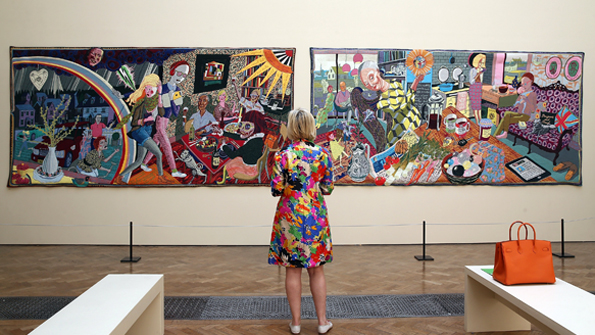
The Vanity of Small Differences by Grayson Perry - A series of 6 tapestries partly inspired by Hogarth's A Rake's Progress
It was W. H. Auden who wrote in his poem about partition: "Two peoples fanatically at odds, With their different diets and incompatible gods." Yet to outsiders, the two communities in Northern Ireland look, seem and act identically. Eugene Robinson wrote in the Seattle Times about how Northern Ireland Protestants and Catholics are at the same time identical and alien. He said:
"When I was the Post’s London correspondent in the early 1990s, I covered the Northern Ireland conflict. The first thing I went to see in Belfast was the notorious "peace line" between the Falls Road, a Catholic stronghold, and Shankill Road, a Protestant redoubt. Everything looked the same on both sides — the houses, the shops, the people — yet it was as if they were two different countries. Animosities had been passed down through generations. Even now, 15 years later, a civil exchange between two of the leading antagonists — Ian Paisley and Gerry Adams — is big news."
Kevin Myers wrote:
"Visitors to this archipelago [Britain and Ireland] are baffled by the differences that are so passionately cherished: for what they usually perceive are similar hedgerows, Georgian architecture, endless rain, common law, wigged judges, unarmed police officers, right-hand drive, a mysteriously ubiquitous brown sauce, tea, fish and chips, and midnight drunks seeking to reduce complete strangers to smears of DNA."
Christopher Hitchens wrote about Northern Ireland:
"I used to work in Northern Ireland, where religion is by no means a minor business either, and at first couldn’t tell by looking whether someone was Catholic or Protestant. After a while, I thought I could guess with a fair degree of accuracy, but most of the inhabitants of Belfast seemed able to do it by some kind of instinct. There is a small underlay of ethnic difference there, with the original Gaels being a little darker and smaller than the blonder Scots who were imported as settlers, but to the outsider it is impalpable. It’s just that it’s the dominant question locally."
He also said:
"In numerous cases of apparently ethno-nationalist conflict, the deepest hatreds are manifested between people who—to most outward appearances—exhibit very few significant distinctions. It is one of the great contradictions of civilization and one of the great sources of its discontents, and Sigmund Freud even found a term for it: "the narcissism of the small difference." As he wrote, "It is precisely the minor differences in people who are otherwise alike that form the basis of feelings of hostility between them."
Sir Ivor Roberts, president of Trinity College, Oxford wrote:
"On the island of Ireland, we had two branches of Christianity literally at each other’s throats in the name of nationalism and mutual religious intolerance. Why was this? The answer to the question comes, I think, in an essay by Freud nearly 100 years ago on the subject of what he called “the narcissism of small differences”. Freud’s contention was that it was precisely in the groups which had relatively little to distinguish each other that the jealousies, the narcissism most easily led to violent attempts to mark that difference and to want to obliterate those who most nearly resembled you. The read across to Northern Ireland is clear enough. 
To circumvent these “minor differences”, to move away from nationalism and tribalism/sectarianism involves reducing the extent to which people feel secure and understood only among people like themselves. Put another way, we need to find a way to overcome what has been described as social autism. The Canadian author and latterly politician Michael Ignatieff put it well “the pathology of groups so enclosed in their own circle of victimhood or so locked into their own myths or rituals of violence that they can’t listen, can’t hear, can’t learn from anybody outside themselves.” We need to overcome, in Northern Ireland, this bell-jar mentality by discounting and rejecting sectarianism in all its sinister forms and promoting not just trust but the kind of individualism that can survive only in conditions of trust. The murderous attack made against NI police officer Ronan Kerr for daring to join the new integrated police service in Northern Ireland is, of course, anathema to that approach and a classic example of intolerance and of the collective gangsterism in which paramilitary structures thrive."
It's Christopher Hitchens who is last and the best on it:
"Condemnation of bigotry and superstition is not just a moral question but a matter of survival."

August 24, 2014

George Packer - Emulation and imitation is a good way to learn how to write

George Packer - New Yorker
New Yorker staff writer George Parker spoke with Christopher Hitchens in 2009 and explained how he modelled himself and his writing on the work of George Orwell:
"I needed to know how does one become a writer, and so I just read straight through what was then the only collection of George Orwell’s essays and journalism and letters… I became a slavish emulator and imitator for a while in my 20s. I think it’s a good way to learn how to write - To find a writer you feel some affinity for, and just master their prose style, their rhythms, get the cadences into your own nerve system and then try to find your own way into it." 
As I noted in an earlier post, Hunter S. Thompson did the same thing, modelled himself on great writers, and he explained how he did this on Charlie Rose:
"If you type out somebody's work, you learn a lot about it. Amazingly it's like music. And from typing out parts of Faulkner, Hemingway, Fitzgerald - these were writers that were very big in my life and the lives of the people around me - so yea I wanted to learn from the best I guess."

August 23, 2014

Avoid politeness, be constructively blunt

Henry Louis Mencken at work
There is a difference between being irreverent and offensive. Criticism and confrontation is a cleansing act that helps people and argument to refine and streamline. Just as destruction is not opposite to birth, reform and creation, so impoliteness can be constructive and politeness can be destructive. Don't be destructively polite, be constructively blunt. As Edward Land said"politeness is the poison of collaboration." Maria Popova echoed this when she said:
"[Refuse] to infest the garden of honest human communication with the Victorian-seeded, American-sprouted weed of pointless politeness."
Thomas Sowell said:
"When you want to help people, you tell the truth. When you want to help yourself, you tell people what they want to hear."

August 22, 2014

Poetry and literature, the new scripture


Anyone who knows me by my social media presence knows that I love quotes. Yes it can be a meaningless act - Ralph Waldo Emerson who said that "I hate quotations, tell me what you know" - but if exercised correctly, quotations have huge instructional value. They inform us around the challenges and happenings of every day life. Like the words of Samuel Beckett - "never matter, try again, fail again, fail better" - these sooth and guide my conscience as I navigate the many obstacles and labour against the many rejections. Douglas Murray wrote in his article 'Have It By Heart' in the Spectator Magazine:
"It is worth filling your head with the best words in their best order because it gives you the greatest company as well as guidance throughout your life."
Yet as Sean O'Casey said:
"All the world's a stage and most of us are desperately unrehearsed."

August 14, 2014

Ian Knox - Unionist politics are much funnier, Republicans make more ideas and less jokes

A typical cartoon on unionism by Northern Ireland cartoonist Ian Knox
Satirists like Loyalists Against Democracy (@LADFLEG) are regularly inveighed against for being too one sided, overly and unfairly shining a light on loyalist misbehaviour. Legacy media is often admonished with demonising loyalism. I have continually rejected these charges as unfounded and baseless.

And to best back up my position I defer simply to Ian Knox, long time Northern Ireland cartoonist. In 1999 he wrote that Unionist politics are simply much, much funnier:
"I’ve got a section [in my book Culture Vultures] on unionist politics but no equivalent one on nationalist politics, because, well… Unionist politics are much funnier. You might feel that a group of people grimly opposed to change would be less amusing than another group who feel that history is on their side, but it doesn’t seem to work like that. Aside from all the horrors of the last thirty-odd years - the slogans, the debates, the atrocities - it seems to me that while nationalism/republicanism might throw out more ideas, unionism generates more jokes."
He reiterated this self-evident situation, when he said in 2014:
"The whole world of unionism is much wilder and wackier."
And below is a typical Ian Knox cartoon of the republican tribe:

August 11, 2014

The Lundy terror, Ctd

The scene in Londonderry, Northern Ireland, as spectators watch the annual Burning of Lundy ceremony. Robert Lundy
I was struck by the Israel-Gaza debate. One point repeatedly made, as Ed O'Loughlin did, was that it is eminently possible to be fiercely critical of Israel policy without hating Jewish people. What a perfect epigram to articulate the situation in Northern Ireland - it's eminently possible to be fiercely critical of loyalist policy and conduct without hating the loyalist people.

Yet it remains that anyone who criticises loyalism is automatically calumnied, castigated and cast aside as either, a demoniser/generaliser (though it be eminently self-evident that loyalism does the demonisers work for them) or, a "Lundy", "Guilty Prod" or "Rotten Prod". This second reaction is by far the more dangerous, coming as it does with an exterminationist impulse, so let me look at the "Lundy"-"Guilty Prod"-"Rotten Prod" pejorative and slander more closely.

August 10, 2014

Christopher Hitchens on Indochina

17-year-old Nguyen Thi Hue, who is blind, with her mother. View Nachtwey's photo essay on Agent Orange.
Christopher Hitchens said in a 2007 interview with Vanity Fair:
"The American enterprise in Indochina was, I think, foredoomed by one thing, namely its direct inheritance from French colonialism in that region. The French empire should never have been restored after 1945. I think if President Roosevelt had not died, it wouldn’t have been. The United States should not have tried to come to its rescue, and shouldn’t have tried to succeed it. It’s not America’s role to succeed Western colonialism. It’s its role to help those colonies to become emancipated. And we missed that chance, and having missed it, engaged in a war where terrifying and illegal methods of warfare, like carpet bombing, the use of chemical defoliant, like Agent Orange, and other terrible war crimes were committed. And part of the reason why Cambodia went to year zero was that it had been half bombed back into the Stone Age already. And I’m sorry that should be on the conscience of anyone who supported the war, which I did not. But thought I don’t try and evade the responsibility for what the other side eventually did, not just in Cambodia, but also in Vietnam, but there was never any chance of keeping Vietnam partitioned, and it shouldn’t have been tried. Now furthermore, no American interest was really involved there. We were told we were fighting against the Chinese takeover, whereas the best insurance against Maoism in Indochina is always Vietam. That’s been proved many times since then. So none of this applies in the case of Iraq, where we went to overthrow a hideous dictatorship that was a local aggressor, a sponsor of international terrorism, had used weapons of mass destruction inside and outside its own borders, was hated by its people, and was in thoroughgoing breach of all important United Nations resolutions. None of this, by the way, was the case with the government of Vietnam."
In full here. Read Christopher Hitchens in Vanity Fair from August 2006 here.


August 09, 2014

Anti-Columbus Movement, Ctd

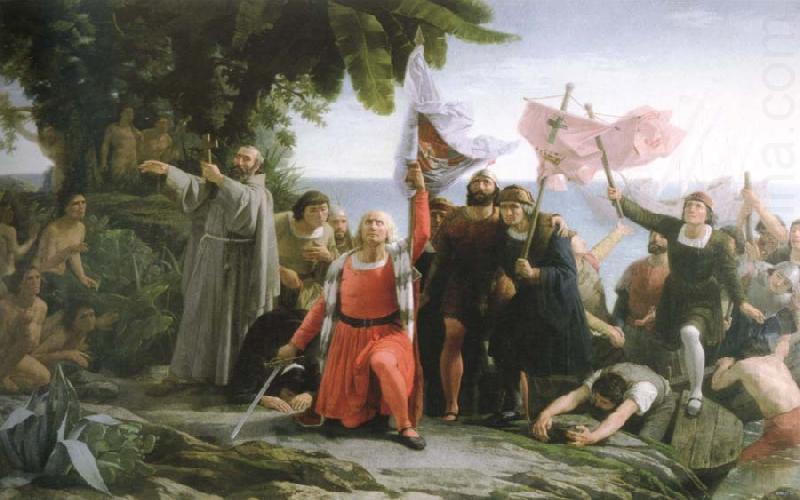
The first landing of Christopher Columbus by Dióscoro Teófilo Puebla Tolín
Within the theatre of political conversation, debate and argument in Ireland, and especially Northern Ireland, I find a self-hating, infantile and rejectionist school of thought that dwells within the republican mindset. The one that defines itself by it's relentless resentment towards Britain and its long involvement in Ireland. 

A reactionary ideology that sees British involvement as only one of land seizure, confiscation and conquest, degradation and exploitation, conflict and instability; as though prior to British involvement the island was one of immutable peace and stability; and as though, if Britain wasn't involved, other great super powers would not have done the same and probably much, much worse.

And that point was made on Radio 4, the grandest of ironies for myself - seen as a planter by the most extreme nationalist. The point was made by Dr Luciana Martins of Birbeck College who is from Brazil and was speaking about how Brazil emerged as a nation. She said:
"There was de kind of regret that we weren’t discovered by the British because the Portuguese legacy wasn’t so good. So there was something about, ‘Well if we were discovered by the British we would be the United States now’."

August 08, 2014

The authoritarianism of "West-Brit"

Study of Sean O’Casey by Dublin artist Reginald Gray, for the New York Times (1966)
"Sean O’Casey... a ‘West Brit’ or a ‘shoneen’?" This is the question southern protestant Irish blogger Patrick Comerford asked sardonically. A jibe at the violently hysterical reaction to his play 'The Play and the Stars' in which he challenged the unchallengeable - the inviolable 1916 revolutionary orthodoxy. That blog post written in 2011 looked directly at the term "west-Brit", it's origins and etymology in an article entitled, "‘West Brit’ is a racist and pejorative term unacceptable in a pluralist democracy". Patrick began by explaining that the term started out as a non-pejorative, positive sobriquet:
"Daniel O’Connell used the term positively in a debate in the House of Commons in 1832 when he said: “The people of Ireland are ready to become a portion of the Empire, provided they be made so in reality and not in name alone; they are ready to become a kind of West Briton if made so in benefits and justice; but if not, we are Irishmen again.”
It then became a negative, pejorative term:
"The term “West Brit” gained prominent usage in the land struggle of the 1880s. By the 1900s, DP Moran, founder of The Leader, was using the term frequently to describe people he did not consider to be sufficiently Irish. It was synonymous with those he described as “Sourfaces,” those who mourned the death of Queen Victoria, and It included virtually all members of the Church of Ireland and those Roman Catholics who did not measure up to his definition of “Irish Irelanders”."

July 19, 2014

Belfast Castle Wedding


This happened on Wednesday July 16 2014. See my Live Drawing website with a full portfolio and selection of photos, here.

July 16, 2014

Leo Baxendale - Art is theft

Giles cartoon 25th July 1954
Leo Baxendale wrote:
"The catalyst for my creation of Bash Street was a Giles cartoon of January 1953: kids pouring out of school, heads flying off and sundry mayhems. Straight away, I pencilled a drawing of 'The Kids of Bash Street School' and posted it from my home in Preston to R. D. Low, the managing editor of D.C. Thomson's children's publications in Dundee. I received an offhand response, a dampener. It was only after I'd created Little Plum (April 1953) and Minnie the Minx (September 1953) that the Beano editor George Moonie travelled to Preston on 20 October 1953 and asked me to go ahead with Bash Street (he gave it the provisional title of 'When The Bell Goes'; when it appeared in The Beano in February 1954, it was titled 'When The Bell Rings'."
He also wrote:
"Alan Moore, Steve Bell, Savage Pencil and others have taken the ethos of my work, The Beano Spirit, that uninhibited outlook, and they’re carrying it on in their own work. I think that’s wonderful."

Christopher Hitchens on the word "community"

Wikipedia explained the etymology and origin of the line, "when I hear the word culture, I reach for my gun":
"When the Nazis achieved power in 1933, Hanns Johst wrote the play Schlageter, an expression of Nazi ideology performed on Hitler's 44th birthday, 20 April 1933, to celebrate his victory. The famous line "when I hear the word culture, I reach for my gun", often associated with Nazi leaders, derives from this play. The actual original line from the play is slightly different: "Wenn ich Kultur höre ... entsichere ich meinen Browning!" "Whenever I hear of culture... I release the safety catch of my Browning!" (Act 1, Scene 1). 
The famous line is regularly misattributed, sometimes to Hermann Göring and sometimes to Heinrich Himmler. In December 2007, historian David Starkey misattributed it to Joseph Goebbels in comments criticizing Queen Elizabeth II for being "poorly educated and philistine". It has also been adapted, for example by Stephen Hawking as "When I hear of Schrödinger's cat, I reach for my pistol" and by filmmaker Jean-Luc Godard in 1963's film Le Mépris, when a producer says to Fritz Lang: "Whenever I hear the word culture, I bring out my checkbook." Lang evokes the original line as he answers "Some years ago—some horrible years ago—the Nazis used to take out a pistol instead of a checkbook." Songwriter Roger Miller of Mission of Burma titled his 1981 song "That's When I Reach for My Revolver" after the line.
Christopher Hitchens said of the word "community":
"The word “community” pisses me off. Who isn’t in a community now? It’s particularly bad in my adopted country and in my home town of Washington DC. “The defence community”; alright if you must. “The intelligence community” for the CIA is an outrage. “The donor community” for those who seek to influence politics by giving money under the table is appalling. And the ultimate reductio ad absurdum of it, I did actually once read in a very guardedly written account of organised crime - “the Sicilian business community.” You hear the word “community”, keep your hand on your wallet… It robs the language of the word."
Here's my adaptation:
"Whenever I hear the word community, I reach for my gun."

July 15, 2014

Andrew Sullivan (@SullyDish) on the Tuam babies

Cartoon by Martyn Turner
Fintan O'Toole tweeted:
"[Ireland] locked up more people in psychiatric wards than Stalin's Soviet Union did."
Andrew Sullivan said:
"The Magdalene Laundries were really a kind of gulag for sexual miscreants."
Another called it "Ireland’s architecture of containment". Then put it like this:
"You had these industrial schools, the Magdalene laundries, the mother and baby homes, all with different remits, but the basic model was to contain and segregate anything that was deemed morally inferior by society, whether that’s children, unwed mothers, the women in the Magdalenes, etc. The mother and baby homes were different in that they were regulated by the state and had to be accredited adoption societies, at least by 1952, which is when that became legal in Ireland. They received stipends from the day they opened, from the government. They were receiving the equivalent of an industrial wage at that time for each mother and baby, from the state. If that were the case, why were so many of these women, like my mother or Philomena Lee, expected to earn their keep if the state were in fact funding that? It really doesn’t make a whole lot of sense. Obviously there was some profit being made there, not to mention what half of our parents paid. That’s another story unto itself. Adoptive parents were “donating” huge amounts of money."

July 14, 2014

Being middle class


Simon Hattenstone wrote in the Guardian:
"[Rod Liddle] talks about his return to London as a young man (he was born in Bermondsey, hence his allegiance to Millwall) to study at London School of Economics and how shocked he was to encounter students who were so posh and so privileged and just so bloody... liberal. Before that he had considered himself middle-class (his father ended up as a tax inspector, his mother worked at the then DHSS). But not any more. "The gap between my family and the poorest family in Middlesbrough was tiny, and the gap between my family and the London lot was just enormous. And that difference has got bigger and bigger and bigger."
Alan Bennett experienced something similar:
"If the dons [at Trinity College, Cambridge] were genial some of my fellow candidates were less so. That weekend was the first time I had come across public schoolboys in the mass and I was appalled. They were loud, self-confident and all seemed to know one another, shouting down the table to prove it while also being shockingly greedy. Public school they might be but they were louts. Seated at long refectory tables beneath the mellow portraits of Tudor and Stuart grandees, neat, timorous and genteel we grammar school boys were the interlopers; these slobs, as they seemed to me, the party in possession."

July 13, 2014

Kenneth Branagh - Art is theft, Ctd


Kenneth Branagh, in an interview with Charlie Rose on June 2014, said:
"Shakespeare was fantastically comprehensive in where he went for all his stories. He knew how to borrow and he knew how to be inspired."
He also said:
"The Barge speech in Thomas North’s ‘Lives of the Ancient Romans’, Shakespeare pilfers fairly comprehensively. He scattered his gatherings but always, always transforming."
Steven Greenblatt wrote in the Telegraph about the move of ideas from Montaigne to Shakespeare:
"The borrowing extends beyond certain expressions – kind of traffic, name of magistrate, use of service, and the like – to a vision of a whole society organised on principles directly counter to those in place in the familiar, grim realm of contemporary European reality. That is, here [The Tempest] as in the case of King Lear, Shakespeare is mining Florio’s Montaigne not simply for turns of phrase but for key concepts central to the play in question."
He continued:
"Scholars have seen Montaigne’s fingerprints on many other works by Shakespeare, whether in the echoing of words or ideas. When Hamlet exclaims to his mother, “Ecstasy? My pulse as yours doth temperately keep time,” (III .iv.130–31), Shakespeare may have picked up a hint from Montaigne’s “during his ecstasy, he seemed to have neither pulse nor breath” from “Of the Force of Imagination.” And Polonius’s “This above all: to thine own self be true” may owe something to “That above all, he be instructed to yield, yea to quit his weapons unto truth” from “Of the Institution of Education of Children.” More broadly, there is something strikingly Montaigne-like in Hamlet’s intertwining of Stoicism — “Give me that man / That is not passion’s slave, and I will wear him / In my heart’s core” — (III .ii.64–66) with philosophical skepticism — “And yet to me what is this quintessence of dust?” — (II .ii.297–98) and inner acceptance — “If it be now, ’tis not to come. If it be not to come, it will be now. If it be not now, yet it will come. The readiness is all.” (V.ii.158–60)...But what is a problem for the scholarly attempt to establish a clear line of influence is, from the perspective of the common reader, a source of deep pleasure. Two of the greatest writers of the Renaissance — two of the greatest writers the world has ever known — were at work almost at the same time, reflecting on the human condition and inventing the stylistic means to register their subtlest perceptions in language."

July 11, 2014

Christopher Hitchens - You can't ventriloquise the dead


[UPDATE - see more thoughts on Tumblr here]

Christopher Hitchens said:
"Michael Korda, who has just done an excellent book on president Grant, General Grant, said you mustn’t ever write a biography in which you say, at this point he or she must have thought or he or she must have felt or must have… You’re not entitled and you’ll lose your integrity as a biographer and you can’t know it and you shouldn’t do it. And I thought how right that is. I’ve nodded at that so many times."

July 07, 2014

Eleanor Mills (@eleanormills) - When it's cool to be dumb, Ctd

Nothing in the world is more dangerous than sincere ignorance and conscientious stupidity.
Martin Luther King Jr.

Eleanor Mills wrote in the Sunday Times of July 6 2014:
"Being “cool” was about rebelling: an urge to be doing what I shouldn’t — because I could. At 13 I would slink off to pubs in Covent Garden with my best mate — we’d tell her mother we were going to the cinema — and pretend to be 18 or older. We would drink and flirt and get into trouble, revelling in the newly honed power that we had over men, and then run off home on the night bus with our child-rate photocards.
And more:
"By 14 and 15 I was going clubbing (Phil Salon’s Mud Club, the Wag, Heaven) and dancing until the small hours. I was even interviewed by Paula Yates for a Channel 4 series she was making called Too Much Too Young.
She explained the report:
"Most school dropouts do not become pop stars. Indeed a large American study, just published in Child Development — a prestigious psychology magazine — found that indulging in minor delinquency, early romantic attachments and drug use at age 13, 14 and 15 might make you popular for a few years but is correlated with “long-term difficulties in close relationships... as well as significant problems with alcohol and substance use [along with] elevated levels of criminal behaviour” in early adulthood."

July 01, 2014

The authoritarian terror of Lundyism

Cartoon by Ian Knox of Alliance leader and NI Justice Minister, David Ford MLA
Any unionist opinion that deviates from the hardline, reactionary fringe is immediately and unavoidably smeared "Lundy." The colloquial curse word for the moderate member of the Unionist community. And you see it with the PSNI - An eire-phobia - where the slightest criticism of or incursion against loyalist promiscuity is labelled IRA. (Yet the irony is that in calling PSNI the PSNI-IRA, loyalists sound like republicans who call PSNI the PSNI-RUC.) A plurality and diversity of unionist opinion isn't just disapproved, but effectively outlawed. A total prohibition on anything not outwardly and chauvinistically Protestant.

The Lundy is the kuffar. The traitor. The heretic and apostate who has gone prostrate before the enemy. Only the deep and double-dyed sectarians and tribalists are the true and authentic holders and representatives of the community.

Of course this is nonsense. By their hysterical reactionism - the deep and double-dyed sectarian, so sure of themselves, so self-loving, so unbending - becomes a parody and caricature of the tradition they purport to represent. They don't seem to have any mechanism to question or analyse their own method and direction. This is not only incredibly self-satisfied but self-destructive. He who doesn't have the ability to adapt and and mould with the changing of events is doomed.

I want to live in a multi-ethnic, multi-cultural, multi-confessional society and live with a multi-confessional unionism. It's only through argument and dissent and the constant challenging of ideas that you can refine and develop political ideology and practice.

I've variously been called a "Unionists my arse". A "condescending appeaser" by Jamie Bryson. Nick Garbutt being called a "snob" by Willie Frazer

The other colloquial swear word and pjejorative term for the unionist that deviates from the hardline, is "guilty prod". Glenn Bradley explained being called a "guilty prod" here.


My previous post on the authoritarianism of fringe unionism against the moderate, here. See all my posts on Ian Knox, who did the cartoon above, here.
Related Posts Plugin for WordPress, Blogger...