
Andrew Sullivan said at the end of 2013 here:
"The surrender of journalism to advertizing and public relations – not alliance with, but surrender to – was the biggest media story of 2013 that the media almost didn’t cover at all."

"The surrender of journalism to advertizing and public relations – not alliance with, but surrender to – was the biggest media story of 2013 that the media almost didn’t cover at all."
"The problem is, if you have a sense of fairness, simply by saying that you believe in a higher power because you believe in it, you've automatically given license to anyone else who wants to say that... I want to live in a world that has a marketplace of ideas. where everybody is busted on their bullshit all the time because I think that's the way we get to truth."He continued on tolerance:
"What we call tolerance nowadays, maybe always—I'm always skeptical about the "nowadays" thing. I don't think things get that much different. What we call "tolerance" is often just condescending. It's often just saying, "Okay, you believe what you want to believe that's fine with me." I think true respect... it's one of the reasons I get along so much better with fundamentalist Christians than I do with liberal Christians because fundamentalist Christians I can look them in the eye and say, "You are wrong." They also know that I will always fight for their right to say that."See full transcript here and here.
"I have a dear friend in Jerusalem, that home of rectitude and certainty that is so often presented to us as “holy” for no better reason than its unenviable position as “home” to three (highly schismatic but self-described) “mono”theisms. His name is Dr. Israel Shahak; for many years he did exemplary service as chairman of the Israeli League for Human and Civil Rights. Nothing in his life, as a Jewish youth in pre-1940 Poland and subsequent survivor of indescribable privations and losses, might be expected to have conditioned him to welcome the disruptive. Yet on some occasions when I have asked him for his impression of events, he has calmly and deliberately replied: “There are some encouraging signs of polarisation.” Nothing flippant inheres in this remark; a long and risky life has persuaded him that only an open conflict of ideas and principles can produce any clarity. Conflict may be painful, but the painless solution does not exist in any case and the pursuit of it leads to the painful outcome of mindlessness and pointlessness; the apotheosis of the ostrich."
 |
| Graphic via Paul Krugman |

"And what we know in Ireland is, unless something is being driven very very clearly, what happens is it goes back to the default mechanism in Ireland which is patronage, which is cronyism, machine politics. Which is the way these things get done."
"Only one in ten school leavers went to university 30 years ago; now almost half do. New research by Malcolm Brynin at Essex University confirms that the graduate premium is declining. It fell by almost a third in the 15 years after 1993. The reward for being a graduate has dropped away, but paradoxically more employers are demanding graduate qualifications. A degree is now a necessity if you hope to avoid a badly paid job, but it no longer guarantees a well paid one."On Northern Ireland, Patrick Murphy cut through the euphemism and obfuscation when he said in The Irish News that:
"[Northern Ireland universities are not remotely close to being the best in Ireland, never mind the world."

"Censorship has a long if not very honorable place in Irish history. The British imposed press controls during the 1919-21 war of independence, as did the pro-Treaty side in the subsequent Irish civil war. Newspapers were forbidden, for instance, to use words like “guerilla” to describe opponents of the new Irish government. Censorship lived on after the early Troubles. In the south of Ireland it took a less political and more religious form. The state censor was allowed to ban books and films on moral grounds, i.e. when they offended Catholic doctrine or values.
In Northern Ireland censorship remained entirely political. In the 1920’s the pro-British Unionist government passed the Special Powers Act, a draconian piece of legislation which gave the police the authority to ban any dubious expression of political thinking and to imprison those responsible.
"[If] one person gets up and says:
“You know, about this Holocaust, I’m not sure it even happened. In fact, I’m pretty certain it didn’t. Indeed, I begin to wonder if the only thing is that the Jews brought a little bit of violence on themselves.”
That person doesn't just have a right to speak, that person’s right to speak must be given extra protection. Because what he has to say must have taken him some effort to come up with, might contain a grain of historical truth, might in any case get people to think about why do they know what they already think they know. How do I know that I know this, except that I’ve always been taught this and never heard anything else?

"The actress [Jennifer Lawrence] is one of an increasingly vocal band of women — the television presenter and former model Tyra Banks being one and the equalities minister Jo Swinson being another — to call for an end to “fat shaming”, that is, to calling people fat.
At first glance, this is a great idea, and one that clearly comes from a good place. “It should be illegal to call somebody fat on TV,” Lawrence said last week. “Because why is humiliating people funny? . . . If we’re regulating cigarettes and sex and cuss words because of the effect they have on our younger generation, why aren’t we regulating things like calling people fat?”

"In an interview with last Saturday's Irish News, he blamed the Troubles on British government betrayal, complained that English politicians know nothing about Irish politics, claimed that Dublin is more generous than London. Ian Paisley appears more matey with Bertie than Blair. Furthermore, he lauded his relationship with Bertie Ahern because, and I quote, "I am an Ulsterman and he is a southern Irishman. We know how to talk to one another."
The simplest explanation for Paisley's ambivalent Britishness is that he is really an Ulster nationalist. He's certainly flirted with advocates of an independent Northern Ireland throughout his political career - but these flirtations have never gone further than fond kiss goodnight.

"Bryson has been at the forefront of the flag protests and has become a spokesperson for working class Protestants. It is he and his followers that the unionist leadership now feel they have to appease."Her sentiments were backed by a Belfast taxi driver. She recounted her encounter with the Protestant driver here:
"On my way to Stormont on Monday, I spoke to my taxi driver, a protestant. It’s become a cliché of journalism but it was his words which were to be the most portentous. We laughed at how friendly everybody is in Belfast when you talk to them and how unbelievable it is that so much trouble can have occurred in one small place. My driver said he thought that was the problem, that everybody was too nice, too nice especially to the “nutters.”"She concluded by saying: "The question of how to undo the evolution of extremist tendencies remains unanswered." The Irish Times article in full here. My previous post on appeasing fanatacism is here.

"I am always doing that which I cannot do, in order that I may learn how to do it."
- Pablo Picasso
In electoral terms the UUP seems to be trying to slot in between TUV and DUP. That's going to be a hard sell.
— Alex.Kane (@AlexKane221b) January 7, 2014
Truth is, Haass was forced on unionism. Robinson no more invited him in than I invited in the Planters. Copeland is at least honest about it
— Squinter (@squinteratn) December 24, 2013
@EamonnMallie No we stand up and boot the planters back to Scotland were they belong!
— Clint Derry (@clintderry) July 18, 2013

"British invaders Mark Quinsey and Patrick Azimkar were shot dead at Massereene Army base, Antrim. Apparently the Real IRA have claimed responsibility for eliminating these tools of British colonial rule."And according to a post here, I'm a "British colonial student". My post here on Orwell touches on the racist leanings of celtic nationalism. George Orwell said:
"Its motive force is a belief in the past and future greatness of the Celtic peoples, and it has a strong tinge of racialism. The Celt is supposed to be spiritually superior to the Saxon — simpler, more creative, less vulgar, less snobbish, etc."Racism is intimately linked with fanatical nationalism. In 'Du Principe federatif (1863) Proudhon said that nationalism was evil in itself, and that it was 'the product of politics rather than nature'. He further said that nationalism leads inevitably to war, compromises personal liberties and reinforces the dictatorial powers of the state.
Helping to depoliticise the Irish language, East Belfast Irish Language Centre opens in Skainos. #standingroomonly pic.twitter.com/4Mj90Y5uWM
— john kyle (@cllrjohnkyle) January 9, 2014
Loyalism needn't fear the Irish language. We must contribute "to a shared society, rather than responding to the effects of a divided one."
— Izzy Giles (@YsabellGiles) January 10, 2014
"That’s not to say nationality is irrelevant to identity, just that people’s ideas of it differ. Admittedly that’s a concept we have a history of struggling with here, mainly because too many people spend too much time insisting the most important thing about them is their own version of Irishness. In real life, the story is always individual."
 |
| My cartoon of Kellys Cellars, Belfast to accompany the guest post by Jason O'Rourke |


"He does not accept that the really important challenge at the moment is not to move from nationalism to unionism, but to move beyond both."Seamus Heaney said the same thing in a 1997 interview with The Paris Review here:
"But listen to what I’m saying! Protestant, Catholic—the point is to fly under or out and beyond those radar systems."My earlier posts on Heaney here and here. My earlier posts on Conor Cruise O'Brien here, here and here.

"Alexander the Great at the age of 22 had… brought the entire Persian Empire under his sway… at 23 Descartes evolved a new system of philosophy. At 24 Pitt was Prime Minister of Great Britain… and at 24 25 Napoleons Bonaparte saved the Republic. Is it now to be judged that at 25 my client, Peter Mulligan, is too young to manage a public house in Chapel Street."

"Twitter is a publishing medium more dangerous than any that has ever before existed. The problem is that it is once trivially ephemeral and hideously permanent. Whatever your state of mind, whether you’re drunk or sober, depressed or euphoric, it’s there waiting to capture your every thought from the moment you wake up to the moment you check your Twitter feed one last time before you go to sleep."He continued:
"You might be a journalist, like me, who writes hundreds of thousands of words’ worth of considered, well-wrought, nuanced articles expressing precisely who you are and where you’re coming from. But as far as the mob is concerned, that makes not the blindest bit of difference. It’s on those 140 characters you’re being tried and condemned. You’re hateful. You’re a misogynist. You’re anti-disabled. You’re a racist. You’re a rapist. Or whatever. And there’s no room for wriggling, you said it, after all. It’s there: in black and white — and ‘favourited’ by various ill-wishers, just in case you try to erase it."
Speak fluent human! RT “@mathewi good advice on "throat clearing," which I am kind of addicted to RT @zseward pic.twitter.com/8uY24QwT4Y”
— Brian John Spencer (@brianjohnspencr) December 17, 2013
Read Gideon Lichfield in the tweet above. See what he says about "throat clearing." Well, writing can be very hard. Perfectly hard enough to not require the extra difficulties that are of the perfectly avoidable kind. People often have the habit of coating their writing with introductory layers of fluff that mask for an introduction. According to Lichfield: avoid the throat clearing. 

"I think that the positions I hold against Islamic theocracy are for example - especially its extension by promiscuous criminal violence - are defences of the Enlightenment. Which is the most radical conclusion that humanity has yet reached and the greatest of its radical achievements. I won't enumerate them, I'll just assume that people know what I mean by that. That these things probably do need to be defended every generation, that this is our call for that. I don't want to be found waiting. The reactionaries I think are those who try to accomodate themselves to that or try to make excuses for promiscuous violence or the proposal for a caliphate. What could be more conservative than saying that not just an empire should be established, and a religious one, but a former one should be re-established. Imperial nostalgia as well as imperialism."Christopher Hitchens has also said that free speech needs to be fought for by every generation. He said:
"The urge to shut out bad news or unwelcome opinions will always be a very strong one, which is why the battle to reaffirm freedom of speech needs to be refought in every generation."
Tut tut. Someone didn't read last week's @telegraph pic.twitter.com/GguZQDNE5R
— Christian Adams (@Adamstoon1) December 29, 2013
"The Haass talks may not have produced conclusive agreement among our leaders, but they have taught us something about our society. The most significant division in Northern Irish politics today is not between Nationalist and Unionist. Rather, it is a division between those who still want to see politics as such, and those who want to strive beyond it."Read my The Two Worlds of Northern Ireland series from here. My post on professor John Brewer who said that the silent majority needs to reclaim the peace process here. My blog post on Fionualla Meredith who said that the moderate needs to speak up and pound the streets here. Analysis from Pete Shirlow here. My blog following Richard Haass comment that a majority want peace is here. Brian Feeney and the Unionist who has utterly divorced himself and herself from the political process, the 'internal emigre' here. My previous posts in 'The Two Worlds of Northern Ireland' series here, here, here, here, here, here, here and here.

"Listen, smile, agree. Then do whatever the fuck you were gonna do anyway."
"What is happening in Iran is very interesting. Within the carapace of a theocratic state, an almost completely secular society is being created. This is for a ghoulish reason. The Iranian mullahs lost so many young people in the suicide waves they sent against Saddam Hussein, gangs of school children and teenagers to clear mind-fields in the Iraqi border... They lost so many young people that they had to pay Iranian mothers, incentives if you agree to have 3 or more children you can have a lot more subsidy and quite a lot of help from the regime. They tried to breed quickly a new regime, a consequence of which it worked out all right - but not in the way they expected. A consequence of which more than half of the country is under 25 and they all hate the mullahs. So it's what I call the baby boomerang in Iran. And if you want to get a drink, drugs or pornography you can do that very swiftly and the mullahs are powerless to stop it."In an interview with Peter Robinson of the Hoover Institute here, Christopher Hitchens explained the same phenomenon:
"The hatred for the regime among the young is a delightful thing to see as is the friendship towards the United States. And I have a word for it--it's the baby boomerang. You see, the Mullahs threw away so many of their young people in the suicide wave, war with Saddam Hussein--which people I think still remember the throwing away of handfuls of the younger generation. You know, it turned into a pointless war. They had to give Iranian women incentives to make up the deficit.
Now there is a baby boom but it's a baby boomerang because this younger generation despises the Mullahs and the state that they run, wants to live in America, wants--if it can't do that, wants to live an American life. The regime meanwhile is becoming visibly senile. It's not reproducing itself or palpably senile. And so even the revolutionary guards are getting a bit long in the tooth... Oh give it ten years and yes it will metamorphose into something like a secular Middle Eastern democracy but the timeline of Hezbollah and of the nukes isn't a ten year timeline."My point is that, within a conflict state, an almost completely post-conflict secular society is being created in Northern Ireland. There is a quiet, internal and endogenous transformation which must reach into the political arena. There are two words of Northern Ireland and the progressive, liberal and secular one is in the ascendency. Whereupon Northern Ireland will no longer be the "outcast from life's feast."
"I feel that unionists are essentially besieged. They’re under a pan-nationalist siege, of which the main stimulus is being supplied by Sinn Fein. So I don’t see it as my job to get out and annoy unionists. I think they’re been annoyed quite enough."
"It seems to me that Sinn Fein has a simple choice to make: fully committing itself to co-governing Northern Ireland and making it the best possible place for both communities: or push on with a bogus, one-sided ‘reconciliation’ project that forever widens the gulf between themselves and unionists."On Sinn Fein not being a republican party, the author of the Ulster's Doomed blog said:
"In that sense both the SDLP and Sinn Féin are actually nationalist parties, but the SDLP is a republican nationalist party, while Sinn Féin is simply a nationalist party... Sinn Féin is essentially a Catholic nationalist party... For Irish nationalism to succeed in its project – and for that project to have been worth the effort – it must be a truly republican project, and as things stand at present Sinn Féin is not... Let a new party arise – a party that unites Catholic, Protestant, dissenter, atheist and all others is a common endeavour. Let the rump of Sinn Féin co-exist, if for no other reason that to emphasise the difference. And then let the battle of ideas commence."On the religiosity of Sinn Fein, it was written in The Irish Independent here:
"In McGuinness and Gerry Adams, Sinn Féin boasts the most ostentatiously religious leadership of any mainstream political party on this island (unionist parties included). Yet the ease with which these self-styled Holy Joes resort to bluster and doublespeak when speaking about what they claim are their most fundamental beliefs is breathtaking."
"Sinn Fein cannot be fully committed to all-island, all-community politics if it continues to insist on its own version of history and what it means to be Irish. How can a party be truly all-island and committed to convincing unionists if it sells t-shirts and mugs emblazoned with “IRA undefeated army”?
Increasingly, SF is not only demanding respect for its tradition of militant republicanism, it is trying to promote this as the only real republicanism. In spite of the fact that the large majority of republicans on this island repeatedly rejected the campaign of the Provisionals, they demand that their party icons be accepted by the rest of society.
Recently Gerry Adams even told the Dáil that Provisional IRA members stood alongside Pearse and Connolly. Simultaneously, his party has undertaken an aggressive policy of trying to turn the commemoration of events of 1916-22 to their narrow party advantage.
In case anyone still believes that Fianna Fáil says these things about Sinn Fein because of a fear of electoral challenge, the fact is we have been saying these things for years and, they are in no way our direct competitor.
Their basic positioning is as the all-purpose, anti-everything protest party. Ours is to be a centre-ground alternative, offering responsible opposition. We never have and never will cede to them the right to define Irish republicanism."
 |
| Jason O'Rourke gives a read in Belfast city centre |
In April 1982 Sir Peter Frogatt, vice-Chancellor of Queen's, told Sir Ewart Bell, head of the Northern Ireland Civil service, that there was "a considerable exodus to British universities especially on the part of the Protestant community."Brian Feeney said:
Ewart Bell reported this to the then proconsul Jim Prior and said he regarded it as "another step towards the extent to which the Protestant community is 'opting out' of Northern Ireland."
"None of these internal émigrés participates in or endorses the antics of the yahoos waving flags or hammering big drums outside Catholic Churches... Yesterday's [Haass talks] failure will simply reinforce the majority of unionists in their opinion that, in the words of Alex Kane, they prefer to go to the garden centre that bother voting."Brian Feeney concluded:
"It seems the out-working of Ewart Bell's 1982 warning about students will be extrapolated to society in general so that as the nationalist vote increases Sinn Fein will take ownership of the north. The DUP can still change but they can't stop it. If they weren't so pig-headed and bigoted they could influence it before they become a minority."

"Silently, humorously, doggedly, they mass around a dripping platform, a remarkable feudal, patriarchal, tribal, historical anachronism in these days of moderation, toleration – whine, don’t fight – enlightenment."I also looked at John Hewitt's 1970 poem, 'Conversations in Hungary' here:
"Our friends in BudapestConor Cruise O'Brien said in 1996:
days later also, puzzled, queried why,
when the time's vibrant with technology,
Such violence should still be manifest.
Between two factions, in religion's name.
It is 300 years since, they declared,
divergent sects put claim and
counterclaim to arbitration of the torch
and sword."
"I have, in an Orange context at an Orange House, urged them to see that marching through areas that don't want them is not good policy for the Orange Order itself or for the unionist community."

"My own approach is I'm just a thinking out loud person. I'm a conservative who is attacking [George] Bush which is putting me in a strange position. The limitation of a blog is that it has to be instant; which means it can't be a terribly considered judgement. But it's also deep because you can have hyperlinks that link the reader to original sources and original texts. So readers, unlike TV, or even unlike newspapers, readers can look at my opinion and then they can go to the original source and make their own mind up. That is enormous depth."In full here. Previous blog on Andrew Sullivan and legal blogging here. This blog post was originally posted on my law blog, Twitter for Lawyers here.
"I [an arts student] have three-and-a-half contact hours a week. Two of these are just ‘advisable’, and are sacrificed to essay crises with some regularity... Us Arts students have to decide to work. We have to get ourselves up, preferably in the morning. We have to choose to do today what we could do at 2am tomorrow. We have to turn down a pub trip in favour of an evening alone with our books. Hungover and exhausted, who wouldn’t rather sit watching acid drip into alkaline for a couple of hours, rather than trawling through Asser’s Life of King Alfred."I want to ask again: What average 18,19, 20 or 21 year old is going to construct an effective learning curriculum around a 3-8 hour week of lectures and tutorials? From my own personal experience, not many. This is where the self-directed drinks curriculum takes precedence, as per By my mind, this is a waste an inefficient allocation of human potential.
"I enrolled into college... However any idealism was quickly squashed. For the most part, people weren't there to learn - they were there to party, and hangovers permitting, learn something along the way. I started asking questions."Previous posts in The Cult of University series here, here university here, here, here, on the University Neurosis here, on The Legally Blonde complex here and also a piece here. Also on the Huffington Post here.

"The companion article written by Eugene Lawrence highlighted the greatest enemy of the common schools as being the Roman Catholic Church and its leader Pope Pius IX as well as other religious/political institutions that did not promote American common schools. The article favored the condition of the common schools and emphasized what we consider today to be the separation of church and state:
“Their people have become conscious that the common school is the source of ease, comfort, wealth; that it doubles the value of their lands, build towns, factories, railroads; and hence all over the south there is a plain advance toward a new condition of society.” (p.386)
Furthermore, Lawrence cited the common schools as places for “repression of violence” and “cultivation of knowledge” and expresses the notion that the enemies of the common school, which included, “a foreign pope, democratic politicians and a foreign sect” as being responsible for “the decreed destruction of the common school…” (p.386)
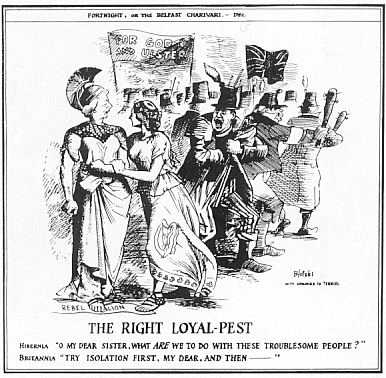
"Loyalist violence around parades and flags has created little solidarity from the rest of the UK. Perhaps no matter for now. However, with (a) possible Scottish independence, and (b) Britain’s place in Europe being debated, potentially significant changes to the UK could follow. These could have huge and potentially negative implications for Northern Ireland. Violent attacks on security forces do little for Ulster unionism in the wider UK."
