Showing posts with label partition. Show all posts

April 25, 2017

Is the British uniform really foreign?


On April 17 2017 Sinn Féin MEP Matt Carthy told a Sinn Féin commemoration at the republican plot at St Finbarr’s Cemetery in Cork where lord mayors Tomas Mac Curtain and Terence Mac Swiney are buried:
"Let me just make it clear – it is important that we remember those who fought in world wars; those people who were part of the Irish nation but for whatever reason decided to wear foreign uniforms, it’s absolutely legitimate that they should be remembered and should be commemorated."
Diarmaid Ferriter in ‘The Transformation of Ireland: 1900-2000’ wrote:
"Thousands of Irish soldiers, many of them nationalist, fought with the British army, suggesting a high degree of contentment with Ireland’s place within the Empire."
People suggest that Ireland before independence was a mere colony. However as Edward Carson said, Ireland had county councils and representative institutions. And John Redmond said in 1915:
"[Ireland has] its feet firmly planted in the groundwork and foundation of a free nation."
Read my post on Ireland's social revolution here.

The terrible ignorance of Ireland's unionists


Northern Ireland is the subject of a "terrible ignorance" by the people of the Republic of Ireland. This allows misunderstandings to linger and suspicions to fester. There are stereotypes of what an Irish protestant is like, as I wrote here, but these are incorrect. I wrote in my article, 'A Terrible Ignorance':
"Not only did Ireland of the twentieth century airbrush the constitutionalist tradition, they erased the avatar of a loyal Irish-British person and burnt the hard-drive. 
My Irishness is not singular and prescriptive, I’m Irish and British. Two buckets are easier carried than one, so I stand in-between. 
The unorthodox views of the northern protestant are never considered by the south. The Irish suffer willed amnesia when it comes to the loyal Ulstermen and women who are British and Irish."

TK Whitaker - It is much too naive to believe that Britain simply imposed Partition on Ireland


Diarmaid Ferriter wrote:
"The oft repeated contention was that partition was a British imposition and could only be undone by Britain; that there was no requirement for the Free State, or later the Republic, to come up with a solution."

June 23, 2016

Nationalism's failure to allay Unionism's fear of Rome Rule

Rev. Joseph Hocking
In a previous post I wrote that Edwardian Ireland was an apartheid state. I also wrote about the conciliation-omission of nationalism prior to the frustration of Home Rule, and I also wrote about the culpable neglect of republicanism post-partition to understand unionism or communicate to unionism the merits of unity.

February 22, 2016

Sir James Craig was Irish

Sir James Craig, Viscount Craigavon, by society painter Sir John Lavery

William O'Brien wrote a description of Sir James Craig, the first Prime Minister of Northern Ireland and utterly loyal adjutant to Sir Edward Carson, in ‘The Irish Revolution and how it came about’ (1923):
"Sir James Craig… The Ulster leader was never an incorrigible enemy of a modus vivendi with his Southern countrymen. Like so many of the higher Orange type, if he was an irresponsible being for half a dozen mad “ anniversary ” days, he was for all the rest of the year a kindly neighbour, a fast friend, more honest of heart than complex in the convolutions of his brain matter, but in all things, flattering or otherwise, as irredeemably Irish as the granite ribs of Cave Hill."
TIME Magazine featured Sir James Craig on the May 26 1924 cover of the magazine. Inside it produced a short feature on the first Prime Minister of Northern Ireland:

February 20, 2016

Partition in Ireland is strengthened by violence

Cartoon by Ian Knox
George Bernard Shaw portended that partition in the north would lead to "an autonomous political lunatic asylum." J.B. Armour, liberal presbyterian and Home Ruler, said:
"For years they have been yelling against Home Rule, and now they have got a form of Home Rule which the Devil himself could not have devised."

February 17, 2016

Why do people call Northern Ireland Ulster?

Edward Carson and James Craig, the founding fathers of Northern Ireland, who were party to the dismembering not only of Ireland but Ulster also
Nick Laird wrote:
"Under nationality I write Irish/British, though I’d be happier with Ulsterman, since Ulster itself (incorporating Northern Ireland and the Irish counties of Cavan, Monaghan and Donegal) is a province administrated by both Dublin and London."
Ulster is a misnomer, as Mr. Clynes said in 1920, "Ulster is an expression which has misled a great many people." Letter writer, J.H. Nunn, wrote to the Irish times in 1916:

February 12, 2016

Edward Carson, father of the IRA?


In the final lines of the September 1913 poem, Yeats wrote, "Romantic Ireland’s dead and gone. It’s with O’Leary in the grave." The rebel leaders shared these fears and, inspired by the rebellion of Edward Carson, they later emulated Carson's example.

February 06, 2016

Unionism won, Ctd


The IRA murder decades were a catastrophic, monumental, spectacular failure. The IRA's only triumph was to further polarise Protestant-Catholic and Planter-Gael relations, and to further poison the ability of protestants to self-identity as Irish (see research here). It ripped apart the Planter and the Gael and left Northerners with the demented notion that unionists are not and cannot be Irish.
Before 1916 and partition unionists were Irishmen. Before the IRA campaign many unionists saw themselves as Irish, now many few do. Sinn Fein reps have been known to speak to Americans, called themselves Irish unionists as British.

January 12, 2016

Christopher Hitchens on Northern Ireland, Ctd


A generation of journalists cut their teeth in Northern Ireland covering the Troubles: Robert Fisk, Max Hastings, Jeremy Paxman, John Simpson and Kevin Myers. You can add Christopher Hitchens to that incomplete list.

October 02, 2015

Irish Rugby unites Ireland

The IRFU flag

Terence O'Neill was asked in an interview in 1965 with Telefís Éireann, 'Prime. Minister, when Ireland is playing England, in a Rugby International for instance, what do you feel, as Prime Minister of Northern Ireland, as somebody from Northern Ireland?' Terence O’Neill responded:
"I think we all feel the same and we all cheer for Ireland and we always have done."
The interviewer John O’Donohue continued: 'You don’t find any awkwardness in questions of allegiances when Rugby is being played?' Terence O’Neill returned:
"No, certainly not."
Jack Kyle said:
"That was the wonderful thing about [Irish rugby, the absence of religion]. When the various unions were splitting up, the Irish Rugby Union said: “we play as one country”. Those of us from Ulster were very fortunate that happened. It was also a much greater honour for us to play for the whole country. I think it says a lot that during all the Troubles, never once did a southern side fail to come north or a northern side fail to go south."

April 07, 2015

Easter Tuesday 1916 by James Stephens

James Stephens by Sir William Rothenstein
Ninety-nine years ago the Dublin writer James Stephens lived and worked and wrote in and about Dublin. He was there on Easter Monday when the Rising leaders and rebels commandeered the GPO and other landmark buildings across Dublin in a failed attempt to overthrow British rule. He recorded the Saturday and Sunday that preceded the bloodshed, and gave and an account of Day One, Easter Monday 1916 here. He carried on and documented each of fighting that followed. And here you can read in full his experience of the Easter Tuesday, Day Two of the Easter Rising, the 6 days that would change Ireland forever. Compared with Easter 2015 when skies are open blue, the weather of 1916 was markedly more inclement. James Stephens began:
"A sultry, lowering day, and dusk skies fat with rain. 

April 02, 2015

Christopher Hitchens on partition

W.H. Auden
W. H. Auden wrote, "Two peoples fanatically at odds, With their different diets and incompatible gods." Marya Mannes wrote in 1959 
"Borders are scratched across the 
hearts of men

By strangers with a calm, judicial 
pen,

And when the borders bleed we 
watch with dread

The lines of ink across the map 
turn red."

April 24, 2014

Remembering Ireland's "patriot dead" of 1916. Forgetting Ireland's unionists.


GPO in ruins after the Easter Rising in 1916
Edward Carson said that the ideals and ambitions of Ulster should be clearly understood by the people of England, Scotland and Wales.

I want to make something very clear - The ideals and ambitions of Northern Ireland unionists and Protestants should be clearly understood in Southern Ireland. For they are each and all, "fellow countrymen."*

Being a Protestant unionist does not preclude that person from being Irish. John Hewitt said it. Nick Laird said it. Sam McAughtry said it. Loyalist Gusty Spence said it. Edward Carson was Irish. He was British. He was an Irish Unionist. An Irish man who simply wanted to be Irish and remain part of the social, political and economic infrastructure of the British Empire. As he said:
"We’re both [Tom Kettle, Home Rule nationalist] Irishmen, and that is what matters."
Edward Carson, who opposed Home Rule was an Irish unionist and wanted Ireland united. In a

March 20, 2014

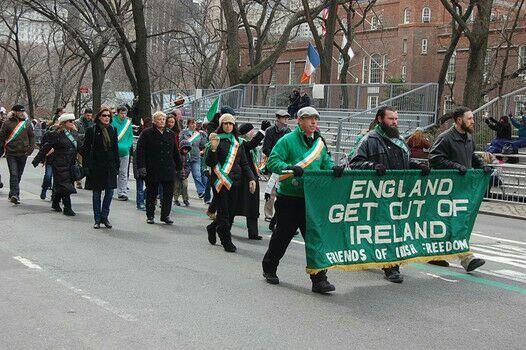
Hey Irish America! Arthur Guinness was a Protestant, a Unionist and Irish and British

2014-03-18-BritsOutBrianJohnSpencer.jpg
'England get out of Ireland', St. Patrick's Day Parade 2014, via Long Island Catholic Examiner, Deirdre Haggerty here.
[This article originally appeared on the Huffington Post, here and includes a number of corrections and an update.]

(Update below)
Irish America needs to go buy a book and learn some history. They don't have a baldy notion. Here's some context.
March 17th every year, every where is the day to be Irish. To celebrate Ireland. To celebrate Irishness. But for many, being Irish is a very exclusive and static thing. Padriag Reidy (@mePadraigReidy) alluded to it in the Guardian and rightly slapped it down, saying that'"authentic" cultural events are for faschists.' But I want to take this further.
I'm like Padraig, I'm Irish. But unlike Padraig, I'm from Northern Ireland, I'm a Protestant and I'm a Unionist who sees himself as both Irish and British.

January 16, 2014

#WhitePaper - What does a united Ireland actually mean? Ctd

Graphic via Paul Krugman
A commenter wrote on Slugger O'Toole here that more and more of his or her Catholic friends are thinking with their heads, rather than their hearts. They want to know more about what a united Ireland actually means in terms of the important issues which will effect them and their families (jobs, health, education, economy, social security, housing, political representation, policing, justice etc). Until then they see it as a case of ‘better the devil you know’ - i.e. the status quo.

This is what this series is about. Trying to find out what a united Ireland would look like in terms of jobs. But making a reasoned and considered case for maintaining the Union. Fintan O'Toole wrote in The News York Times a piece by the title 'Ireland's Rebound Is European Blarney' and said:

August 21, 2013

"Get the British out of Northern Ireland and on that happy day, all would be well with the world"


The conservative philosopher Michael Oakeshott always wanted to take the world as it is: to enjoy present laughter over utopian bliss. As someone born in the north of Ireland/Northern Ireland I've never understood the Irish republican narrative, that if we can just get the Brits/colonists/imperialists out, all will be well in the world.

I never actually heard it said. But I knew it as the unbending belief. And here's the second but, at 3 minutes 40 seconds into the video above and here, a former IRA member gave expression to this simplistic narrative. He said:
"We thought we could make change here and the change we wanted to make essentially was to get the British out of Northern Ireland and on that happy day, all would be well with the world." 
He then finished by saying:
"It (Brits out) was as simple as that for most people."  

As I wrote in an earlier blog post here, the matter was not as simple as get the Brits out. Nor was it a simple majority sentiment. Many socially aspirant Catholics on the island were unionists pre-partition and protestants almost unanimously, as a religious minority, did not want to live in a country whose affairs would be directed in-large part by the Catholic church. And so by default were almost totally unionist.

And the matter was not as simple as, get the Brits out and "all would be well with the world". Clerical bullying, lecturing, interference, social illiberalism, de Valera's idealistic anti-industry, pro-agrarian society all contributed to the creation of an incredibly bleak and oppressive state, as I wrote about here (again on Fintan O'Toole).

More recently, Fintan O'Toole said at the 2013 MacGill Summer School here, that partition was inevitable and that the three pillars of the Irish state failed massively since partition.
"Partition, which was both inevitable and tragic, and produced perhaps two failed states, he (O'Toole) said. “The North failed in obscene violence but the South failed in a slower fashion and the southern State has also lost legitimacy."
Previously, O'Toole has said that 2016 should be a time for "national embarrassment" by the measure that such a degree of sovereignty has been exported to Europe since 1973 and to the troika since November 2010.

July 23, 2013

SF fixation on Britain is bad for mental health


The importance of the Bell Magazine (the most important literary and cultural journal ever published in Ireland) to public discourse in Ireland and Northern Ireland today cannot be underestimated.

The founder member and editor of the Bell Magazine, Seán Ó Faoláin made some interesting remarks on the 'Irish fixation' on Britain. He said the obsession was bad not just for the nation's political status, but also bad for the whole definition of Irish identity. Seán Ó Faoláin said in his publication 'Eire and the Commonwealth' (of which Ireland was a member between 1931 and 1949) that:
'It is essential for the mental health of Ireland that we should as quickly as possible get to the stage where we do not give a damn about Britain.'
Related Posts Plugin for WordPress, Blogger...