
It all began with a simple Matisse-inspired cartoon and a chance tweet. The cartoon then led to the Michael Deane 'Horsemeat' collection and the first wine label. You can read all about the creative process and working relationship here.


"Everyone envies everyone else."He also wrote a poem, 'On Being Twenty-Six':
"I feared these present years, The middle twenties, When deftness disappears, And each event is Freighted with a source-encrusting doubt, And turned to drought."Quentin Blake said: "As soon as I knew something was intended for print, I tightened up."
"The main thing as I keep saying, I never tire of saying is, to keep testing yourself against other writers who are better than you. That’s what qualifies one as a writer I think, permanently running the risk of having to say I don’t know why I bother."He elaborated on this:
"[With George Orwell] you don’t get the sense for example when you’re reading Proust or Nebokhov or George Eliot that you shouldn’t be in the writing business."

"Of course the rough draft is always a ghastly mess bearing little relation to the finished result, but all the same it is the main part of the job."
 |
| Kingsley Amis by Anglo-Polish impressionist painter Feliks Topolski |
"Being pray to the anxiety of influence - and if any writer tells you that she or he doesn’t suffer from the anxiety of influence then they’re a stone-cold liar."
"W.H. Auden notoriously used to write in the marginalia "GETS", in the margins of books for "Good Enough To Steal". So I most re-read James Joyce’s Dubliners to steal stuff."
 |
| My Conference Notes Cartoon of Josh Richards (@Mighty_Ginge) at @Create2014Co, more here. |
 |
| Fintan O'Toole by Jon Berkeley |
"I was browsing Forbes, the magazine for billionaires, online about a year ago. There was a piece about Ireland’s status as a tax haven. Apparently through some technological glitch, you could see that two phrases had been edited out and replaced with euphemisms. Thus “Ireland’s tax favoured status” was struck out and replaced with “Ireland’s hospitality”.Fintan O'Toole explained how critical language is to international community's perception of Ireland:
And the statement that “US companies can pretend to be headquartered in Ireland in order to avoid US tax” was doctored to say that US companies can “set up shop in Ireland”. This kind of thing is amusing, but it’s also deadly serious."
"The Forbes piece is a perfect illustration of how vulnerable the perception of Ireland is to changes of language. Ireland is either a hospitable place where you can set up shop like a friendly village grocer or a cynical tax haven, and increasingly, in the US, it is routinely referred to as the latter.
 |
| Drawing Irish writer and thinker Colm Dore (@ColmDore) at Arcadia Deli |
 |
| Cartoon if Isaiah Berlin |
"There is little need to stress the fact that monism, and faith in a single criterion, has always proved a source of deep satisfaction both to the intellect and to the emotions… [However] it is bound, provided it is inflexible enough, to encounter some unforeseen and unforeseeable human development, which it will not fit; and will then be used to justify the a priori barbarities of Procrustes - the vivisection of actual human societies into some fixed pattern dictated by our fallible understanding of a largely imaginary past or a wholly imaginary future."
"Census figures for the Upper Ormeau Road… is 57% Catholic and 27% Protestant, yet just 36% describe themselves as "Irish", with the remainder evenly split between British and Northern Irish. So what can explain the DUP’s betrayal of an area that epitomises Peter Robinson’s stated vision of a Northern Ireland "at peace with itself" and "for all of us, not them and us".Cowardice in the face of loyalism must be a partial explanation, and it is quite some cowardice, as the upper Ormeau Road are believed to barely number into double figures. Electoral calculations in Belfast and more widely against the TUV will also be a factor. However, this retreat from its own policy and constitutional objective implies so much short-sightedness, spinelessness and stupidity that there has to be a deeper explanation.Is the DUP really envisaging a Northern Ireland that depends on Catholic support which would in turn depend on tolerance, neutrality and equality? The fact that the party sees no value whatsoever in protecting places like the upper Ormeau Road suggests its true vision is a retreat into a patchwork of ethnic laagers, with Northern Ireland becoming a Catholic Bosnia overlaid with a Protestant Republika Srpska. What other explanation can there be when ten loyalists with a ladder outweigh the 40% of Catholics in upper Ormeau who, even now, have made their peace with partition.
What the DUP wants or fears is not necessarily what will come to pass. Council reorganisation still points more to a “Belgium on the Bann” scenario, with an Irish west, a British east and an uneasily shared capital. But that less-than-ideal future is the best we can hope for and every step the DUP takes to the right brings the Balkans closer into view."
"Nineteen years after the war ended, Bosnia operates as two "entities", the predominantly Muslim and Croat Federation, and the overwhelmingly Serb-dominated Serb Republic (RS). The highly autonomous RS was recognised by the peace settlement. Many Muslims regard it as the product of ethnic cleansing, while for Serbs its existence is a guarantor of peace."
"[In Paris] I saw Picasso for the first time and Léger and all those big painters. When I saw Matisse's work – especially his late collages – he became the most important man in my life."Also here and here. Below is how Matisse inspired other modern graphic designers.
 |
| Benjamin Frankling, a pillar of the American Englightenment, by Gerald Scarfe, here |
"Above all, we are in need of a renewed Enlightenment, which will base itself on the proposition that the proper study of mankind is man and woman. This Enlightenment will not need to depend, like its predecessors, on the heroic breakthroughs of a few gifted and exceptionally courageous people. It is within the compass of the average person. The study of literature and poetry, both for its own sake and for the eternal ethical questions with which it deals, can now easily depose the scrutiny of sacred texts that have been found to be corrupt and confected. The pursuit of unfettered scientific inquiry, and the availability of new findings to masses of people by electronic means, will revolutionize our concepts of research and development. Very importantly, the divorce between the sexual life and fear, and the sexual life and disease, and the sexual life and tyranny, can now at last be attempted, on the sole condition that we banish all religions from the discourse. And all this and more is, for the first time in our history, within the reach if not the grasp of everyone."Jenni Russell (@jennirsl) wrote that there's nothing inevitable about the victory of enlightenment values. In an earlier post I wrote that Christopher Hitchens said that enlightenment principles need to be fought for and defended by every generation. Scottish historian Niall Ferguson (@nfergus) noted that "the greatest thinkers of the Scottish Enlightenment were not nationalists but cosmopolitans".
"Ignorance and bigotry, like other insanities, are incapable of self-government."I earlier wrote that we could say that sectarians are mentally and morally unwell. And so as Christopher Hitchens said, "condemnation of bigotry and superstition is not just a moral question but a matter of survival."
 |
| Cartoon of Paisley with Harold Wilson, Ted Heath, Jim Callaghan, Thatcher, Major and then Blair and Ahern. By Ian Knox. |
"Death is one of the things we do well in Ireland. There is a decency, a kindness, a communal instinct to try to lessen a family’s grief by taking a little bit of it onto ourselves...
 |
| Scanlan's Monthly cover by Ralph Steadman of Richard Nixon getting punched |
"The death this week of Christopher Hitchens and the remarkably undiluted, intense praise lavished on him by media discussions... Hitchens was an extremely controversial, polarizing figure. And particularly over the last decade, he expressed views — not ancillary to his writings but central to them — that were nothing short of repellent.
Subordinating his brave and intellectually rigorous defense of atheism, Hitchens’ glee over violence, bloodshed, and perpetual war dominated the last decade of his life. Dennis Perrin, a friend and former protégée of Hitchens, described all the way back in 2003 how Hitchens’ virtues as a writer and thinker were fully swamped by his pulsating excitement over war and the Bush/Cheney imperial agenda:
I can barely read him anymore. His pieces in the Brit tabloid The Mirror and in Slate are a mishmash of imperial justifications and plain bombast; the old elegant style is dead. His TV appearances show a smug, nasty scold with little tolerance for those who disagree with him. He looks more and more like a Ralph Steadman sketch. And in addition to all this, he’s now revising what he said during the buildup to the Iraq war."
"Nobody should have to silently watch someone with this history be converted into some sort of universally beloved literary saint. To enshrine him as worthy of unalloyed admiration is to insist that these actions were either themselves commendable or, at worst, insignificant. Nobody who writes about politics for decades will be entirely free of serious error, but how serious the error is, whether it reflects on their character, and whether they came to regret it, are all vital parts of honestly describing and assessing their work. To demand its exclusion is an act of dishonesty.

"In some ways ‘cartoonist’ is a derogatory term. People have said it to me dozens of times – you’re just a cartoonist. But I’m rather keen on the Wittgenstein bit about the only thing of value being what you cannot say. That’s the thing about drawing: when you try to say something in pictures, it gains a dimension that language can’t match. I like that.”And I wouldn't even use the term illustrator. As Quentin Blake said:
"There's a snobbery about illustration."
"I always wanted to be an artist, period: I hate the word illustrator - it just sounds so limp - I prefer cartoonist. Goya was a cartoonist, Daumier was a cartoonist, even Picasso used the cartoon form to express himself. But cartooning has got a really bad name now hasn’t it? People think it’s just something for filling up a column in a newspaper [adopts condescending voice] ‘Oh, it’s only a cartoon, here’s a fiver…’ I’m not trying to be artsy-fartsy but I don’t like the division that one thing is fine art and another thing isn’t."
"Cartooning meant more to me than just funny pictures. I needed to apply it as a weapon almost."And finally Ralph Steadman said:
"I try to use cartoon as an artist. I hate artistic snobbery. It’s bullshit. You should have no truck with it whatsoever. Have no truck with it."

I feared these present years,
The middle twenties,
When deftness disappears,
And each event is
Freighted with a source-encrusting doubt,
And turned to drought.
 |
| George Orwell by Ralph Steadman, with full selection here |
"Be deeply suspicious, first of all, of your own prejudices before you begin to approach the prejudices of others."
"George Orwell... was more likely in politics to chasten his own side than the enemy."Christopher Hitchens too:
"The unpleasant facts that George Orwell chose to face were usually the ones that put his own position, or his own preference to the test."
 |
| Christopher Hitchens by Ralph Steadman |
"The point was made better by Lionel Trilling. The remarkable thing about Orwell and the encouraging thing was he is not a genius. He lived to only 46 years. He never went to university. He never had a steady job. He usually didn’t have a steady publisher. He will never be forgotten because he managed to disprove imperialism, Stalinism and fascism in one lifetime and made some imperishable raids on its territory that no-one is ever going to forget. All the time ill. All the time poor."He then said:
"[George Orwell] shows how much difference a person of really average integrity and intelligence and education can make if they have a little courage and a little intellectual honesty. The shortcomings of the individual you can see in him too. But he basically won his own battle against his own prejudices. This is an example for all time. You don’t get the sense for example when you’re reading Proust or Nebokhov or George Eliot that you shouldn’t be in the writing business. All the people in history who said alas there was nothing I could do are lying or at least discrediting themselves. They could have. They just chose not to."
 |
| Philip Larkin by Ralph Steadman |
"After finishing my first books, say by 1945, I thought I had come to an end. I couldn’t write another novel, I published nothing. My personal life was rather harassing. Then in 1950 I went to Belfast, and things reawoke somehow. I wrote some poems, and thought, These aren’t bad, and had that little pamphlet XX Poems printed privately. I felt for the first time I was speaking for myself. Thoughts, feelings, language cohered and jumped. They have to do that. Of course they are always lying around in you, but they have to get together."He also said to the Paris Review:
"The best writing conditions I ever had were in Belfast, when I was working at the University there."In his 1950 letter to Monica Jones, Larkin described the city and its people 8 weeks after his arrival there:
"A wide and cobble-streeted town, lined with frowning buildings in the late Victorian manner & some indifferent shops. I’m already fed up with anything called Ulster, Northern, Victoria, etc., also with the Irish male face (craggy, drink-flushed, with greasy black curls and a too-tight collar & the Irish female face (plump, bad-teethed, pinkly powdered, with a diamante lizard on the lapel)."

"The most effective defender of the paper is not one of these. He has shaggy dark hair and a beard - or he did when I last saw him. For more than 20 years I have turned to his work as you would reach for coffee in the morning. He is outrageous, anarchic, brilliant, sometimes inexplicable and a bit mad (not really). For those who doubt the truth is subversive and often absurd, I point them towards two pages in the Guardian, where he resides.
Only Steve Bell exposes consistently, fearlessly, the bullshit of "public life". Indeed, his characters are often drowning in or water-skiing on the stuff. "Right, that's it," says the last governor of the Bank of England, Sir Mervyn King, to Gordon Brown, then prime minister, and chancellor Alistair Darling, "heads down, tea break over!" They are up to their chins in a tank of turds.
Steve Bell is a cartoonist and a true journalist with few rivals. He is Hogarth and Swift with a touch of Peter Sellers and a sprinkling of Orwell. He is more of an English original than one of his prime targets, Margaret Thatcher, the former petit-bourgeois totem. Often using the wickedly all-seeing penguin star of his strip, "If..." he rumbled both Thatcher and her protege, Blair, early in their criminal ascendancy."In full here. The New Statesman also covered this with, 'John Pilger on Steve Bell and the cartoonist as true journalist.'
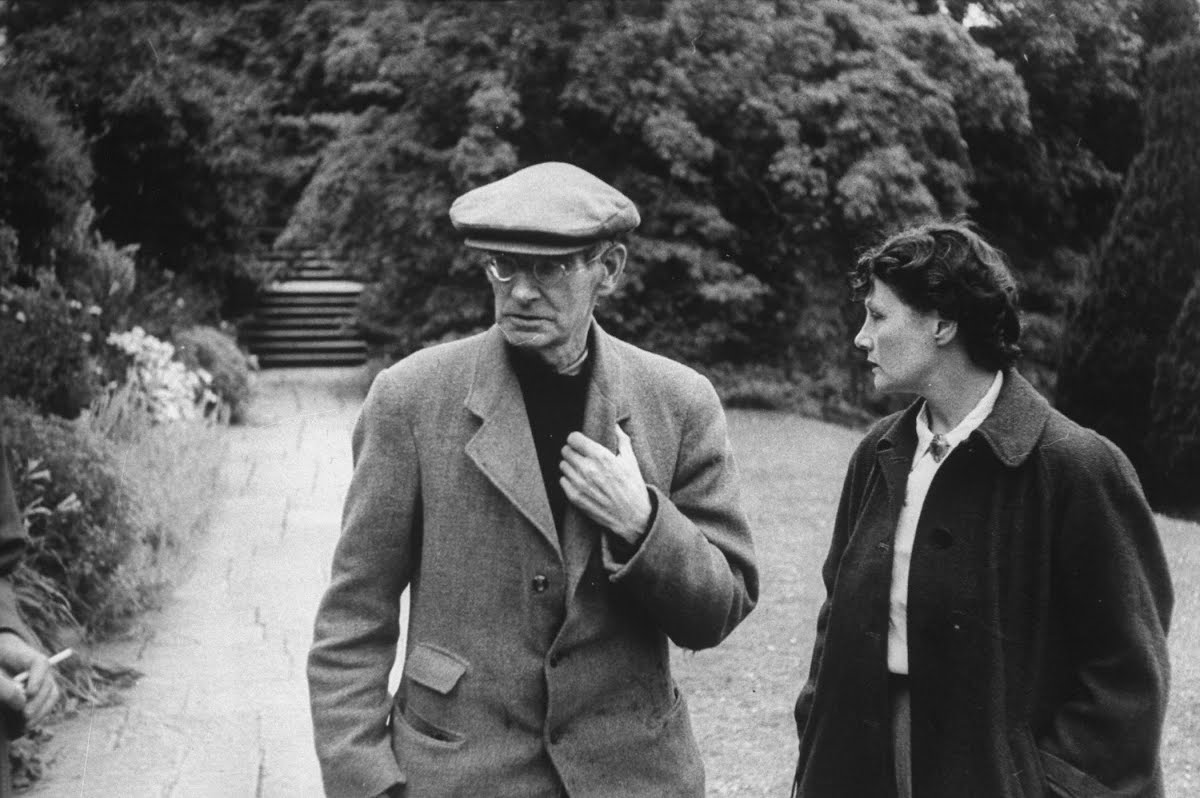 |
| Irish writer Sean O'Casey and his wife Eileen Reynolds |
"When I write a new play. When I sit down to try to write a new play, I’ve had the experience of many plays before. Yet that new play that I am going to try to write gives me the same agony, the same trouble, the, same effort, the same Herculean work as the very first play I ever wrote gave to me."Christopher Hitchens said the same thing:
"I hate to agree with George Will about this… The truth is, yes there is nothing like not writing for making you unhappy and if you have the compulsion then the only problem that you’ll have is, you surrender to this compulsion more and more and, you’ll find [writing] gets harder the more you do it. That seems a shame. It should get easier, it should become more like a facility for example. It becomes more difficult and it becomes more difficult because you are reading more and more work by better and better people and you’ve lost the sheer nerve and the blind solipsism that allowed you to think you could try it when you were young before you had made any proper comparisons. So it gets much more nerve wracking and much more difficult in every way costly for you and no doubt for your readers."Samuel Beckett on writing more generally said in 1954:
"It’s hard to go on with everything loathed and repudiated as soon as formulated, and in the act of formulation, and before formulation."Beckett also wrote:
"I realized that Joyce had gone as far as one could in the direction of knowing more, [being] in control of one’s material. He was always adding to it; you only have to look at his proofs to see that. I realized that my own way was in impoverishment, in lack of knowledge and in taking away, in subtracting rather than in adding."
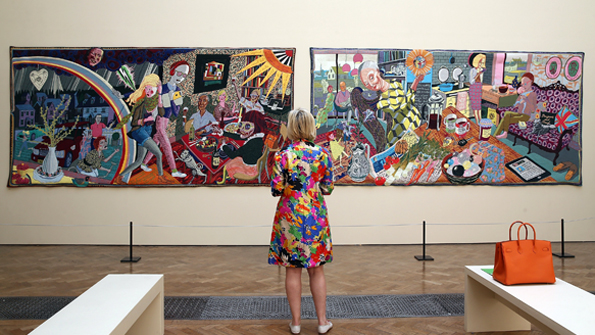 |
| The Vanity of Small Differences by Grayson Perry - A series of 6 tapestries partly inspired by Hogarth's A Rake's Progress |
"When I was the Post’s London correspondent in the early 1990s, I covered the Northern Ireland conflict. The first thing I went to see in Belfast was the notorious "peace line" between the Falls Road, a Catholic stronghold, and Shankill Road, a Protestant redoubt. Everything looked the same on both sides — the houses, the shops, the people — yet it was as if they were two different countries. Animosities had been passed down through generations. Even now, 15 years later, a civil exchange between two of the leading antagonists — Ian Paisley and Gerry Adams — is big news."Kevin Myers wrote:
"Visitors to this archipelago [Britain and Ireland] are baffled by the differences that are so passionately cherished: for what they usually perceive are similar hedgerows, Georgian architecture, endless rain, common law, wigged judges, unarmed police officers, right-hand drive, a mysteriously ubiquitous brown sauce, tea, fish and chips, and midnight drunks seeking to reduce complete strangers to smears of DNA."Christopher Hitchens wrote about Northern Ireland:
"I used to work in Northern Ireland, where religion is by no means a minor business either, and at first couldn’t tell by looking whether someone was Catholic or Protestant. After a while, I thought I could guess with a fair degree of accuracy, but most of the inhabitants of Belfast seemed able to do it by some kind of instinct. There is a small underlay of ethnic difference there, with the original Gaels being a little darker and smaller than the blonder Scots who were imported as settlers, but to the outsider it is impalpable. It’s just that it’s the dominant question locally."He also said:
"In numerous cases of apparently ethno-nationalist conflict, the deepest hatreds are manifested between people who—to most outward appearances—exhibit very few significant distinctions. It is one of the great contradictions of civilization and one of the great sources of its discontents, and Sigmund Freud even found a term for it: "the narcissism of the small difference." As he wrote, "It is precisely the minor differences in people who are otherwise alike that form the basis of feelings of hostility between them."Sir Ivor Roberts, president of Trinity College, Oxford wrote:
"On the island of Ireland, we had two branches of Christianity literally at each other’s throats in the name of nationalism and mutual religious intolerance. Why was this? The answer to the question comes, I think, in an essay by Freud nearly 100 years ago on the subject of what he called “the narcissism of small differences”. Freud’s contention was that it was precisely in the groups which had relatively little to distinguish each other that the jealousies, the narcissism most easily led to violent attempts to mark that difference and to want to obliterate those who most nearly resembled you. The read across to Northern Ireland is clear enough.
To circumvent these “minor differences”, to move away from nationalism and tribalism/sectarianism involves reducing the extent to which people feel secure and understood only among people like themselves. Put another way, we need to find a way to overcome what has been described as social autism. The Canadian author and latterly politician Michael Ignatieff put it well “the pathology of groups so enclosed in their own circle of victimhood or so locked into their own myths or rituals of violence that they can’t listen, can’t hear, can’t learn from anybody outside themselves.” We need to overcome, in Northern Ireland, this bell-jar mentality by discounting and rejecting sectarianism in all its sinister forms and promoting not just trust but the kind of individualism that can survive only in conditions of trust. The murderous attack made against NI police officer Ronan Kerr for daring to join the new integrated police service in Northern Ireland is, of course, anathema to that approach and a classic example of intolerance and of the collective gangsterism in which paramilitary structures thrive."It's Christopher Hitchens who is last and the best on it:
"Condemnation of bigotry and superstition is not just a moral question but a matter of survival."

