January 03, 2014

Guest Post - Moon Child

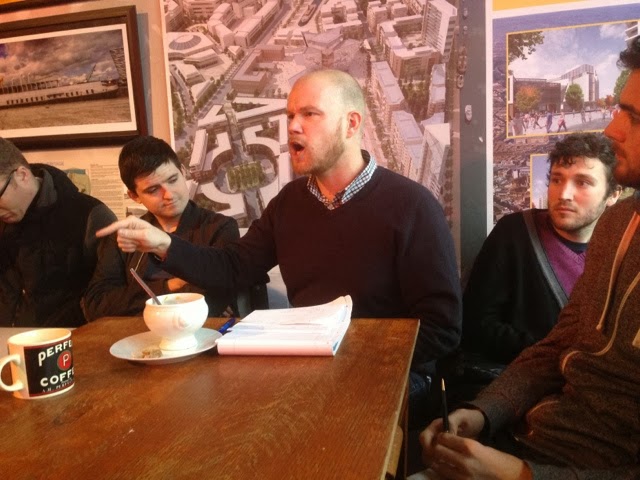
Jason O'Rourke gives a read in Belfast city centre
During the winter it gets dark early in Belfast. You may grudgingly accept that this is the price you pay for those heady long summer nights, but even so, it’s December now, and June is a long way off. It’s difficult to conjure the memory of warmth and blue evening skies when it’s pitch black at 5 p.m.

Tonight it is icy outside; the air is clean and clear. Despite interference from the orange streetlamps the evening sky is deep and massive; a myriad of stars can be seen in sharp focus. There are no clouds to hinder your view. On nights like this, when all these stars are visible, you look up at the sky in awe of the scale of it all: there are so many possibilities out there. The moon is a fat, blunt-ended, waxing crescent; almost gibbous. It hangs low in the sky, a colossal presence above the roof-ridges of the terraced houses, and its crater-pocks and lines are easily visible. Belfast is bathed in its pale light; the frosty pavements and rooftops glitter in its glow. It is entrancing; you want to stop the car to look at it.

January 02, 2014

The two world's of Northern Ireland, Ctd internal émigrés

Brian Feeney wrote in The Irish News of January 1 2014:
In April 1982 Sir Peter Frogatt, vice-Chancellor of Queen's, told Sir Ewart Bell, head of the Northern Ireland Civil service, that there was "a considerable exodus to British universities especially on the part of the Protestant community."

Ewart Bell reported this to the then proconsul Jim Prior and said he regarded it as "another step towards the extent to which the Protestant community is 'opting out' of Northern Ireland."
Brian Feeney said:
"None of these internal émigrés participates in or endorses the antics of the yahoos waving flags or hammering big drums outside Catholic Churches... Yesterday's [Haass talks] failure will simply reinforce the majority of unionists in their opinion that, in the words of Alex Kane, they prefer to go to the garden centre that bother voting."
Brian Feeney concluded:
"It seems the out-working of Ewart Bell's 1982 warning about students will be extrapolated to society in general so that as the nationalist vote increases Sinn Fein will take ownership of the north. The DUP can still change but they can't stop it. If they weren't so pig-headed and bigoted they could influence it before they become a minority."
Read me blog post on professor John Brewer who said that the silent majority needs to reclaim the peace process here. My blog post on Fionualla Meredith who said people need to speak up and pound the streets here. With contributions from Pete Shirlow here. My blog following Richard Haass comment that a majority want peace is here. My previous posts in 'The Two Worlds of Northern Ireland' series here, here, here, here, here, here and here.

When are we going to have an honest conversation about the conduct of PUL parades?


In response to the failure of the Haass talks, Alliance Leader David Ford said: "The real issue with parades was never about structures - the problem was behavior." This is interesting since the Belfast City Centre Management report here on the 12th July parades delivered a stinging indictment against the bands and Orange lodges that march through the capital city. It found tourists who complained of an "intimidatory atmosphere", "louts roaming around drunk" and an untidy public realm.

In my earlier post here I cited a 1925 essay by the Ulster MP W.D. Allen on an Orange demonstration in Tyrone.
"Silently, humorously, doggedly, they mass around a dripping platform, a remarkable feudal, patriarchal, tribal, historical anachronism in these days of moderation, toleration – whine, don’t fight – enlightenment."
I also looked at John Hewitt's 1970 poem, 'Conversations in Hungary' here:
"Our friends in Budapest
days later also, puzzled, queried why,
when the time's vibrant with technology,
Such violence should still be manifest.

Between two factions, in religion's name.
It is 300 years since, they declared,
divergent sects put claim and
counterclaim to arbitration of the torch
and sword."
Conor Cruise O'Brien said in 1996:
"I have, in an Orange context at an Orange House, urged them to see that marching through areas that don't want them is not good policy for the Orange Order itself or for the unionist community."
The first "Orange riot" on record was in 1824, in Abingdon, New York. The 'Orange Riots' of 1870 and 1871 in New York here were infamous. After this, the Congregationalist minister Merrill Richardson from the pulpit of his Madison Avenue church said that the time had come to take back New York City, for if "the higher classes will not govern, the lower classes will."

Andrew Sullivan - Blogging has enormous depth


Andrew Sullivan said in 2006 on what blogging is:
"My own approach is I'm just a thinking out loud person. I'm a conservative who is attacking [George] Bush which is putting me in a strange position. The limitation of a blog is that it has to be instant; which means it can't be a terribly considered judgement. But it's also deep because you can have hyperlinks that link the reader to original sources and original texts. So readers, unlike TV, or even unlike newspapers, readers can look at my opinion and then they can go to the original source and make their own mind up. That is enormous depth."
In full here. Previous blog on Andrew Sullivan and legal blogging here. This blog post was originally posted on my law blog, Twitter for Lawyers here.

January 01, 2014

The Cult of University, Ctd Science versus arts students

The point made in the last post in The Cult of University series here, was that attending 8 hours of lectures per week in an arts/humanities/social 'science' course is a waste of £27,000, except for the academically gifted. Carola Binney (@carolabinney) said in The Spectator here:
"I [an arts student] have three-and-a-half contact hours a week. Two of these are just ‘advisable’, and are sacrificed to essay crises with some regularity... Us Arts students have to decide to work. We have to get ourselves up, preferably in the morning. We have to choose to do today what we could do at 2am tomorrow. We have to turn down a pub trip in favour of an evening alone with our books. Hungover and exhausted, who wouldn’t rather sit watching acid drip into alkaline for a couple of hours, rather than trawling through Asser’s Life of King Alfred."
I want to ask again: What average 18,19, 20 or 21 year old is going to construct an effective learning curriculum around a 3-8 hour week of lectures and tutorials? From my own personal experience, not many. This is where the self-directed drinks curriculum takes precedence, as per By my mind, this is a waste an inefficient allocation of human potential.

Dale J. Stephens said here:
"I enrolled into college... However any idealism was quickly squashed. For the most part, people weren't there to learn - they were there to party, and hangovers permitting, learn something along the way. I started asking questions." 
Previous posts in The Cult of University series here, here university here, here, here, on the University Neurosis here, on The Legally Blonde complex here and also a piece here. Also on the Huffington Post here.

My blog post on YouGov who found that employers have found graduates non-work-ready, here. My blog post here where a Sunday Times poll found that students are critical of university teaching standard and that universities are more interested in research than teaching students.

Thomas Nast - No Sect Can Rule this School


Carlos Velazquez wrote a commentary on the cartoon done by Thomas Nast, the father of the American editorial cartoonist tradition, which accompanied an article from a 1875 edition of Harper’s Weekly.  On page 385 of that publication is an articleed titled 'The Public Schools and its Foes.' Directly above the article was another political cartoon by Nast. The Thomas Nast cartoon, 'No Church need apply' depicts a Catholic bishop passing out Vatican decrees to young school children. These children are placed in a doorway of the school, besides which appeared a sign which read, 'No Sect can rule this school,' This was the theme of the companion article. Carlos explained the cartoon and the companion article here:
"The companion article written by Eugene Lawrence highlighted the greatest enemy of the common schools as being the Roman Catholic Church and its leader Pope Pius IX as well as other religious/political institutions that did not promote American common schools. The article favored the condition of the common schools and emphasized what we consider today to be the separation of church and state: 
“Their people have become conscious that the common school is the source of ease, comfort, wealth; that it doubles the value of their lands, build towns, factories, railroads; and hence all over the south there is a plain advance toward a new condition of society.” (p.386)
Furthermore, Lawrence cited the common schools as places for “repression of violence” and “cultivation of knowledge” and expresses the notion that the enemies of the common school, which included, “a foreign pope, democratic politicians and a foreign sect” as being responsible for “the decreed destruction of the common school…” (p.386)

Loyalist violence weakens the argument for Northern Ireland remaining in the Union


John Major previously spoke of loyalism's "phantom fear" here.  Hugo MacNeill has since written a piece by the title, 'Young People Have a New Vision for Northern Ireland', in The Irish Times here:
"Loyalist violence around parades and flags has created little solidarity from the rest of the UK. Perhaps no matter for now. However, with (a) possible Scottish independence, and (b) Britain’s place in Europe being debated, potentially significant changes to the UK could follow. These could have huge and potentially negative implications for Northern Ireland. Violent attacks on security forces do little for Ulster unionism in the wider UK."

December 31, 2013

The artist's journey, Maria Popova Explains Our Remix Culture

The above image is a screen shot from a video on remix culture by Kirby Ferguson here and here
Maria Popova gave a Creative Mornings presentation here and included a video by Kirby Ferguson who said:
"George Lucas collected materials, he combined them, he transformed them. Without the films that preceeded it, there could be no Star Wars. Creation requires influence. Everything we make is a remix of existing creations, our lives and the lives of others."
Watch the Kirby Ferson video, Everything is a Remix here. See Ferguson's blog here. Read about the remix culture on Wikipedia here. Watch the Maria Popova video in full here. Daniel Hannan on combinatorial creativity here.

My blog post on Aleks Krotoski on combinatorial creativity is here (Krotoski's blogs here, here and here). My previous posts on the artist's journey featuring political cartoonists Morten Morland, Martin Rowson and Steve Bell here, on the standing on the shoulder of giants cartoon by Thompson here and on Terry Bradley here. With a special focus on my work and on how I moved from a wine label illustration to an exhibition series here, on the elements that were combined to create a wall painting for Michael Deane here, the process behind a wall painting here, my move from pen and ink and into a clay model version of the Michael Deane Decano Man here, and my explanation on how the original Decano man was created here. On the Deaneos wine label, click here. For the Deaneos Prosecco label, click here.

My Art is Theft series featuring Ronald Searle, Quentin Blake and Morten Morland here, with Ian Knox and Brook here, with Morten Morland talking about theft here, and a piece on the links between Morten Morland and Michael Ramirez here. On the theft of Peter Brookes' cartoon, read here.

December 30, 2013

Retuning our definition of success, Ctd James Hart

"Once a musician has enough ability to get into a top music school, the thing that distinguishes one performer from another is how hard he or she works. That’s it. And what’s more, the people at the very top don’t work just harder or even much harder than everyone else. They work much, much harder." 
 - Malcolm Gladwell, Outliers: The Story of Success
In October 2013 The Irish Times wrote a piece here on the Irish rugby player James Hart by the title, 'James Hart’s work ethic at Grenoble opens alternative route to success.' And that's the key point. The assumption that natural gift is the normal route to success, as opposed to hard work. Matthew Syed spoke about that on Radio 4 which I covered here. James Hart explained his story to Peter O'Reilly in The Sunday Times of December 29 2013 here:
"I was on a bus on the way out to a 20s session in Donnybrook when I got the call. The day I got my Leaving Cert results. All I’d been working for was to make the Leinster 20s. It was a real kick in the balls. I just didn’t give up."
He explained his move to France and the role of being up close and personal with the senior players at Stade Toulousain:
"I was just in awe of [Byron Kelleher and Jean-Baptiste Elissalde]. I used to love watching the two of them pass and kick. Kelleher was so physically impressive. Elissalde was just so smart in the way he read the game and could kick off either foot. That summer I read one of Jonny Wilkinson’s books and it kind of made sense to me. I knew I had a bit of natural talent but I knew that if I was going to make anything of myself, I’d have to work extremely hard. So that’s what I decided... I’d have been bored out of my tree at weekends. I used to just have a bag of balls and kick and pass, I don’t know for how long. It was just what I used to do when I was bored. I suppose all those hours add up. At the start I found it tough. I wasn’t really playing well. I was thinking, ‘Am I really that good?’ And sometimes I wanted to go home. I rang my mam and told her: ‘I can’t do this.’ You’ve got to hold your own, though. I’d be upset for a little bit and I’d tell myself: ‘You’ve got to keep working. Maybe something will happen.’"
Bernard Jackman gave his take on James Hart here:
"Lots of players want to be great but not many are willing to put in the hours and hours of practice that it takes. I’ve never seen anybody train as hard as James Hart. He has made himself an unbelievably good, technical player. He’s picture perfect."
Read my blog post on Christopher Hitchens and his definition and secret to success here, where he said:
"I became a really hard worker. A person of almost iron self discipline. I built my own workspace at home. I never went to an office anymore. I didn't hang out with people at lunch. Got on with it. If I wasn't reading, I was writing."
We can also look to this quote by unknown:
"Successful people aren't born that way. They become successful by establishing the habit of doing things unsuccessful people don't like to do. The successful people don't always like these things themselves; they just get on and do them."
My previous posts on the need to redefine our definition of success with Maria Popova here, with Matthew Syed here, with Matthew Syed again here, with Dan Pink here, with Washington educationalist Michelle Rhee here, and with Sir Ken Robinson here. My posts on creativity with Charlie Rose here, with Aleks Krotowski on combinatorial creativity here, on networked knowledge here, here, with Giles Coren here, with Sinead O'Connor here, with Muriel Rukeyser here and on coffeehouses as crucibles of creativity here.

December 27, 2013

(Guest post) Special Delivery: a Screenplay

The characters:

John McCarthy: Journalist, and former hostage during the Lebanon Hostage Crisis, held captive for five years from 1986 to 1991. Now making a documentary series for the BBC with Sandi Toksvig called Island Race.


 Big Tony: Taxi driver for AA Taxis on the Lower Ormeau Road. Sound big fella.

Act 1. Scene 1: The A2 between Belfast and Bangor, 1995, hedged rural landscape. Dawn is just breaking and the taxi’s headlamps are on. We see the car from behind, rolling calmly along the otherwise deserted road in the half-light. Big Tony is a reliable driver, and has been specifically sought out and tasked with collecting John McCarthy early in the morning. He knows who is in his cab. John is going to Bangor to visit his old cell mate Brian Keenan.

[We can hear the conversation from inside the taxi]:

Big Tony: Do I know you from somewhere?

John McCarthy: I’m John McCarthy.

December 25, 2013

Northern Ireland's social and economic emigrant, Ctd


Susan Hattis Rolef wrote a piece in The Jerusalem Post here by the title, 'Think About It: Why Israelis moved to Europe'. She said of why young Israelis leave Israel:
"The reasons for their decision to leave are varied, and include besides the economic reasons (usually the straw that breaks the camel’s back) loss of hope that peace will ever prevail between Israel and its neighbors, for which they believe Israel is as much to blame as the Arabs; discomfort with the lack of determination of Israel’s leaders to make a serious effort to separate religion and state, and enable seculars to enjoy nonreligious marriages and burial services, public transportation on Saturday etc.; and the feeling that life in Israel frequently feels like life in a pressure cooker, where too many people are nervous, intolerant and violent."
Sound familiar? I touched on the issue of forced emigration from Northern Ireland on Eamonnmallie.com here. I also wrote a piece on Slugger O'Toole here in response to a question David McCann wrote here on the same site: 'Are Young People Getting a Fair Go Politically in Northern Ireland?'

Previous post in the series here.

Why "Thinking like a lawyer" is a nonsense

Senior editor and legal correspondent, Dahlia Lithwick said in The New Republic here:
"Being trained to “think like a lawyer” is terrific as far as it goes. But legal education is notoriously abstract, impractical, and obfuscating. I don’t want someone to “think like a doctor” when she’s taking out my gall bladder. I want her to take out my gall bladder."
Jordan Weismann, associate editor of The Atlantic Magazine said the same for the tired platitude, "thinking like a lawyer". He said here:
"And in the end, despite all the homilies about how you can do anything with a law degree, firms big and small are still the major driver of J.D. hiring. Without Big Law's explosive growth, it's impossible to imagine that law schools would have ever expanded or raised tuition the way they did during the good times. With Big Law on the rocks, we can only be thankful that schools themselves are now shrinking."

December 24, 2013

The artist's journey, Ctd Terry Bradley


If we compare the image above and below with the 3 images at the bottom it is remarkable to see the evolution of the artist, Terry Bradley, over the years. From work that is clumpy and crude to delicate and detailed. It really proves what Sir Ken Robinson preaches here, that artistic and skills of creativity can be learnt and developed. It also gives a nod to Maria Popova and Matthew Syed who say here that we need to reevaluate success and how we achieve it.

My previous posts on the artist's journey here and here, and with focus on my work here, here and here.

December 23, 2013

Live Drawing - Christmas Party


I was at a Christmas party and took on the task of entertaining the kids with my grand selection of pens, pencils, crayons, felt-tip pens and paper. Below are some of the cartoons I produced as well as one of baby Henry.

Art is theft, Ctd Ronald Searle and Morten Morland


Ronald Searle above. Morten Morland remixes below:


And below is Quentin Blake:


#WhitePaper - The case for Northern Ireland Ctd Conall McDevitt

The goal of this series is to articulate a positive, considered and optimistic case for maintaining the Union. My first post on the series is here. (An earlier piece again that inspired this project, which includes contributions from Diarmaid Ferriter, Charles Townsend, Alan Hynes, Seán Ó Faoláin and Ernest A. Boyd can be read here.) In the second post I want to look at what Conall McDevitt had to say on the matter of a United Ireland in an interview with Alan in Belfast here.

His first point was the very raison d'etre of this series, that the case for a United Ireland hasn't actually been articulated. He said:
"If we’re honest with ourselves we haven’t done a huge amount of work in trying to work through what that would look like (if you’re thinking about a united Ireland) or to consider the practical issues around it. How would you pay for it? What system of government might be best? Would it be a unitary state? Or would you have a federal Ireland?"
Below are a selection of interesting points made by Conall. The first that there is a need to make Northern Ireland work:
"The trick to a new Ireland is to make Northern Ireland as it is today work. That is the key to building a new Ireland. To make Northern Ireland as it is today a success."
He also said that a United Ireland would likely be federal:
"Éamon de Valera in debates in the Dáil at the time of the Republic of Ireland bill, whenever they were establishing the republic, talked openly and at length about the fact that a united Ireland would nearly certainly be a federal Ireland. O think federalism would be the way of us being able to capture the diversity of who we are. It would be the way we could use to acknowledge regional identities and regional levels of government at the same time as having a national sense of purpose. It would involve sending TDs to the Dáil rather than MPs to Westminster but Stormont would most likely remain. Stormont would most likely continue to run the health service here."
He also said that people would be free to express their British identity. He said:
"There’s no question that in the new Ireland people born and wishing to enjoy a British identity should have the right to that identity. That seems to me to be a fundamental tenet of the new Ireland."
The first post in the series can be seen here and the earlier piece again which inspired this project (and includes contributions from Diarmaid Ferriter, Charles Townsend, Alan Hynes, Seán Ó Faoláin and Ernest A. Boyd) can be read here.

December 22, 2013

The doctrine of 'Civil Intolerance'

The Quilliam Foundation explained the need for the UK to adopt a clear anti-extremism strategy and explained the need for 'civil intolerance' here:
"The UK prides itself on its ability to uphold civil liberties and the values of tolerance, respect and democracy. These should not be compromised, and a doctrine of ‘legal tolerance’ should be adhered to when dealing with extremist views. There is naturally a reluctance to intervene in the rights of others with regards to the associations they make. Despite this hesitation however, the fact that extremism in any form poses a threat to our civil liberties and to the British values we cherish so much cannot be ignored. Ideas and ideologies that sow division, bigotry and hatred such as those that may eventually lead to terrorism should not and cannot be left unchallenged in our society. Here, a doctrine of ‘civil intolerance’ is encouraged."
Quilliam policy document in full here.

The artist's journey, Ctd Model Decano Man


Above and below you will see a sample of images of a clay model I made in the spur of the moment after a flash of inspiration. The model is of Michael Deane's Decano man which was originally produced for my exhibition, Belfast Faces and Famous Places and then used on Michael Deane's Chez Deaneo wine bottle (read about that process here). Click here to see the combinational, remix and networked creative process that helped to create the Decano Man in that started all this. That then lead onto the Horse Meat series of paintings here which placed the Decano figure into a series of culinary, gastronomical and animal settings. This was then followed by a commission to produce an image for Michael Deane's signature Prosecco (read about that process here). 

This also coincided with a commission to produce a 6 foot wall painting which further built on the look, feel and style of the Decano man series (see that process here). This then led onto a 4 foot wall painting which built again on all of the work made up until that point (see that process here). At that stage, the process slowed in terms of output but undoubtedly continued internally. Then came the inspiration to create the clay model. From this point I hope to create a fuller model by colour and detail.

Surveying the whole process it is interesting to see that, from that one drawing of Michael Deane has exploded a fountain of creativity which hasn't stopped flowing. And the clay model Decano man is just the latest in a serial and sequential creative process. Long may it continue.


  • Belfast Faces and Famous Places here.
  • Deaneos wine here.
  • The combinatorial and remix creative process that created the original Decano Man here.
  • Horse Meat exhibition here.
  • Deaneo's Prosecco here.


Overview the whole process from start to finish by viewing herehere, hereherehereherehere and here.

December 21, 2013

Third Way - 21 December 2013

 
I made a brief address along the following lines.
"Peace has to be fought for in every generation. As Christopher Hitchens said, the enlightenment principles have to be promoted and defended time after time. We are the post-conflict generation. We are the poeple of Northern Ireland who have liberated ourselves from the Cold War mentality of green versus orange. We are like Rosa Luxembourg, internationalists whose loyalties lie beyond the nation state. 
Our leaders are failing. As Trevor Ringland said, we need to become more demanding of our leaders. 
We want to mark the 16th anniversary of the GFA and every year thereafter. Look at Hannah Nelson. She is so representative of the post-conflict generation. She was wheeled out for Obama and then binned, and the extremists were wheeled back in. The United Community document was rushed out for Obama and then shelved. Now we have the Haass failure. 
Tony Novosel said post-conflict societies can slip back into violence. The precedence is there also  that socities can maintain the peace. Just as Americans fought for the removal of the Jim crow laws, so we need to fight for change. The urge to censor and shut out unwelcome or unpleasant opinions will always exist. Freedom of speech has to be refought for in every generation.  
W.B. Yeats wrote: 'The centre cannot hold, mere anarchy is loosed upon the world/ The worst are full of riotous passions, the best lack all conviction.' We the best need to fight for our peace, stability and prosperity."
More images from the day below:

December 20, 2013

Live Drawing - DUP politicians


I spent the Saturday of November 23 2013 with the Arts Council NI at the DUP Conference drawing politicians and the proceedings. To see a selection of my drawings of the proceedings click here. To see a selection of my drawings of the politicians click and see below.

Also see my blog post on drawing Edwin Poots here.
Related Posts Plugin for WordPress, Blogger...