
By no means a copy or plagiarism, but the remixing of the visual idiom is interesting. Above is Ronald Searle and immediately below is Morten Morland.

 |
| The famous Roy Lichtenstein 'Wham!' panel is the above image. The original by Irv Novick is below it. |
 |
| Kingsley Amis by Anglo-Polish impressionist painter Feliks Topolski |
"Being pray to the anxiety of influence - and if any writer tells you that she or he doesn’t suffer from the anxiety of influence then they’re a stone-cold liar."
"W.H. Auden notoriously used to write in the marginalia "GETS", in the margins of books for "Good Enough To Steal". So I most re-read James Joyce’s Dubliners to steal stuff."
 |
| Giles cartoon 25th July 1954 |
"The catalyst for my creation of Bash Street was a Giles cartoon of January 1953: kids pouring out of school, heads flying off and sundry mayhems. Straight away, I pencilled a drawing of 'The Kids of Bash Street School' and posted it from my home in Preston to R. D. Low, the managing editor of D.C. Thomson's children's publications in Dundee. I received an offhand response, a dampener. It was only after I'd created Little Plum (April 1953) and Minnie the Minx (September 1953) that the Beano editor George Moonie travelled to Preston on 20 October 1953 and asked me to go ahead with Bash Street (he gave it the provisional title of 'When The Bell Goes'; when it appeared in The Beano in February 1954, it was titled 'When The Bell Rings'."He also wrote:
"Alan Moore, Steve Bell, Savage Pencil and others have taken the ethos of my work, The Beano Spirit, that uninhibited outlook, and they’re carrying it on in their own work. I think that’s wonderful."

"Shakespeare was fantastically comprehensive in where he went for all his stories. He knew how to borrow and he knew how to be inspired."He also said:
"The Barge speech in Thomas North’s ‘Lives of the Ancient Romans’, Shakespeare pilfers fairly comprehensively. He scattered his gatherings but always, always transforming."Steven Greenblatt wrote in the Telegraph about the move of ideas from Montaigne to Shakespeare:
"The borrowing extends beyond certain expressions – kind of traffic, name of magistrate, use of service, and the like – to a vision of a whole society organised on principles directly counter to those in place in the familiar, grim realm of contemporary European reality. That is, here [The Tempest] as in the case of King Lear, Shakespeare is mining Florio’s Montaigne not simply for turns of phrase but for key concepts central to the play in question."He continued:
"Scholars have seen Montaigne’s fingerprints on many other works by Shakespeare, whether in the echoing of words or ideas. When Hamlet exclaims to his mother, “Ecstasy? My pulse as yours doth temperately keep time,” (III .iv.130–31), Shakespeare may have picked up a hint from Montaigne’s “during his ecstasy, he seemed to have neither pulse nor breath” from “Of the Force of Imagination.” And Polonius’s “This above all: to thine own self be true” may owe something to “That above all, he be instructed to yield, yea to quit his weapons unto truth” from “Of the Institution of Education of Children.” More broadly, there is something strikingly Montaigne-like in Hamlet’s intertwining of Stoicism — “Give me that man / That is not passion’s slave, and I will wear him / In my heart’s core” — (III .ii.64–66) with philosophical skepticism — “And yet to me what is this quintessence of dust?” — (II .ii.297–98) and inner acceptance — “If it be now, ’tis not to come. If it be not to come, it will be now. If it be not now, yet it will come. The readiness is all.” (V.ii.158–60)...But what is a problem for the scholarly attempt to establish a clear line of influence is, from the perspective of the common reader, a source of deep pleasure. Two of the greatest writers of the Renaissance — two of the greatest writers the world has ever known — were at work almost at the same time, reflecting on the human condition and inventing the stylistic means to register their subtlest perceptions in language."


"[Elaine Sturtevant] made her controversial artistic debut in 1965 at the Bianchini Gallery, New York, when she repeated Andy Warhol's Flowers, a series of silk-screen prints that he had shown a couple of weeks before. Today it is par for the course for images to be sampled, re-used and edited, but in the early 60s, acts of appropriation were yet to become a staple of the art world."On the occasion of her 2012 retrospective, Sturtevant: Image Over Image, at the Moderna Museet, Stockholm, Elaine Sturtevant said:
"What is currently compelling is our pervasive cybernetic mode, which plunks copyright into mythology, makes origins a romantic notion, and pushes creativity outside the self. Remake, reuse, reassemble, recombine – that's the way to go."According to Alexis Petridis, Gerald Scarfe and Ralph Steadman fell out after Steadman's first wife accused Scarfe of plagiarism.

"I learned to draw and paint on my own, and I did it by copying."He also said:
"I understood more about Vermeer by painting my own Vermeer… than I had ever learned by simply staring at his paintings."Oliver jeffers said the same:
"Only those with no memory insist on their originality."Andrew Sullivan wrote a piece, 'In defence of duplicating art'.
 |
| Rembrandt, Self Portrait at the Age of 34. |
"Good artists copy, great artists steal," said Pablo Picasso. Or at least he gets the credit for saying it. Perhaps he pinched the words from Oscar Wilde. For there truly is nothing new under the sun, or not entirely new, anyway. Originality does not burst from an artist's head like an alien entity, but is a subtle game of variations and transformations out of which, once in a while, comes the shudder of true artistic surprise.


"Only those with no memory insist on their originality."
— Coco Chanel
"Imitation is not just the sincerest form of flattery - it's the sincerest form of learning."
― George Bernard Shaw


"Only those with no memory insist on their originality."
— Coco Chanel
"Imitation is not just the sincerest form of flattery - it's the sincerest form of learning."
― George Bernard Shaw

"There is a reason the character of the Boy in my first picture books wears a red and white stripy jumper, and that reason is Maurice Sendak. Or, more specifically, that reason is an homage to my favorite monster in Sendak's most famous picture book, Where the Wild Things Are... As a young artist trying to find my style, I deliberately tried to avoid being directly influenced by – and thus compared with – such strong and unique work. However, as he so informed my childhood, I could not resist one very direct and visual tribute – a red and white stripy jumper."
"Of all Isaac Newton’s gifts to humanity, my personal favourite is his famous turn of phrase, written in a letter to Robert Hooke in 1676: “If I have seen further it is by standing on the shoulders of giants.”
There is such a beautiful humility and economy in the words, a vivid evocation of the process of human learning. The Principia Mathematica is a work of genius, no doubt, but in that phrase Newton acknowledges how his work builds on the breakthroughs of Kepler, Copernicus, Tycho Brahe, Galileo and so on.
Since then, of course, Newton’s model of classical mechanics has been superseded by quantum physics, with the likes of Einstein, Planck and Bohr building on, and sometimes dismantling, those earlier theories."

"Please don’t steal my car... But my ideas? Sure, yes, please, by all means, take them...
I got an email from a reader last week. She was spitting angry at another blogger and wanted me to lower the hammer on him. According to my loyal reader, he had plagiarized many of my ideas, writing one post after another that, while not using my words, clearly demonstrated to her that he was hunting on my land.
Not true, I assured her. He hadn’t plagiarized anything, he had built something new, by synthesizing ideas and experiences to invent the next step, a step available to all of us."

 |
| The above image is a screen shot from a video on remix culture by Kirby Ferguson here and here |
"George Lucas collected materials, he combined them, he transformed them. Without the films that preceeded it, there could be no Star Wars. Creation requires influence. Everything we make is a remix of existing creations, our lives and the lives of others."Watch the Kirby Ferson video, Everything is a Remix here. See Ferguson's blog here. Read about the remix culture on Wikipedia here. Watch the Maria Popova video in full here. Daniel Hannan on combinatorial creativity here.


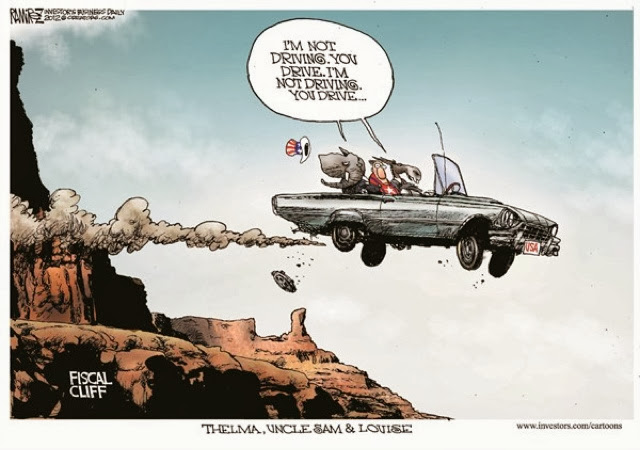
"Influence, plagiarism, copying etc, is a difficult subject in any creative profession. It’s been said that plagiarism is the sincerest form of flattery, but I have a feeling it was a plagiarist who first said it. In court. On his knees. It’s bollocks of course. In its purest form it’s the sincerest form of laziness…
In a profession like cartooning though, it can often be difficult to distinguish between intentional plagiarism and (unfortunate) coincidence, and between influence and identity theft. I reckon most cartoonist at some point must have drawn a cartoon and realised afterwards that the idea was not a result of their own brilliance, but an unintentional ‘rip-off’ of an idea they’d seen in the past. As most cartoonists themselves are eager follower of cartoons, it is not entirely surprising that this can happen.
@Blowercartoons ....and here's one I did earlier! pic.twitter.com/gdvqLmPCpR
— Peter Brookes (@BrookesTimes) July 5, 2013


