Showing posts with label networked knowledge. Show all posts

January 22, 2014

Combinatorial creativity, Ctd Abraham Lincoln


Abraham Lincoln delivered the famous The House Divided Speech  on June 16, 1858. In that speech he said:
"A house divided against itself cannot stand. I believe this government cannot endure, permanently, half slave and half free. I do not expect the Union to be dissolved — I do not expect the house to fall — but I do expect it will cease to be divided. It will become all one thing or all the other. Either the opponents of slavery will arrest the further spread of it, and place it where the public mind shall rest in the belief that it is in the course of ultimate extinction; or its advocates will push it forward, till it shall become lawful in all the States, old as well as new — North as well as South."
Captain Terence O'Neill said in 'Ulster at Cross Roads', December 9 1968:
"I could not see how an Ulster divided against itself could hope to stand." 
This epigram did not spring from nowhere or was it simply clutched from the air. This was the product of the collective readings and experience of Lincoln.

December 31, 2013

The artist's journey, Maria Popova Explains Our Remix Culture

The above image is a screen shot from a video on remix culture by Kirby Ferguson here and here
Maria Popova gave a Creative Mornings presentation here and included a video by Kirby Ferguson who said:
"George Lucas collected materials, he combined them, he transformed them. Without the films that preceeded it, there could be no Star Wars. Creation requires influence. Everything we make is a remix of existing creations, our lives and the lives of others."
Watch the Kirby Ferson video, Everything is a Remix here. See Ferguson's blog here. Read about the remix culture on Wikipedia here. Watch the Maria Popova video in full here. Daniel Hannan on combinatorial creativity here.

My blog post on Aleks Krotoski on combinatorial creativity is here (Krotoski's blogs here, here and here). My previous posts on the artist's journey featuring political cartoonists Morten Morland, Martin Rowson and Steve Bell here, on the standing on the shoulder of giants cartoon by Thompson here and on Terry Bradley here. With a special focus on my work and on how I moved from a wine label illustration to an exhibition series here, on the elements that were combined to create a wall painting for Michael Deane here, the process behind a wall painting here, my move from pen and ink and into a clay model version of the Michael Deane Decano Man here, and my explanation on how the original Decano man was created here. On the Deaneos wine label, click here. For the Deaneos Prosecco label, click here.

My Art is Theft series featuring Ronald Searle, Quentin Blake and Morten Morland here, with Ian Knox and Brook here, with Morten Morland talking about theft here, and a piece on the links between Morten Morland and Michael Ramirez here. On the theft of Peter Brookes' cartoon, read here.

December 18, 2013

Art is theft, Ctd Morten Morland


Morten Morland wrote here:
"Influence, plagiarism, copying etc, is a difficult subject in any creative profession. It’s been said that plagiarism is the sincerest form of flattery, but I have a feeling it was a plagiarist who first said it. In court. On his knees. It’s bollocks of course. In its purest form it’s the sincerest form of laziness… 
In a profession like cartooning though, it can often be difficult to distinguish between intentional plagiarism and (unfortunate) coincidence, and between influence and identity theft. I reckon most cartoonist at some point must have drawn a cartoon and realised afterwards that the idea was not a result of their own brilliance, but an unintentional ‘rip-off’ of an idea they’d seen in the past. As most cartoonists themselves are eager follower of cartoons, it is not entirely surprising that this can happen.

September 10, 2013

Aleks Krotoski on Combinatorial Creativity


On a recent BBC Radio 4 show, 'Last Bus to Serendip' Aleks Krotoski (@aleksk) discussed serendipity (her blog runs some stuff on it here and here as well). Serendipity being that delightful learning moment or moment of discovery, encounter or chance meeting that can change the course of your life. That happy accident we've nearly all had. We're all like lightning conductors to everyone else's lightning. The term was coined by Horace Walpole, an 18th Century man of letters who created the word after the Three Princes of Serendip who made great discoveries whether through chance or sagacity.


Aleks Krotoski explored serendipity its role and effect in building networked knowledge and fuelling combinatorial creativity. She asked the poet Richard Price, "Do you think about serendipity during the creative process and when writing poetry?" He responded by explaining the two types of serendipity. The first kind of serendipity:
"Very much so. There are two kinds of serendipity for poets. One is serendipity of influence. A good example is, I'm in a second hand book shop in Brighton. I come across the biography of the French poet Guillaume Apollinaire and I'm very taken by his WW1 poetry. 15 years later, I'm working on my last book 'Small World' which is just about parenthood. There is no connection there. Yet Apollinaire's style - that became really careful for 'Small World'."   
Aleks interjected: "The reason why people talk about libraries as sources of serendipity is that 2 books next to one another could have completely different topics but could bump well against one another. But you're talking about war and parenthood - some people may not see the connection. To be able to see that connection is quite a skill."
"Maybe but it's also to do with the industrial process of reading tonnes and tonnes of things."

August 15, 2013

Nate Silver - Be The Fox, Be A Polymath


Nate Silver, he's the man. Statistician, forecaster, consummate polymath and self-professed fox. A fox because "the fox knows many things." What's special about Nate Silver, who calls theFiveThirtyEight blog on the New York Times his online home, is that he takes a big-picture approach to using statistical tools in his analysis of politics.
Nate Silver rejects much of the mainstream, conventional statistical ideology and method taught in colleges and universities today. Like Michael Oakeshott’s practical cook, Nate Silver is a practical statistician who demands less theory, less hypothesizing and more on-the-ground understanding of how baseball, poker, elections and other uncertain processes work.
His philosophy as a fox is that multi-disciplined polymaths are superior to technocrat, single-subject specialists. His idea is that various skills serve each other well in a positive feedback loop. To find out more about Nate Silver I've transcribed some of the most salient aspects of his discussion with Charlie Rose which you can watch in full, above andhere.

Charlie Rose asked Nate: "What are your core competences?"

Nate Silver responded:
"It’s the combination of knowing about statistics but also being a good storyteller. Here’s a topic where the numbers are really dry; but no, it’s pretty interesting if you actually think through things in the right way. It doesn’t mean creating false certainty but talking about where the forecast is coming from and not just throwing up numbers and leaving the environment.

July 18, 2013

Combinatorial creativity and networked knowledge

I recently started digging into the concepts of remix culture and combinatorial creativity, concepts introduced to me by Maria Popova on Brainpickings. She's effectively managed to give expression, in plain English, to the suspicions I've been mulling over as I consider the creative process and how ideas and end-products come to completion. This is my second post on this theme, my first being here.

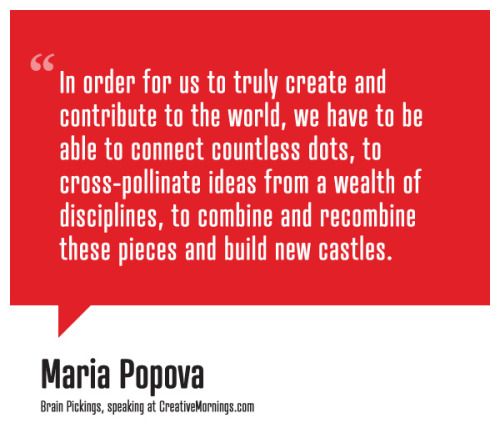
Today I want to sketch and push things out; and to try and get my head around the two concepts in the title. Over to Maria writing here:
"The idea that in order for us to truly create and contribute to the world, we have to be able to connect countless dots, to cross-pollinate ideas from a wealth of disciplines, to combine and recombine these pieces and build new castles.
Related Posts Plugin for WordPress, Blogger...