March 20, 2016

#NorthernIreland2016 Interview Series - Willis McBriar


Willis was raised on a farm in Mid-Down. After studying at QUB he worked for BBC as an engineer/trainer. Willis is now a trainer in Creative Digital Media living in Belfast.

March 19, 2016

The eloquence of the scripted impromptu

Henry Grattan by James Gillray
It was said of Henry Grattan:
"Like his friend Henry Flood, Grattan worked on his natural eloquence and oratory skills by studying models such as Bolingbroke and Junius."
To speech in prose, practice. Moliere said:
"For more than forty years I have been speaking prose without knowing it."

#NorthernIreland2016 Interview Series - Brendan Heading


Brendan is from North Belfast and was educated at St Therese of Lisieux primary school, for the first five years, on the old site at 65 Somerton Road, and latterly at the "new" school at its present site
on the Antrim Road. Brendan passed the 11+ and studied at St Malachy's between 89 and 97. He graduated in Computer Science at QUB in 2001. He is currently a software engineer living and working in the greater Belfast area.

March 18, 2016

The German and Russian sympathies of Connolly and Pearse


As by the Paris Review if he could speak German to his German captors in the Second World War, Kurt Vonnegut said:
"I had heard my parents speak it a lot. They hadn’t taught me how to do it, since there had been such bitterness in America against all things German during the First World War. I tried a few words I knew on our captors, and they asked me if I was of German ancestry, and I said, “Yes.” They wanted to know why I was making war against my brothers. 
I honestly found the question ignorant and comical. My parents had separated me so thoroughly from my Germanic past that my captors might as well have been Bolivians or Tibetans, for all they meant to me."

#NorthernIreland2016 Interview Series - Ed Henderson


Ed Henderson was born and raised in South Belfast by his mother, a talented nurse and his father, a local journalist, turned author who focussed on reporting the Troubles through the 70s to present day. Ed studied at the Royal Belfast Academical Istitution until he turned 21 when he moved to England to study marketing and advertising in Newcastle Upon Tyne. On finishing his degree in 2007 he moved to London to work in advertising until 2014 when he decided to return home and set-up back in Belfast. He is currently an account director working at an advertising agency in South Belfast.

March 17, 2016

Would Unionism allow a Sinn Fein First Minister?

Cartoon by Ian Knox
Alex Kane said on BBC Hearts and Minds:
"And what happens when unionism is in trouble? It harks back to the mantra of united we stand, divided we allow McGuinness to become First Minister. 
So up pops Nigel Dodds to insist that unity is the answer to unionist prayers, then up springs David McNarry to say that unity must embrace the TUV, Orange Order, Conservatives and anyone who has a red, white or blue shirt in their wardrobe. 
The reality, of course, is that unionist unity won’t work, because unionist unity is merely a euphemism for a sectarian headcount: and sectarian headcounts will, sooner rather than later, kill off devolution. 
What unionism needs to do is promote a coherent and attractive argument in favour of the Union: an argument that presents the Union as valuable in its own right rather than as merely the next-best-option to Irish unity."

#NorthernIreland2016 Interview Series - Stephen Hillis


Stephen Hillis is a 40 year old married man with 2 young children. He was brought up in Belfast and Newtownards.  He then studied at UUC and attempted to leave Northern Ireland twice, firstly to the US and then London. "But I always felt the call to home," he said. Stephen has settled in County Antrim to bring up a family, working in Belfast. He said:

March 16, 2016

Nora Connolly, daughter of James Connolly, on Easter 1916

Read 'The Unbroken Tradition' by Nora Connolly, published 1918, in full here
The writer and activist Nora Connolly (born 1893), daughter of James Connolly, wrote ‘The unbroken tradition’ an account of the Irish rebellion of 1916, published in 1918. Nora wrote about the her experience of Easter Week 1916 and the aftermath of the rebellion, with general commentary on the movement, its leaders and events.

#NorthernIreland2016 Interview Series - Aaron Callan


Aaron is from Limavady where He went to primary school and secondary school. From there He went to Ulster University and Queen's University Belfast. He is currently an Ulster Unionist Councillor for Limavady on the Causeway Coast and Glens Borough Council.

March 15, 2016

'The [Easter Rising] as I saw it' - By Mrs. Hamilton Norway


'The Sinn Fein rebellion as I saw it' was written by Mrs. Mary Louisa Hamilton Norway (Mary L.G. Norway) (wife of the secretary for the Post Office in Ireland). The 100 page book, formed of three letters originally intended for friends and family, give an account of Easter Week 1916 as she experienced it from the Royal Hibernian Hotel, Dawson Street, Dublin. Original text, via archive.org, in full here, and in PDF here.

#NorthernIreland2016 Interview Series - Susan Irvine Russam


Susan Irvine Russam is 60 and lives in Holywood, County Down. She was at Holywood High School (now Priory College) Queen's University Belfast, University of Glasgow and Ulster University. She has been Chief Executive of GEMS NI since 2001. 

March 14, 2016

'Six Days of the Irish Republic' - By L.G. Redmond-Howard

The front cover - the great Greek portico of the GPO circled in flames like "a prairie fire"
L.G. Redmond-Howard, nephew and biographer of John Redmond, wrote 'Six Days of the Irish Republic - A Narrative And Critical Account of the Latest Phase of Irish Politics', published in 1916.

The book was an account of the Rising at its aftermath. On Monday when the fighting broke out Redmond-Howard was installed at the “Metropole” hotel, situated alongside the Post Office. From here he could not get any direct view of what was the centre of the battle, so he moved across to the “Imperial,” which, situated vis-à-vis the Post Office on the top of Clery’s Stores, commanded the fullest view of the rebel headquarters.

#NorthernIreland2016 Interview Series - Patrick McKeating


Patrick is from Belfast and was educated at Rathmore Grammar School. In 2004 he moved to Dublin to study History in Trinity College. Six years ago he moved to England to teach and am currently Head of History in a London academy.

March 13, 2016

Ireland - Most Oppressed People Ever?

By Andre Carrilho

Professor Bew said that those who see the role of Britain in the history of the world as singularly negative represent an "infantilised version of the past". Fintan O'Toole wrote in ‘After the Ball’ (2003) that Ireland’s history is not at all unique:
"Irish people like to see ireland as an exceptional place. Our suffering throughout history is unparalleled… Our struggle for freedom inspired the people of the world… The complexity of our dilemmas is unsurpassed… And because Ireland occupies a place in the world grossly disproportionate to its population, this sense of our uniqueness is often reflected back on us from the outside. 
All of this is, of course, an illusion. Many countries, even in Europe, have similar experiences of struggling to secure their independence against larger neighbours in the 20th century. Many cultures have been shaped by the same broadly nationalist cultural revivals of the 19th century."

Gerald Dawe speaks to the #NorthernIreland2016 Interview Project


Gerald was born in north Belfast. He grew up there with his mother, grandmother and sister in the 1950s. He went to school in Orangefield and studied at Ulster University before moving to Galway in 1974 under a major state award where he wrote a thesis on William Carleton. Gerald lived and worked in Galway for twenty years before moving to Trinity College where he have taught since 1988. Gerald now lives on the coast a few miles south of Dublin. He published his first book of poems, Sheltering Places, in 1978 and his most recent, Mickey Finn's Air, in 2014. He has also published several books of literary and cultural studies and edited various anthologies including Earth Voices Whispering: irish poetry of war 1914-1945.

March 12, 2016

Leaving rugby

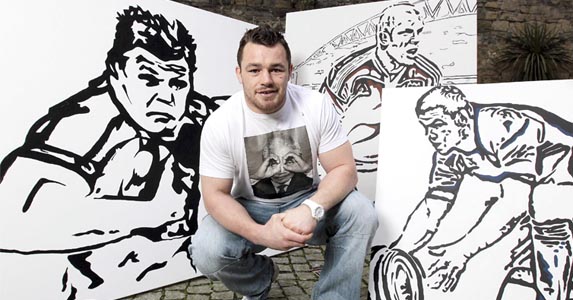
Irish prop Cian Healy has found time for art during his rugby career. It will be great to see his art when he has more time after his life in rugby
Jim O’Callaghan is a Dublin city councillor and former Leinster rugby player, he wrote an article in the Village Magazine decrying the change in grassroots rugby: ‘Rugby surrendered its social benefit’. Irish rugby is now about achievement and excellence rather than participation and enjoyment he said. He wrote that sociologists and social historians of the future will examine the change in participation in rugby in Ireland over the past twenty years.

#NorthernIreland2016 Interview Series - Jenny McCartney


Jenny McCartney is 44 and was born in Belfast. She was Educated at Methodist College, Belfast and later Keble College, Oxford. Jenny is currently living and working as a journalist in London.

March 11, 2016

Revolution and perpetual oppression


George Orwell wrote:
"One does not establish a dictatorship in order to safeguard a revolution; one makes the revolution in order to establish the dictatorship."
Andrew Sullivan observed:
"Just as the English Civil War ended with a dictatorship under Oliver Cromwell, and the French Revolution gave us Napoleon Bonaparte, and the unstable chaos of Russian democracy yielded to Vladimir Putin, and the most recent burst of Egyptian democracy set the conditions for General el-Sisi’s coup."
Revolution is a mentality, not an actuality. W.B. Yeats wrote:
"Hurrah for revolution and cannon come again, The beggars have changed places but the lash goes on."
It was explained like this:
"Yeats cynically dismisses armed revolutions as merely perpetuating cycles of oppression. The new ruling class then oppresses the others with the same vehemence with which it was once oppressed."
Yeats also said:
"Parnell came down the road, he said to a cheering man: Ireland shall get her freedom and you will still break stone."
Kevin O’Higgins the Irish Minister for Justice was assassinated by IRA for signing death warrants of 77 republicans during the Civil War. An Phoblacht described O’Higgins as “one of the most blood-guilty Irishmen of our generation”.

Ian Paisley said in 1993:

"We often hear from republicans about the treatment meted out to Irish people by the United Kingdom, but we are apt to forget that the bloodiest deeds ever carried out in Ireland took place when Irishman fought Irishman in the civil war, led by De Valera. De Valera was however defeated, and the settlement was established and stood."

Examples of revolutions include the French Revolution — largely orchestrated by the bourgeoisie (middle class professionals) against the nobility, and the Russian Revolution — in which socialist urban workers ultimately triumphed. In both cases, the winners viciously persecuted the vanquished, and ruthlessly dominated.

The Algerian FLN went on to impose a military dictatorship on Algeria vastly more repressive and blood thirsty than the French colonial regime ever was. It continued to persecute ethnic minorities like the Berbers. And more to the point, it ethnically cleansed Algeria of Jews – the vast majority of whom were not only indigenous but belonged to a community that pre-dated Islam in Algeria.

Read about Fethardism, the religious boycott, in Ireland here.

Oliver Cromwell when dissolving parliament in January 1655 exclaimed:
"What greater hypocrisy than for those who were oppressed by the bishops to become the greatest oppressors themselves, so soon as their yoke was removed."
Patrick Kavanagh wrote in 'The Green Fool':
"The Black and Tans were gentlemen when compared with the Free Staters."
An anonymous Irishman is reported to have said via ‘Is Ulster Right?’ (1913):
"Roman Catholics who fled from the tyranny of the penal laws at home [in Ireland] had no scruple, when they reached the Continent, in taking part in persecutions far more terrible than anything they had seen in Ireland. During the dragonnades in Languedoc, Louis XIV’s Irish brigade joined eagerly in the butchery of old men, women and children and the burning of whole villages. The same heroes distinguished themselves by destroying everything they could find in remote Alpine valleys so that the unfortunate Waldenses might die of starvation."
Sean T O'Kelly said in Geneva in 1933:
"The Free State Government was inspired in its every administrative action by Catholic principles and doctrine."

Kevin Myers speaks to the #NorthernIreland2016 Interview Project

Kevin Myers is a veteran journalist of the Troubles and Irish politics. He is a respected polemicist and historian. He was heavily responsible for bringing  the Irishmen who fought in the First World War back into the consciousness of modern Ireland. He writes a fortnightly column for the Sunday Times.

March 10, 2016

William Brodrick, Leader of the Irish Unionist Alliance, responds in the House of Lords to the Easter Rising

Viscount Midleton (William Brodrick), Leader of the Irish Unionist Alliance (1910-1919)

William O'Brien wrote about Lord Midleton in ‘The Irish Revolution and how it came about’ (1923), writing:
"Lord Midleton and the Irish nobles and country gentlemen, who were afterwards to follow him into the Anti-Partition League were not yet heard of."
Related Posts Plugin for WordPress, Blogger...