Showing posts with label George Orwell. Show all posts

July 01, 2016

George Orwell on Ireland, Ctd


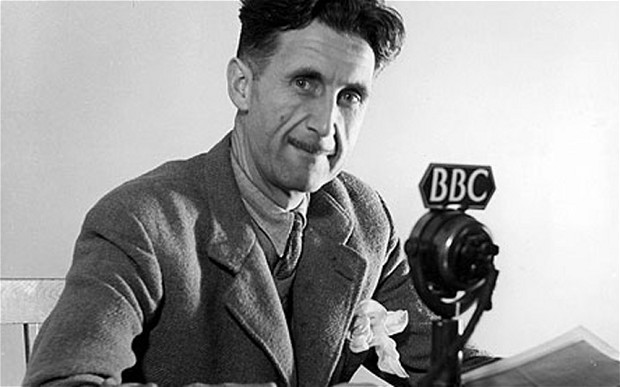
In a previous post I looked at George Orwell and his views on Ireland. Orwell viewed Ireland negatively - Catholic and authoritarian. George Orwell wrote in ‘Why Socialists Don’t Believe In Fun’, 1943:
"At this moment, for instance, the world is at war and wants peace. Yet the world has no experience of peace, and never has had, unless the Noble Savage once existed."

February 19, 2016

Orwell and Heaney on W.B. Yeats

Heaney by Portuguese cartoonist Andre Carrilho 
W.B. Yeats died in 1939, 9 months before the start of war. Orwell wrote in 1943 (via Kevin Kerrane, 'Orwell's Ireland'):

October 24, 2015

George Orwell and "Peace Walls"


The term Peace Wall is emphatically Orwellian. They are not peace but hate walls and walls of war. George Orwell wrote in his book 1984:
"People ignorant of one another’s existence, held apart by walls of hatred and lies, and yet almost exactly the same."

January 18, 2015

Bernard Crickly on the Irish question and liberal prudery and squeamishness

Bernard Crick, biographer of Orwell and political advisor in the Northern Ireland Constitutional convention 1974.
Bernard Crick wrote 'In Defence of Politics', published in 1962, and in the chapter 'A Defence of Politics Against Nationalism', he wrote about Ireland:
"British imperialism only once seriously endangered the established domestic political institutions in the way that German imperialism strangled and frustrated the growth of German liberalism."

December 12, 2014

Sinn Fein and the English Language

Cartoon by Ian Knox
When symmetry of scandal is met with an asymmetry of outrage, something is not right, and you have to say something. When an allegation is pointed at the church or an arm of the state, indignation is universally heaped on those named; yet when an allegation is pointed at the party, there is silence - indignation is selective and sectarian, falling along ideological lines.

With no sense or awareness of inconsistency, people can simultaneously support scrutiny of others and stridently oppose scrutiny of oneself; people can simultaneously credit allegations made against another but outright discredit allegations made against oneself. Mary Lou McDonald said in 2009:

October 29, 2014

George Orwell on Ireland

Cartoon of George Orwell by famous American political cartoonist, Pat Oliphant


George Orwell wrote that the execution of the Easter Rising leaders was "a crime and mistake". He believed that the dispute over Ulster was caused by "the expansionist racist nature of modern republicanism." In a review of Sean O'Casey's autobiography by George Orwell in the Observer, Orwell wrote in 1945:
"Why is it that the worst extremes of jingoism and racialism have to be tolerated when they come from an Irishman?"

October 12, 2014

The Backfire Effect

The Backfire Effect or Identity-Protective Cognition is when people hold onto their personal and tribal narrative even when it is wrong and unfounded. The antidote to this kind of egregious thinking and groupthink is the Orwell Method. But first, a little more on the Backfire Effect.

Maria Popova is well known for writing, "Allow yourself the uncomfortable luxury of changing your mind." This is a painful process, made all the harder by the "Backfire Effect" as Maria Popova explained, changing the mind is a problem many grapple with, however it is hard. Because on one hand:
"The awareness that personal growth means transcending our smaller selves as we reach for a more dimensional, intelligent, and enlightened understanding of the world."
And on the other hand:
"The excruciating growing pains of evolving or completely abandoning our former, more inferior beliefs as we integrate new knowledge and insight into our comprehension of how life works. That discomfort, in fact, can be so intolerable that we often go to great lengths to disguise or deny our changing beliefs by paying less attention to information that contradicts our present convictions and more to that which confirms them."

September 28, 2014

George Orwell - Writing is hard, Ctd


George Orwell's1984 is the classic of classics. One of the most celebrated book in the English canon that speaks and sells powerfully to this day. Yes 1984 is a classic. Yet for Orwell, the writing of it was most testing. Early drafts were seen by Orwell as "ghastly" and "dreadful" messes. While writing 1984 in May 1947, Orwell wrote to his publisher Fred Warburg: 
"Of course the rough draft is always a ghastly mess bearing little relation to the finished result, but all the same it is the main part of the job."

September 03, 2014

The Orwell Method

George Orwell by Ralph Steadman, with full selection here
[UPDATE: Christopher Hitchens explains how Orwell was "arguing all of the time with his own prejudices and his own fears and his own bigotries and his own shortcomings."
 
UPDATE II: Also read my blog post from September 2013 on opposition as the ointment to groupthink.]
 
Paul Muldoon explained:
"Be deeply suspicious, first of all, of your own prejudices before you begin to approach the prejudices of others."
V.S. Pritchett echoed this:
"George Orwell... was more likely in politics to chasten his own side than the enemy."  
Christopher Hitchens too:
"The unpleasant facts that George Orwell chose to face were usually the ones that put his own position, or his own preference to the test."

August 30, 2014

Christopher Hitchens on Orwell and feeling inferior against otherwriters

Christopher Hitchens by Ralph Steadman
Christopher Hitchens said about George Orwell: 
"The point was made better by Lionel Trilling. The remarkable thing about Orwell and the encouraging thing was he is not a genius. He lived to only 46 years. He never went to university. He never had a steady job. He usually didn’t have a steady publisher. He will never be forgotten because he managed to disprove imperialism, Stalinism and fascism in one lifetime and made some imperishable raids on its territory that no-one is ever going to forget. All the time ill. All the time poor."
He then said:
"[George Orwell] shows how much difference a person of really average integrity and intelligence and education can make if they have a little courage and a little intellectual honesty. The shortcomings of the individual you can see in him too. But he basically won his own battle against his own prejudices. This is an example for all time. You don’t get the sense for example when you’re reading Proust or Nebokhov or George Eliot that you shouldn’t be in the writing business. All the people in history who said alas there was nothing I could do are lying or at least discrediting themselves. They could have. They just chose not to."

May 31, 2014

Nick Laird - "All writing is political"

Sketch of George Orwell by Ralph Steadman
George Orwell said:
"The opinion that art should have nothing to do with politics is itself a political attitude."
He also said:
"In our age there is no such thing as 'keeping out of politics.' All issues are political issues, and politics itself is a mass of lies, evasions, folly, hatred and schizophrenia."
Northern Irish writer Nick Laird said:
"I think all writing is political. All writing shows a preoccupation with something, whatever that thing might be, and by putting pen to paper you are establishing a hierarchy of some sort—this emotion over that emotion, this memory over that memory, this thought over another. And isn’t that process of establishing a hierarchy on the page a kind of political act?"


February 05, 2014

Arm Folding and Mirror Holding, Ctd


Being able to mock, laugh and ridicule power is a distinctively British tradition. Britain is after all the mother of the free world. Classical British liberalism is what informed the American Constitution and the First Amendment which gives American a complete right to free speech. Britain gifted America Habeus Corpus. The Britain John Milton made the classic case for free speech in his pamphlet Areopagitica. David Allen Green said:
"Being able to openly ridicule and mock those in power – or seeking power – is perhaps a more important right than many realise."
George Orwell knew that England and the English could never fall to fascism as the people instictively laugh at ostentatious acts of power. He said in England Your England:

January 06, 2014

George Orwell - [Loyalists] and the English Language

Loyalists Against Democracy (@LadFleg), myself and others in the public sphere are regularly reproached for making fun of illiteracy, bad spelling and broad accents. I'm regularly rebuffed as a "snob". A charge I reject, refrain and responded to directly here and here.
Those are made fun of for bad spelling and for poor grammar have committed unpardonable and intolerable acts. They are not beyond criticism. When they commit gratuitous and promiscuous criminality they inflict social and economic misery across the whole of Belfast and the whole of Northern Ireland.

Writing is hard, Ctd

Read Gideon Lichfield in the tweet above. See what he says about "throat clearing." Well, writing can be very hard. Perfectly hard enough to not require the extra difficulties that are of the perfectly avoidable kind. People often have the habit of coating their writing with introductory layers of fluff that mask for an introduction. According to Lichfield: avoid the throat clearing. 

My previous posts in Writing is hard series are here with Alex Massie, with Tim Kreider here, with Christopher Hitchens here, with American author Stanley Karnow here, with Ernest Hemingway here, with Neil Gaiman here, with James Joyce here, with Dan Brown here. My piece that looks at George Orwell's 6 rules to good writing is here. I also wrote a piece on The Huffington Post here.

I've also posted here about the propensity for law school to teach law students to write badly here. I made The Case For Plain English here. I've also written a few pieces, including here, on Writing on Paper as a way of making the writing process easier. Apparently blogging is an art form, see here.

November 03, 2013

George Orwell on Celtic Nationalism

George Orwell writes here on Celtic nationalism:
"Its motive force is a belief in the past and future greatness of the Celtic peoples, and it has a strong tinge of racialism. The Celt is supposed to be spiritually superior to the Saxon — simpler, more creative, less vulgar, less snobbish, etc. — but the usual power hunger is there under the surface. One symptom of it is the delusion that Eire, Scotland or even Wales could preserve its independence unaided and owes nothing to British protection. Among writers, good examples of this school of thought are Hugh McDiarmid and Sean O'Casey. No modern Irish writer, even of the stature of Yeats or Joyce, is completely free from traces of nationalism."

July 01, 2013

Orwell, clear prose and bad legal writing


Pamela Samuelson, writing in the University of Pittsburgh Law Review in 1984 explained why law students write badly:
"As I have worked with law students on supervised writing projects, I have noticed that lucidity does not come naturally to most law students, perhaps because they have been forced in their legal studies to read so much bad writing that they mistake what they've read for the true and proper model."
You can read Pamela Samuelson in full here.

April 04, 2013

Politics and the English Language: Orwell's 6 Rules to Good Writing


This is an unfortunate state of affairs. My love for writing is halted by my finding of writing difficult. These are equal and opposing predispositions and they come together and wrap me up in the bondage of maddening procrastination.
It’s like a rational irrationality. It comes so easy, yet it causes such pain. News that Nobel-winning economist George Akelof procrastinates provided some comfort. But it’s still hard to deal with nonetheless.

Related Posts Plugin for WordPress, Blogger...